

How bad could a second Trump presidency get?
The damage to America’s economy, institutions and the world would be huge
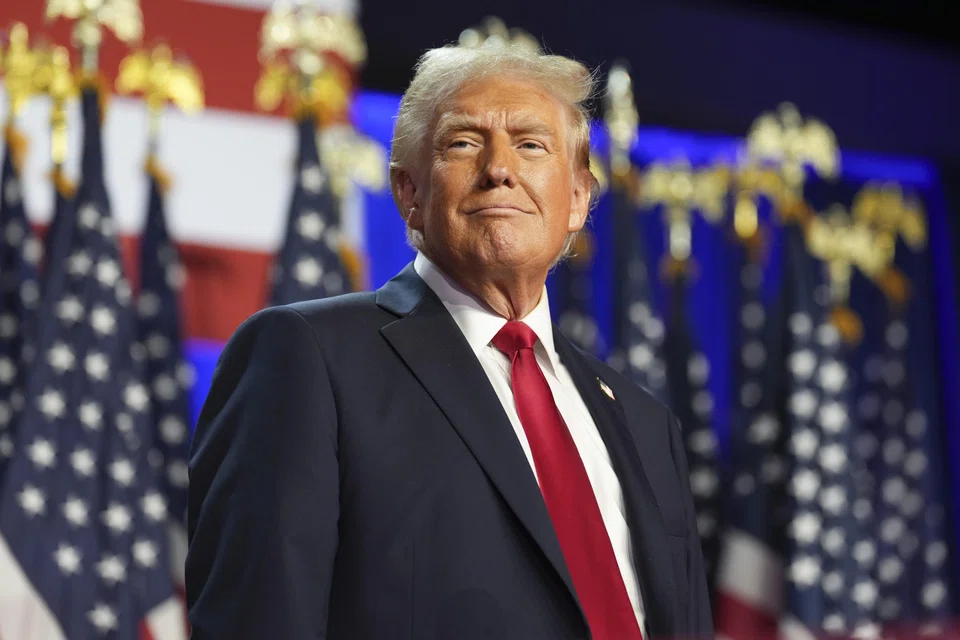
ON THE stump, Donald Trump makes lots of eye-widening pledges. He will deport illegal immigrants by their millions; he will launch missiles at Mexico’s drug cartels; he will use the army to crack down on the “far-left lunatics” who run the Democratic Party.
Yet Trump’s tenure as president, whatever its merits or failings, was not the cataclysm that many Democrats had predicted. The economy hummed along, until the pandemic struck. There were no big foreign policy crises. And although Trump tried to steal the presidential election of 2020, he failed.
So what would a second Trump term be like? Many voters dismiss Trump’s overheated rhetoric as just that. They may see the election as a finely balanced decision about which candidate would manage the economy better, or as a choice between divergent stances on such issues as abortion and immigration.
But Trump not only seems intent on following through on some of his wilder pronouncements if elected, but would also be in a better position to do so than last time. That suggests another way of looking at America’s choice: how badly wrong could things go?
Kamala Harris, the sitting vice-president, is running as the candidate of the status quo. Her unofficial slogan is “We are not going back.” Trump, in contrast, implies that radical change is needed, and that he will provide it.
In all likelihood, if he returns to the White House, he will have trouble implementing many of his most extreme ideas, just as in his first term. He may be stymied by Congress, the courts and the bureaucracy, or distracted by events or dissuaded by aides or foiled by his own incompetence.
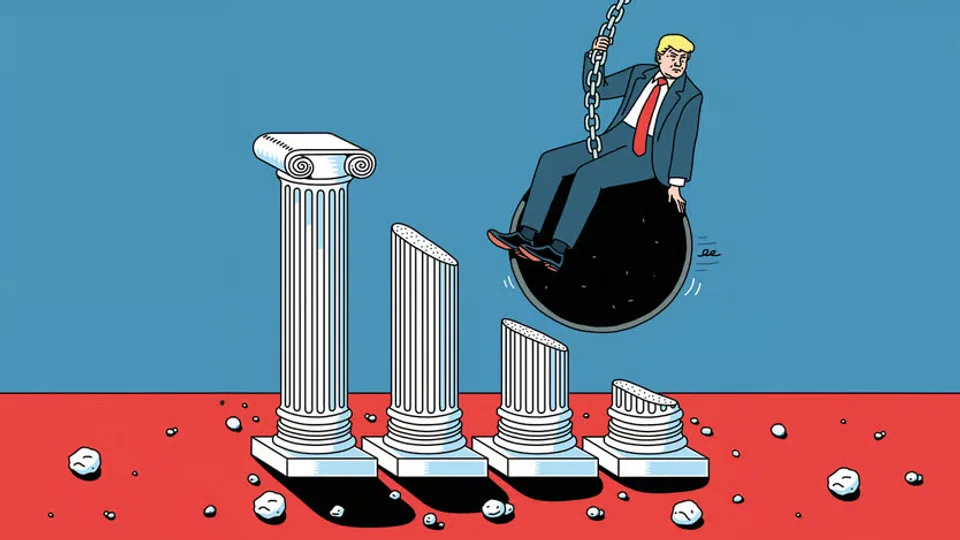
But there is a chance – and not a negligible one – that he might succeed in doing some of the things he talks about, with disastrous consequences for America’s economy, its institutions and the world. Fears that he may permanently damage American democracy and the rule of law are not far-fetched.
Battle-hardened
After eight years of institutionalisation, Trumpism is much more organised than when it crashed into the Oval Office in 2017.
Trump’s agenda was slowed then by inexperienced acolytes who did not know enough about administrative law and the workings of the civil service to make things happen. What is more, Trump, wanting to make his administration appear distinguished, appointed grandees to senior jobs even though they often disagreed with his ideas.
The leaders of a second Trump administration, by contrast, would be loyal veterans. Many of them would arrive in office with plans already in mind. The architects of Project 2025 – a 900-page policy agenda for the next Trump administration drawn up by the Heritage Foundation, a Trumpist think tank – fell out with Trump after Democrats began using it to attack him. But Trump nonetheless embraces the underlying idea that he should return to office with pre-vetted personnel and detailed plans.
The Supreme Court’s recent decision setting out extremely wide immunity for presidents also seems likely to embolden him.
Trump’s economic plans are certainly bold – but not in a good way. The first iteration of Trumponomics was lucky enough to be implemented during a period of high growth and low inflation. Its next incarnation would not only be adopted in less benign circumstances, but would also itself be of a much more disruptive nature.
His campaign is proposing a second, much bigger hike in tariffs; lavish tax cuts; a labour-supply shock in the form of mass deportations; and attacks on the independence of the Federal Reserve.
These are all terrible ideas. “Normally, if you’re cutting off migrant labour, you try to get goods from outside. And if you’re cutting off goods from outside, you try to get migrant labour. If you cut off both, you almost certainly get inflation, if not stagflation,” said Adam Posen of the Peterson Institute for International Economics, a think tank.
JPMorgan Chase, a bank, has estimated that a tariff hike half the size of the one Trump is advocating would knock a third to half a percentage point off gross domestic product growth in its first year and increase inflation by 1.5 to two percentage points.
Whether Trump would be able to put all his plans into practice is doubtful. The president has the authority to raise tariffs on national security grounds or as retaliation for unfair trade practices. Trump’s pledge of an across-the-board tariff of 20 per cent on all imports, and 60 per cent on imports from China, does not really seem to fit under these headings.
But while the courts debated this question, businesses would suffer ruinous disruption, presumably made worse by retaliatory tariffs imposed by other countries. Some advisers think Trump would raise tariffs gradually, as a means to extract concessions from trading partners. That might only draw out the agony, however, and would not reduce the risks of a trade war.
The personal-tax cuts Trump signed into law in 2017 are due to expire next year, and he would have to negotiate with Congress to extend them. He wants to renew them all, as well as end taxation on tips, overtime and Social Security payments. Moreover, were Trump to steer America onto an even more irresponsible fiscal course than its current one, the bond markets might eventually rebel, prompting a reassessment.
Mass deportations of the magnitude that Trump has proposed are also unlikely to happen. The federal government simply would not have the capacity to hunt down and deport millions of people, unless Trump were to enlist the armed forces or deputise state and local law enforcement. There would be public uproar, resistance from Democratic-led states and cities, and endless legal challenges.
“I don’t think that there’s any world, even in Donald Trump’s fantasy, that you’re actually going to try to send... ICE agents door to door, to round up 12 million residents of this country and deport them,” said Mike Johnston, the Democratic mayor of Denver. “There’s just no infrastructure capacity for that, and Denver would never participate in it.”
Shortages in industries that rely on immigrant labour such as agriculture, construction and slaughterhouses would also be inflationary.
Unreserved
If the Fed tightened monetary policy to counteract the inflationary pressures of higher tariffs, a shrinking workforce or lavish spending, Trump would be minded to attack it. Already, some in his orbit are suggesting that a Trump administration undermine Jerome Powell, chair of the Fed whose time in that job (but not as a member of its board) expires in 2026, by appointing a “shadow” chair to make less hawkish recommendations about interest rates.
Yet, an attack on the Fed would be almost certain to horrify the markets. “The stock market is a very effective and instantaneous feedback mechanism for economic policy which provides a constraint on crazy tariffs, a constraint on crazy Fed stuff, but probably not much constraint on unsustainable fiscal policy,” said Jason Furman, a former Democratic policymaker who is now a professor of economics at Harvard University.
Even assuming Trump would eventually relent and water down or abandon some of these policies, he could still cause huge damage in the process.
Many optimistic scenarios rely on markets tanking, inflation jumping or growth slumping to curb his enthusiasm. Moreover, there is no amount of deportations, tariff increases or Fed-bashing that is good for the economy; the only question is how much damage Trump would inflict. Were he really to stick to his guns, inflation, higher interest rates and recession beckon.
Foreign policy also presents alarming risks. Although Trump’s advisers may try to sketch out clear doctrines in rough alignment with “America First” rhetoric, their boss thinks that foreign policy succeeds or fails owing to force of personality, not policies. His stochastic style is inconsistent and unpredictable.
“If former president Trump is re-elected, we are going to pay an enormous chaos premium” as allies scramble to work out what his policies will be, said Kori Schake of the American Enterprise Institute, another think tank. Whereas, during his first term, the world was relatively calm, Trump would return this time as America grapples with wars in the Middle East and in Ukraine.
Trump says his commanding presence would be enough to settle the war in Ukraine within 24 hours of his election – before he is even inaugurated. What this means, if anything, is hard to gauge. The leading candidates for top national security jobs in a second Trump administration have a wide range of views on Ukraine.
Mike Pompeo, a former secretary of state and potential future defence secretary, argues for giving Ukraine a massive US$600 billion in weaponry to force Russia to the negotiating table. JD Vance, who would be vice-president, seems to think any dollar spent on Ukraine is a dollar wasted. Who Trump ultimately listens to is maddeningly unpredictable – often his view is decided by the last person to speak to him.
No matter who is elected president, it seems increasingly likely that Ukraine will have to abandon or at least shelve its ambition to reclaim much of the territory Russia has stolen.
Given Republicans’ hostility to the military aid for Ukraine proposed by Biden’s administration, it seems unlikely that a Republican-led House of Representatives would approve another big dollop – and it is hard to imagine Trump protesting very stridently. But an abrupt and haphazard American abandonment of Ukraine would embolden Vladimir Putin, Russia’s dictator, and increase the risk he poses to his neighbours.
There are many other nightmare scenarios. Might Trump, in effect, void the collective-security guarantee at the heart of the Nato alliance by refusing to counter further Russian aggression? Would he decline to send American forces to help Taiwan in the event of a Chinese blockade or invasion? Would Israel be given a completely free hand to do as it wishes in the Middle East, including striking Iranian oil-production and nuclear-weapons facilities?
All of these are possible. Trump has a deep aversion to war, but also a strong urge to avoid looking weak.
Some vague but worrying trends can be guessed at. “You would assume that the US reaction function is more escalatory because their doctrine is peace through strength,” said Jon Lieber of the Eurasia Group, a geopolitical consultancy. Both Trump and his party are disinclined to sign up to any meaningful international initiatives on climate change. But most important are the possibilities that cannot be ruled out: of a forced capitulation of Ukraine, of the collapse of Nato, of an expanding war in the Middle East and so on.
Perhaps most serious of all are the threats Trump poses to American democracy and the rule of law.
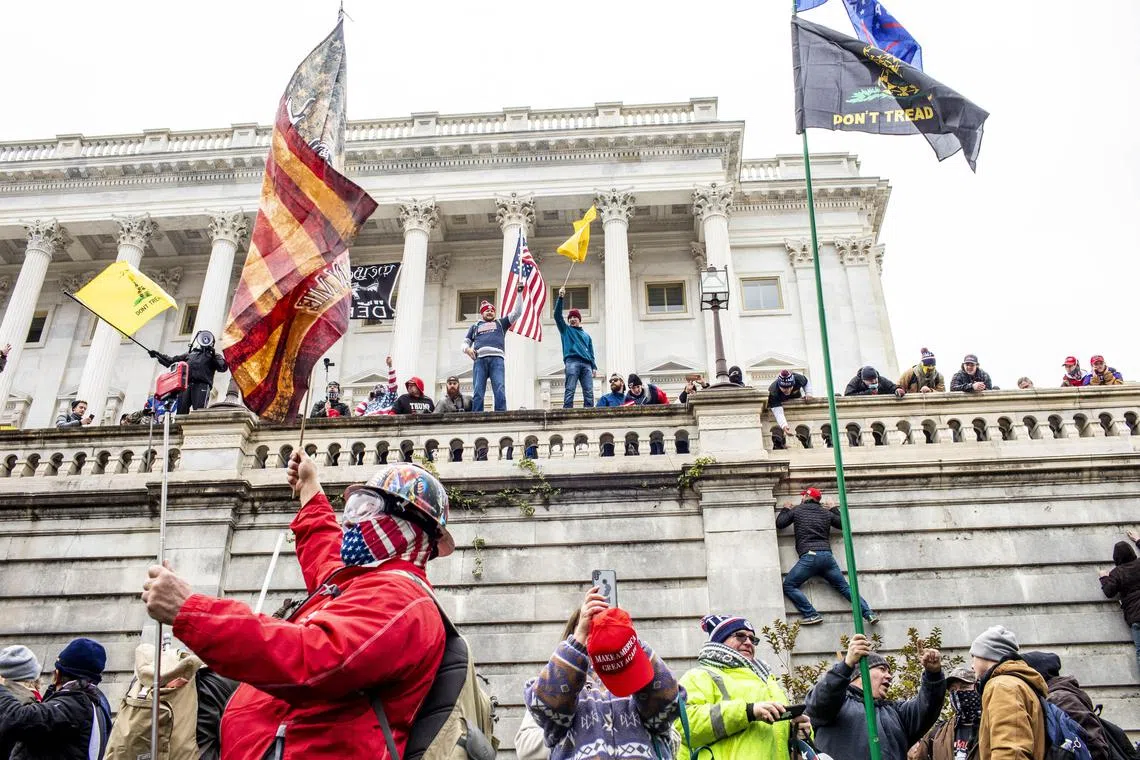
There is no doubt about his autocratic instincts. To stay in power after his election loss in 2020, Trump tried to suborn electoral officials and fomented a mob, ultimately leading to the ransacking of the Capitol by his supporters on Jan 6, 2021.
He has not recanted since. He still insists the election was stolen; he calls those convicted of crimes on Jan 6 “political prisoners” and has pledged to pardon them; he has mused about cancelling the licences of critical broadcasters; he calls his political opponents “the enemy within” that may need to be dealt with using military force.
An astonishing number of those who work closely with Trump come away appalled. John Kelly, a former chief of staff, became the latest in recent days to declare him a “fascist”.
The real question, instead, is whether America’s institutions would be able to constrain him. America’s courts and constitution would be the best check on Trump’s autocratic whims. Trump’s many lawsuits seeking to overturn the election result in 2020 got nowhere, after all.
Trump would not be able to get Congress to adopt constitutional changes, allowing him a third term, for instance. Nor would he have much sway over state governments led by Democrats. Although he has consolidated his control over the Republican Party, making it almost impossible that he would be impeached, there would still be some Republicans in Congress who would resist his worst instincts.
For these reasons, some political scientists think that American institutions will comfortably absorb the shock of a second Trump presidency.
Of the 40 populist governments around the world between 1985 and 2020 identified by Kurt Weyland of the University of Texas, only seven devolved into authoritarianism. And those unfortunate countries had weak institutions and suffered precipitating crises. “I would not think that Trump would be able to do more damage in a second government than in the first,” said Weyland.
The Democrats may control the House of Representatives, ensuring divided government from the start. But even if Republicans began a second Trump term in control of both chambers of Congress, Democrats would be likely to do well in the midterm elections in 2026, constraining Trump for the remainder of his presidency.
Even if the risk of a catastrophic breakdown in American democracy is low, a second Trump term would still corrode democratic institutions.
Benjamin Wittes, the editor-in-chief of Lawfare, a national security publication, warned that Trump would be a worse danger to the rule of law for three reasons: first, “the grown-ups will not be in the room”, unlike in his first term; second, “he does at least rhetorically seem very fixated on revenge” after enduring four separate criminal proceedings; and third, he will be emboldened by his triumph “partly legally and partly electorally over the forces that tried to restrain him”.
Trump is all but certain to dismiss the federal charges against himself. He is also likely to pardon the Jan 6 rioters. He has promised to end the independence of the Department of Justice, a norm since the Watergate scandal. That would allow him to initiate investigations of his political enemies, which seem likelier than not.
“There’s a whole set of second-order considerations that flow from this. Once you know those sorts of selective prosecutions are on the table, you will calibrate your behaviour very differently,” said Brendan Nyhan of Dartmouth College.
Intimidating
The notion that Trump might use the institutions of state to cow potential critics was raised last week when Jeff Bezos, the billionaire owner of the Washington Post, stopped it from publishing an endorsement of Harris.
Bezos said he was trying to bolster the paper’s reputation for independence, not curry favour with Trump, but roughly a tenth of the Post’s subscribers have reached the opposite conclusion and cancelled their subscriptions. There is also the risk that violent extremists, such as the Proud Boys militia, may feel emboldened to harry Trump’s political opponents.
Trump is also likely to try to put his stamp on the federal bureaucracy. He might invoke an authority known as Schedule F, which would allow him to dismiss many low-level civil servants. He has also talked about sacking America’s top generals, whom he considers too “woke”.
There is a chance that he tries to hound Powell into resigning or claims the (legally untested) authority to fire him. All this would politicise parts of the government that have been relatively free from such meddling until now.
These scenarios may sound mundane compared with a stolen election or the institution of a dictatorship, but they would have grave consequences. Selective, politically motivated law enforcement would not only be an injustice in itself, it would also be a threat to America’s economic might, frightening businesses and deterring investment.
What is more, such abuses would be unlikely to stop when Trump leaves office. Given the political polarisation of recent decades, once one of America’s parties has broken a norm, the other is likely to follow suit, if only to remain competitive. Confidence in the rule of law would be difficult to restore.
Many Americans find Democratic ranting about the risks of another Trump term hypocritical. They think that Democrats have weaponised the justice system against Trump, not the other way round. They see Biden’s tenure as a litany of foreign policy failures far worse than anything that occurred on Trump’s watch. The surge in inflation under Biden is proof in their eyes that Trump is a better economic manager.
There is some merit to all these contentions – and a second Trump term might prove no more catastrophic than the first. But voting for Trump on that assumption would be risky in the extreme to America and the world.
©2024 The Economist Newspaper Limited. All rights reserved
This is a slightly abridged version of a piece that was published in The Economist on Oct 31, 2024
TRENDING NOW

Once staunchly pro-China, Malaysian Chinese businesses are now distancing themselves from Beijing

Looking beyond looming CEO succession, should UOB potentially pursue a transformative merger?

Could stablecoins be the future of money?

Grab CEO’s wife Chloe Tong on life with Anthony Tan and finding her purpose

