Iceland looks to inland salmon farming for a greener way to meet demand
The country’s S$435 million aquaculture industry aims to strike a balance between growth and sustainability
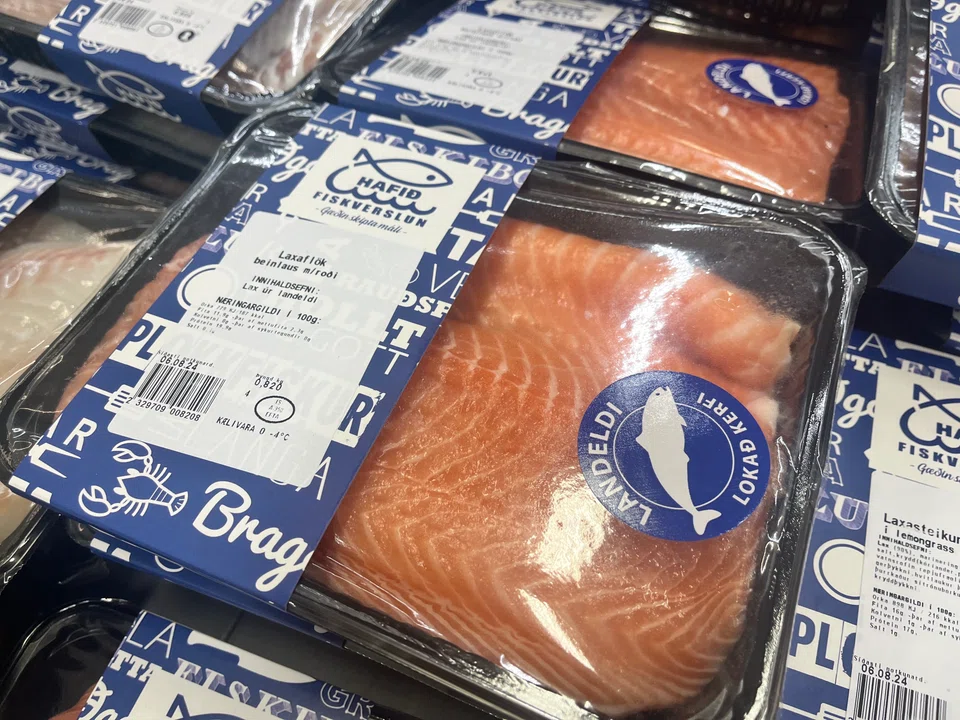
AS ICELAND’S salmon farming industry booms, the country is struggling to ensure its sustainability. Traditional open-pen farming is taking an environmental toll, and while land-based fish farms are a promising alternative, high costs pose a challenge.
Still, some industry players are already betting on land-based farms for the future.
Gudni Gudbergsson, head of the Freshwater and Aquaculture Division at the Marine and Freshwater Research Institute, said: “Investors are putting their money into the land-based farming industry because it has the potential to solve many of the environmental problems that we are dealing with now.”
Iceland’s salmon farming industry has ballooned over the past decade. Annual farmed salmon production surged to 43,523 tonnes in 2023, from just 3,018 tonnes in 2013, according to official statistics.
In 2022, farmed salmon accounted for 90 per cent of the country’s total aquaculture exports.
This growth has been enabled by the proliferation of open-pen salmon farms in the country’s fjords. These large, netted enclosures allow water to flow freely between the farm and the surrounding environment.
Yet, while this method has been economically successful, it has sparked significant environmental concerns.
Risks to nature
Historically, Iceland’s coastal communities have been shaped by the rise and fall of fish populations. In the mid-20th century, overfishing resulted in a dramatic decline in herring stocks, leading to the collapse of many small Icelandic fishing towns.
“Since then, we’ve realised that our fishing industry is not just a pot of gold that we can dig into endlessly,” said Elias Petur Vidfjord Thorarinsson, a project manager at the North Atlantic Salmon Fund (NASF). “We must allow nature to do its thing and thrive as well.”
Commercial salmon farming, however, threatens to disrupt nature. Places such as Denmark and southern Argentina have banned open-pen farming because of the harm caused to wild fish; Canada intends to ban the practice in British Columbia by mid-2029.
A major concern is sea lice: small marine parasites that typically live on fish. In open-pen farms, these parasites thrive due to the high density of fish in a confined area. This can lead to outbreaks, particularly if the pens are not properly maintained – putting both farmed and wild fish at risk.
Another risk is that of escapee fish breeding with wild North Atlantic salmon. This potentially weakens the genetic diversity and fitness of the wild population, which could endanger the species’ long-term survival.
Alexandra Leeper, chief executive officer of the Iceland Ocean Cluster, said: “Any time you’re farming something in such high density in the wild environment, there are going to be consequences.”
A survey of 915 Icelanders, conducted in July by analytics company Gallup, found that 65.4 per cent oppose open-pen salmon farming; only 13.9 per cent support it.
Yet public sentiments have not yet translated to policy. Said Thorarinsson: “Despite strong public opposition to the open-pen salmon farming industry, the government and legislators are not aligning with public opinion.
“They have not taken steps to ban or phase out the industry, which raises concerns about the disconnect from democratic principles.”
In the meantime, the problems associated with open-pen farming are already showing up – and prompting some shifts.
Open-pen salmon production soared from just 337 tonnes in 2011 to 44,504 tonnes in 2021. But it has since decreased 9 per cent to 40,847 tonnes in 2023, according to Icelandic Food and Veterinary Authority data.
“The decrease is due to several factors, mainly production challenges such as escapes, mortalities from sea-lice infestations, and disease outbreaks,” said Thorarinsson.
Yet some of the fall in production also comes from calculated decisions. “Additionally, investors are increasingly turning towards land-based farming here in Iceland, with several new companies emerging over the past two to three years.”
Tides of change
In contrast to open-pen farming, land-based fish farms use man-made tanks. This allows greater control over environmental conditions, reduces the risk of fish escapes, and minimises the impact on wild fish populations and surrounding ecosystems.
Iceland is well positioned to pivot to this mode of farming, said industry players.
“We have more flat land available than, for example, Norway, and we also have warm water from boreholes and lots of fresh water,” said Gudbergsson. “These are key factors that make Iceland an ideal location for land-based aquaculture.”
Yet land-based fish farming does face a hurdle: the high cost of building and operating these facilities, which require much energy and clean water.
For companies to turn a profit, they would likely need to charge more for land-based salmon, said Dr Leeper. Businesses would have to find a way to market their product and differentiate it from cheaper open-pen farmed salmon.
Still, with time, this hurdle could be lowered. As land-based farms become more efficient and scale up, their salmon will be priced similarly or even lower than those produced by open-pen farms, said Thomas Linehan, a programme associate at the NASF.
Near Iceland’s southern shipping harbour in Thorlakshofn is a road named Laxabraut, or “Salmon Row”, which shows how the tides are changing in Iceland’s aquaculture sector.
The road is lined with land-based salmon farms run by companies such as GeoSalmo, Arnarlax, Ice Fish Farm, Thor Landeldi and First Water, many of which plan to scale up their operations in the years ahead.
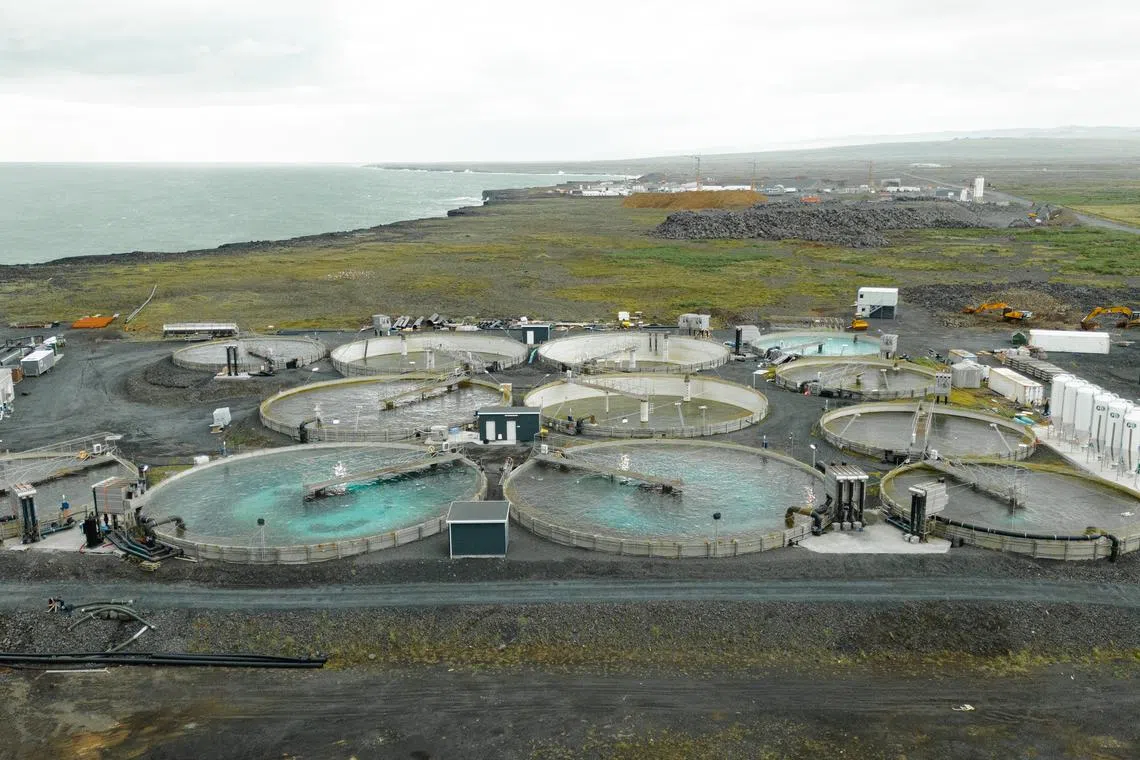
Industry leader First Water completed its first harvest in May 2023 and aims for an eventual total annual production of 50,000 tonnes by 2028.
GeoSalmo has obtained a plot of land along Laxabraut for a farm that should be able to produce up to 90,000 tonnes of salmon annually. It has started construction and expects to start operations by mid-2027, said GeoSalmo’s head of business development Bjarki Mar Johannsson.
The company leverages one of Iceland’s competitive advantages, he added: access to renewable energy. Its farming operations will be fully powered by hydropower – generated by waves – and geothermal energy.
Johannsson noted that open-pen salmon farming has caused growing concerns over fish health, and Iceland’s public feels that some companies have not kept their promises to farm salmon responsibly.
The public is pressuring politicians and companies to take action. What land-based farms hope to offer is a better-controlled environment to raise salmon with extremely low risk for nature, he said.
Amid growing public discourse over the need to develop Iceland’s aquaculture industry sustainably, the Ministry of Food, Agriculture and Fisheries drafted a Bill last year tackling issues across all types of aquaculture production: offshore, in fjords and land-based.
The Bill reached Iceland’s Industrial Affairs Committee, but stalled before parliament adjourned last summer.
NASF’s Thorarinsson said: “Various non-governmental organisations, conservation groups and industry parties had concerns, and the ruling coalition couldn’t agree.”
The Bill might not be revisited until after Iceland’s next elections in September 2025, if a new government coalition takes it up, he said.
Despite the delay, experts such as Dr Leeper are optimistic about the changes that increased investment into the sector might bring.
“Done well, land-based farming is better for the environment and the fish,” she said.
The writer is a final-year communications student at the Nanyang Technological University’s Wee Kim Wee School of Communication and Information. This report is the first of a two-part series on Iceland’s aquaculture industry, produced as part of the school’s Go-Far overseas reporting programme.