

Icing on cake for Keppel’s many reboots in recent years

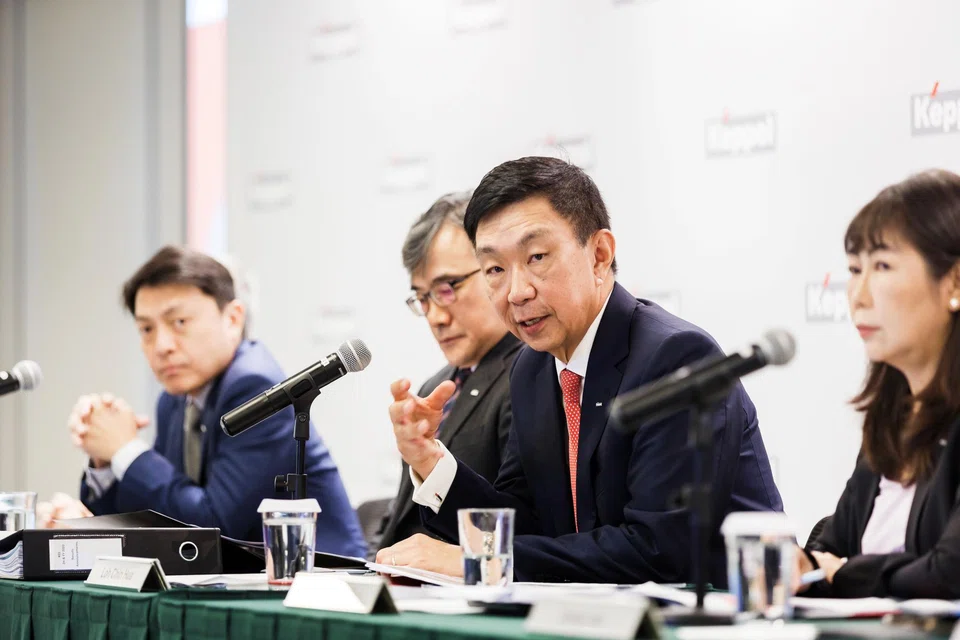
IF 2022 was deemed a “transformational and productive” year for Keppel Corp (in the company’s own words), then 2023 could well be the same. That reveals a lot about the giant firm’s change resolve in a landscape that has altered so much in recent years, chiefly in the offshore and energy fronts.
Keppel’s latest endeavour, unveiled earlier this month, involves ditching its long-held conglomerate status – and in doing so, escaping the “conglomerate discount” that dogs such stocks – to become a “differentiated global alternative real asset manager and operator”.
While quite a mouthful, the new descriptor, in essence, means that the multi-decades-old Keppel is recasting itself as an asset manager and operator by integrating its array of sizeable businesses in real estate, data centres, infrastructure and connectivity.
In turn, these businesses will be managed across three platforms – fund management (fundraising for asset gathering), investment (building deal flow pipeline), and operating (an “engine room” for its technical know-how).
In breaking down silos, Keppel is hoping to tap the payoffs from better synergies and efficiency as well as an asset-light model, all while it continues to pursue the vaunted recurring income and shift away from lumpy profits.
This appears to be the big piece in Keppel’s do-over, the blocks of which were laid, perhaps unwittingly, in the course of the last three years.
In 2020, led by a 10-year road map dubbed Vision 2030, Keppel crunched down its many disparate businesses into four key segments – energy and environment, urban development, connectivity and asset management.
A year later in 2021, the company, once known as one of the world’s largest rig builders, would in a radical move exit the rig business, which was then haemorrhaging. This would pave the way a year later for the sale of its offshore and marine (O&M) arm to another O&M giant Seatrium (up until only this month, it was known as Sembcorp Marine). The mammoth merger deal to create a Singapore-grown global offshore powerhouse was completed not too long ago.
Yet it is Keppel’s latest “grow fast, grow big” move, under the helm of its chief executive Loh Chin Hua, that deserves most attention of all its change efforts. It is quite the “reinvention”, even for a company that began as a shipyard, embarked into offshore, morphed into a conglomerate and had once even owned a bank.
The plan comes replete with goals – to monetise some S$17.5 billion of assets; the company, which has so far monetised S$5 billion, is aspiring for an interim cumulative goal of S$10 billion to S$12 billion by 2026 – not a tall order, according to analysts, given its run rate on this front in the past three years.
As for assets under management (AUM), Keppel is no less ambitious, hoping for a double jump. It is aiming for AUM to double from S$50 billion currently to S$100 billion by 2026, and S$200 billion by 2030.
Noteworthy is that Keppel’s latest revamp also fits snugly with the big-picture makeovers seen in two other companies linked to Temasek.
These exercises, no less thorough and rather radical, involved sector juggernauts CapitaLand and Sembcorp Industries which, as a result, also saw management’s interests align with that of shareholders while asset divestments revved up and returns on equity (ROEs) and dividends rose. The pursuit of an asset-light business model is also a key motivation for these three companies.
In 2021, real estate juggernaut CapitaLand restructured into two distinct entities – a property development arm that was privatised, and the creation of a global real estate investment manager that is listed on the Singapore Exchange. With an AUM of some S$133 billion as at March 2023, CapitaLand Investment is globally one of the largest real estate investment managers.
Then there is Sembcorp, which after a disastrous year roiled by a pandemic-led oil crash, divested non-core assets, exited the O&M business and demerged from Seatrium. In place, and not unlike Keppel, it made a pivot to clean energy, a booming trend in the energy space.
According to Morgan Stanley in a recent report, as a result of the restructuring, CapitaLand generated 90 per cent total return in 2021. As for Sembcorp, it led to a threefold rise in ROE and higher dividends from 2020 lows.
These may imbue hope for Keppel investors. Needless to say, it is worth watching if Keppel lands the “hat trick” in the restructuring boon of Temasek-linked companies.
TRENDING NOW

The only common thing in S-E Asia is that we all eat rice: Cisco’s Asean president

Philippine power giant First Gen rebuffs foreign offers, plans up to US$2.6 billion in expansion

Singapore to use ‘every legal and regulatory lever’ against companies linked to haze: Shanmugam

Once staunchly pro-China, Malaysian Chinese businesses are now distancing themselves from Beijing

