

India-EU ‘mother-of-all deals’ accelerated by US’ protectionist agenda
Why trade liberalisation may be Trump’s key legacy
CONVENTIONAL wisdom holds that Donald Trump’s US presidencies have fuelled global protectionism. Yet, as much as his “America First” agenda triggered a proliferation of measures such as US tariffs, it has indirectly spurred other nations to push forward with major new trade deals.
Since Trump’s re-election in November 2024, the evidence has mounted. Take the example of the 27-member European Union’s trade agreement with the Mercosur bloc (Argentina, Bolivia, Brazil, Paraguay and Uruguay) and Indonesia in Asean.
Beyond this, Brussels is negotiating with the Gulf Cooperation Council states in the Middle East and signalling closer engagement with the Comprehensive and Progressive Trans-Pacific Partnership bloc, which includes multiple Asean states such as Singapore.
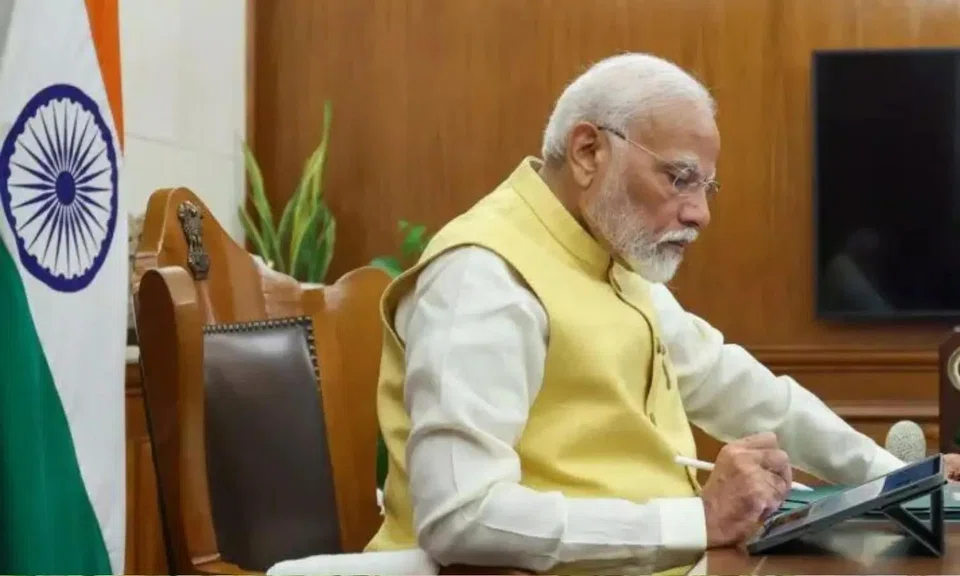
The latest signal of the EU’s intent could come at the 16th India-EU Summit, co-chaired by Prime Minister Narendra Modi and European Commission President Ursula von der Leyen, on Tuesday (Jan 27). The event is expected to announce a defence and security agreement alongside what Dr von der Leyen has called the “mother of all trade deals”, covering about a quarter of global gross domestic product.
There have been signs of an imminent breakthrough. On Monday, Dr von der Leyen and European Council President Antonio Costa were the chief guests at India’s 77th Republic Day Parade in New Delhi.
At the World Economic Forum last week, Dr von der Leyen said: “We are on the cusp of a historic trade deal… Europe wants to do business with the growth centres of today and the economic powerhouses of this century. From Latin America to the Asia-Pacific and far beyond, Europe will always choose the world. And the world is ready to choose Europe.”
Once agreed, the deal could enter provisional application within months, but full ratification may extend to 2028.
Other politicians also note the imminence of an agreement. In Davos, an apparently frustrated US Treasury Secretary Scott Bessent criticised his “virtue-signalling European allies” for pushing forward with a “big trade deal” with New Delhi.
While India and Europe have a long history of collaboration, Trump is the current catalyst. He has regularly disparaged the EU, most recently threatening further tariffs on eight European nations over Greenland.
India has likewise been subject to Trump’s wrath. Last year, he doubled US tariffs on New Delhi to 50 per cent over its purchase of Russian oil following the latter’s 2022 invasion of Ukraine. Russian oil now constitutes nearly 20 per cent of Indian refinery intake, up from roughly 3 per cent pre-war.
In this context, both India and the EU have accelerated their diplomacy. The Modi government has concluded three separate, significant trade deals since last spring with the UK, Oman and New Zealand – the latter two in December 2025.
Negotiations with the EU had stalled for nearly 18 years due to disputes over wide-ranging issues such as tariffs, intellectual property rights, the EU’s new Carbon Border Adjustment Mechanism, and agriculture and dairy market access. Trump’s return provided the necessary pressure to resolve these deadlocks.
While the trade deal headlines the summit, the defence and security agreement is important, too. Finland President Alexander Stubb highlighted this point at Davos when he called the upcoming EU-India deals a “strategic geopolitical move” between two powers which are also the world’s largest democracies, in terms of overall population.
Dr von der Leyen has also highlighted a shared EU-Indian “commitment to a rules-based global order, effective multilateralism and sustainable development”. There are also converging interests around shared defence mechanisms, including for maritime security in the Indian Ocean, where around 40 per cent of bilateral trade passes.
To be sure, some EU countries remain concerned about Modi’s human rights record. However, these have been superseded by the strategic need to find democratic stability beyond Western allies.
Bilateral benefits of the India-EU trade deal
The deal makes economic sense: The EU is already India’s largest trading partner.
Bilateral trade in goods reached around US$135 billion in the financial year 2023 to 2024, an increase of almost 90 per cent in the last decade, with much upside potential given that EU tariffs on Indian goods average 3.8 per cent, while India’s on EU goods are 9.3 per cent.
Forecasts for future bilateral trade indicate this could exceed US$200 billion in goods and services within a decade.
While the UK agreed a trade deal with India last year, Dr von der Leyen seeks a first-mover advantage for the EU. This is critical as India is on track to potentially overtake Japan as the world’s third-largest economy, surpassing US$4 trillion in GDP.
The framework aims to end tariffs on at least 90 per cent of traded goods, boosting services and facilitating investments. This would be phased in over a decade, with sensitive sectors such as agriculture, dairy and autos subject to quotas or gradual cuts.
For the EU, this secures access to India’s 1.4 billion-strong population market, and helps diversify supply chains away from China, and expand cooperation in clean energy and digital technology.
For India, the deal is a key enabler of Modi’s ambitious, long-range 2047 economic vision (“Viksit Bharat 2047”). Key gains include the restoration of tariff concessions under the EU’s Generalised System of Preferences.
There would also be reduction of duties on key exports such as garments, pharmaceuticals and petroleum products, and the opportunity to attract international investment to boost manufacturing.
Economics provided the foundation for the India-EU deal. However, it is geopolitics that provided the acceleration to finally take it over the line.
The writer is an associate at LSE Ideas at the London School of Economics
TRENDING NOW

Once staunchly pro-China, Malaysian Chinese businesses are now distancing themselves from Beijing

Britain’s mansion tax shows the difficulty of targeting wealth
Three hats, one goal: How Ng Kian Swan runs sustainability at NUHS
COE review: The gap between luxury and mass-market cars isn’t the only one worth bridging

