

India prepares for unpredictable G20 year
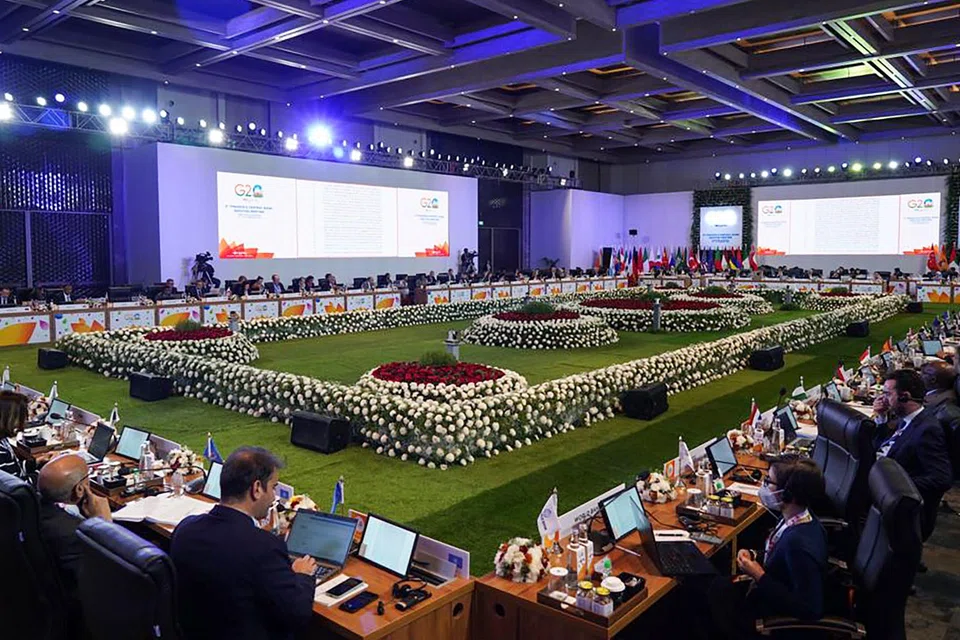
INDIAN Prime Minister Narendra Modi has high hopes for this year’s G20 summitry, yet it takes place amidst the most unpredictable global landscape in decades.
On the one-year anniversary of Russia’s invasion, G20 finance ministers are making final preparations for a two-day meeting from February 24-25. Meanwhile, foreign ministers have their own session next week in India.
In total, India will hold more than 200 meetings across some 50 cities involving ministers, officials and civil society. The pinnacle of this will be a leadership summit in New Delhi in September attended by around 30 heads of state and government, from both G20 members and invited countries such as Bangladesh, Egypt, Mauritius, Netherlands, Nigeria, Oman, Singapore, Spain and the UAE, plus international organisations such as the United Nations, World Health Organisation, World Bank and the International Monetary Fund.
Amidst the international divisions over Ukraine, PM Modi has to navigate his G20 agenda with his stance that the conflict must be resolved through dialogue and diplomacy. India has decided to primarily focus on green development, women empowerment, technological transformation and sustainable development.
He has called for a “depoliticisation of the global supply of food, fertilizers and medical products, so that geo-political tensions do not lead to humanitarian crises”. Moreover, he has called for international cooperation to deal with global issues arguing that the challenges of “climate change, terrorism, and pandemics can be solved not by fighting each other, but only by acting together”.
One of the big uncertainties in the G20 process is the involvement of Russia. New Delhi has said that Moscow, as a key G20 member, will be “participating in this process ... the grouping needs to speak with one voice, particularly on important issues that are affecting the world”. However, President Vladimir Putin decided not to attend the 2022 summit in Indonesia.
In part, this is because tensions over Moscow’s invasion caused much diplomatic fireworks. G20 foreign ministers clashed repeatedly, with Russia’s Sergei Lavrov walking out of meetings at least twice, and there were none of the usual customary group pictures of the so-called “G20 family” taken. With Ukraine proving so divisive, there are potentially huge barriers to constructive discussion taking place again this year.
Yet, it is not just the Ukraine conflict that will cause challenges. Tensions have long been high too between China and the West, and relations are also cool right now between Saudi Arabia and the United States.
In this context of uncertainty, Modi is determined to try to stamp his mark as host of the G20, not least given that it may impact his re-election next year. He may be helped here by recent supportive noises from Chinese President Xi Jinping who said that he and US President Joe Biden, who will attend in the year before his potential re-election in 2024, must find ways to get along better following the longstanding chill in bilateral ties which most recently saw the US shooting down a number of alleged spy balloons over its territories.
The reason why Modi is so keen to chair proceedings, in advance of his re-election, is the prestige that the G20 enjoys. Presidents and prime ministers will potentially be in attendance from China, Germany, India, Japan, Australia, Brazil, United Kingdom, Saudi Arabia, South Africa, Turkey, France, Italy, Germany, Canada, South Korea, Argentina, Mexico, the European Union, the US, and possibly Russia too. Collectively, these powers account for some 90 per cent of global GDP, 80 per cent of world trade, and around 66 per cent of global population.
One priority for India is the outlook for the world economy with continuing concerns that key nations, including much of the West, may enter recession. India’s G20 presidency has formulated priority agendas that include supporting the economy through the difficult period ahead which will be a key topic of discussion at the finance minister meeting this week.
Also on the agenda at the finance meeting is potential global regulation of cryptocurrencies, and rising debt troubles among developing countries. India’s central bank governor said last year that cryptocurrencies are a “huge threat” to financial stability.
In December, the World Bank asserted that the globe’s poorest countries owed US$62 billion in annual debt service to bilateral creditors, a year-on-year increase of around a third, triggering a higher risk of defaults. India is reportedly drafting a proposal for G20 countries to help debtor nations badly hit by the economic impact by asking big lenders to write down some of these loans. Two-thirds of the debt burden is owed to China.
New Delhi will also give support for a push by the IMF and the World Bank for the so-called Common Framework. This is a scheme launched in 2020 to help poor countries delay debt repayments which may potentially be expanded to middle-income countries.
One of the related economic issues that will be discussed are high energy prices. Following Russia’s invasion of Ukraine, energy security has become as important as net zero for some governments, not least in Europe, and this may be the case not just in 2023, but into the medium term.
Broader global economic development issues will also be a key feature of the summit, reflecting India’s status as a key emerging market, with the ambition of spurring a more inclusive global economic order. This will include discussions on sustainability finance, financial inclusion through digital, plus micro, small, and medium enterprises development.
Food security will also be on the agenda. The Ukraine conflict is just one factor in a gathering storm which the director of the UN Food Programme, Patrick Beasley, asserts is giving rise to a global hunger catastrophe.
All of this highlights why this year could be one of the most unpredictable G20s. While it could collapse into rancour, there is an outside possibility significant agreements could be made.
Modi is well aware that in the last decade and a half, while the G20 is widely seen to have seized the mantle from the G7 as the premier forum for international economic cooperation and global governance, it has failed so far to realise the full scale of the ambition some have thrust upon it. In part, this is because it has no formal mechanisms to ensure enforcement of agreements by world leaders.
However, important as this issue is, the Indian G20 presidency will try to exceed expectations in terms of outcomes. Whether it does this will depend much more on whether post-Ukraine conflict divisions between the West and Russia improve, or grow, in the weeks ahead.
Andrew Hammond is an associate at LSE IDEAS at the London School of Economics
TRENDING NOW
From legacy to launch: Francis Yeoh and Yeoh Pei Xien on family unity and YTL’s next‑gen ventures
Things to know about DBS’ incoming chairman Anthony Lim

Wealthy Indonesians snap up government bonds as yields near 8%: OCBC

From local AI partnerships to global opportunities: How MNCs help Singapore firms scale

