Irish breakthrough, but ‘Brex-eternity’ continues
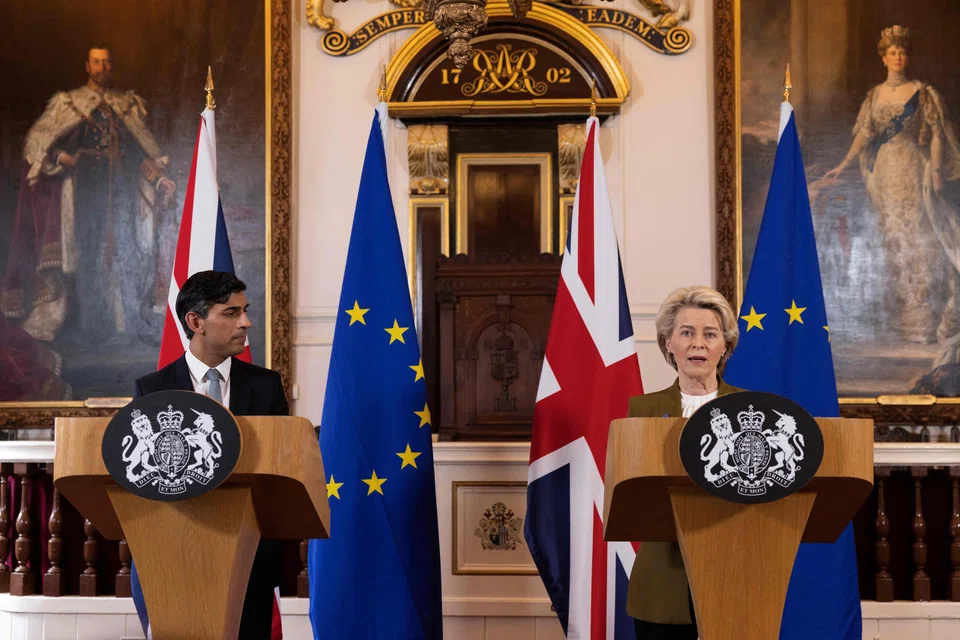
UK PRIME Minister Rishi Sunak struck a deal over the Northern Ireland protocol on Monday (Feb 27) with the European Union. Yet even if the agreement is approved by legislators, it will not end the UK-EU flux since 2016 which has been called “Brex-eternity”.
Seen from the vantage point of early 2023, it is clear that the EU referendum was a seminal moment in post-war history. Yet far from being a single, isolated event, Brexit should be seen as a process made up of multiple negotiations (a catch-all term used here for formal diplomatic discussions and wider debates), including within the United Kingdom; between the EU and the UK; and within the EU about its future.
The new deal, which must yet be signed off by UK legislators, is only the latest chapter in these debates. After four months of negotiations, Sunak and European Commission President Ursula von der Leyen announced the proposed Windsor framework on Monday that seeks to resolve the challenges of the present Northern Ireland protocol.
That protocol was agreed as part of the UK–EU Withdrawal Agreement that formally took the UK out of the EU. Its purpose is to prevent a hard border on the island of Ireland, by requiring Northern Ireland to align with EU law, allowing it to maintain frictionless access to the EU. However, it also means that goods entering Northern Ireland from the rest of the United Kingdom (England, Scotland and Wales) need to prove they comply with EU law in these areas.
At the heart of the revised pact are several key issues: physical controls and checks on trade to Northern Ireland from England, Scotland and Wales; and the role of the European Court of Justice (ECJ) and the application of EU law and the place of Northern Ireland in the UK’s internal market.
On the first issue, it is understood that the majority of controls and checks will disappear on goods destined to remain in Northern Ireland, and the role of the ECJ as the ultimate arbiter of disputes will be removed, while the EU will no longer have the right to automatically launch proceedings against so-called infractions of the protocol. The UK and the EU would deliver the deal through removing customs paperwork for consumers, and guaranteeing medical supplies in the long term.
There will also be a new “Stormont brake” giving assembly ministers in the devolved legislature in Northern Ireland (Stormont) a say on EU laws, allowing them to stop them applying in that nation. Moreover, Northern Ireland ministers will be given sight of new EU laws as they are drafted.
In turn, it is hoped by Sunak and von der Leyen that the deal will help guarantee the future of peace and stability in the nation. This comes around a quarter of a century after the landmark Good Friday agreement helped bring an end to the so-called troubles in Northern Ireland.
However, the deal is far from ratified yet. Sunak is concerned about possible resistance from the hardline Brexit camp in his Conservative Party, plus the Northern Ireland’s Democratic Unionist Party which ideally wants the protocol scrapped altogether.
Even if Sunak can surmount these big challenges, the UK’s Brexit saga is by no means at an end. As UK finance minister Jeremy Hunt, for instance, said in recent weeks, London and Brussels are likely to have an increasingly close economic relationship in the years to come with trade barriers progressively removed.
This underlines that, as the eighth anniversary of the UK’s EU referendum nears, the nation’s relationship with Europe is still not settled. And it is likely to remain so for many years to come in what has been called “Brex-eternity”.
So as much as the new Windsor agreement may be a milestone, the new relationship between London, Brussels and the 27 member states will continue to evolve. This could see a series of further UK-EU bilateral deals to fashion the new relationship, paralleling Swiss-EU relations over the last 30 years.
The Swiss example is interesting in its potential similarities with the UK given that in 1992 Switzerland voted by 50.3 per cent to 49.7 per cent against joining the European Economic Area which is an extension of the EU’s Single Market to member states of the European Free Trade Association. In the three decades since then, Switzerland has negotiated a series of bilateral deals with the EU, including to allow free movement of people which was backed by a vote in 2000. Moreover, 2005 also saw a Swiss vote to join Europe’s Schengen open borders treaty followed by a 2014 plebiscite to allow quotas on EU workers.
In the years ahead, the UK may well also follow a similar path, although not identical to that of Switzerland whose domestic politics are not the same. What this means, however, is that far from getting “Brexit done” in 2019 and 2020, as former prime minister Boris Johnson frequently asserted, UK-EU negotiations and internal political wrangling will continue.
This is one of the great ironies of the UK’s vote to leave the EU in 2016. That is, despite the referendum that saw around 52 per cent of the population apparently voting for cutting ties with the EU, London has since had to devote huge attention to Europe since then as it negotiated exit terms, more so than perhaps almost all previous post-war administrations did before the Brexit vote.
Almost eight years after the Brexit referendum, the country’s future relationship with the EU is therefore still far from being completely defined, despite the massive efforts in recent years to do so. Moreover, views on the relationship (or “model”) the nation wishes to have with the Brussels-based club could well change significantly over time, in a more or less integrationist direction, as political and public opinion evolves.
In practice, there remains a wide range of different models that could be followed in the future with existing agreements with the EU varying widely from Norway to Switzerland and Canada and Turkey. All with their own mix of advantages and disadvantages.
Taken together, the stakes in play therefore remain huge and historic as both sides continue to fashion a new partnership that can bring significant benefits for both at a time of geopolitical turbulence. The irony for London is that to deliver this outcome, it may now continue to need to devote at least as much of its attention toward the EU in coming years as when it was a member of the club.
Andrew Hammond is an associate at LSE IDEAS at the London School of Economics