

Japan’s exciting, fictional sports cars obscure its true progress on electrification

Derryn Wong
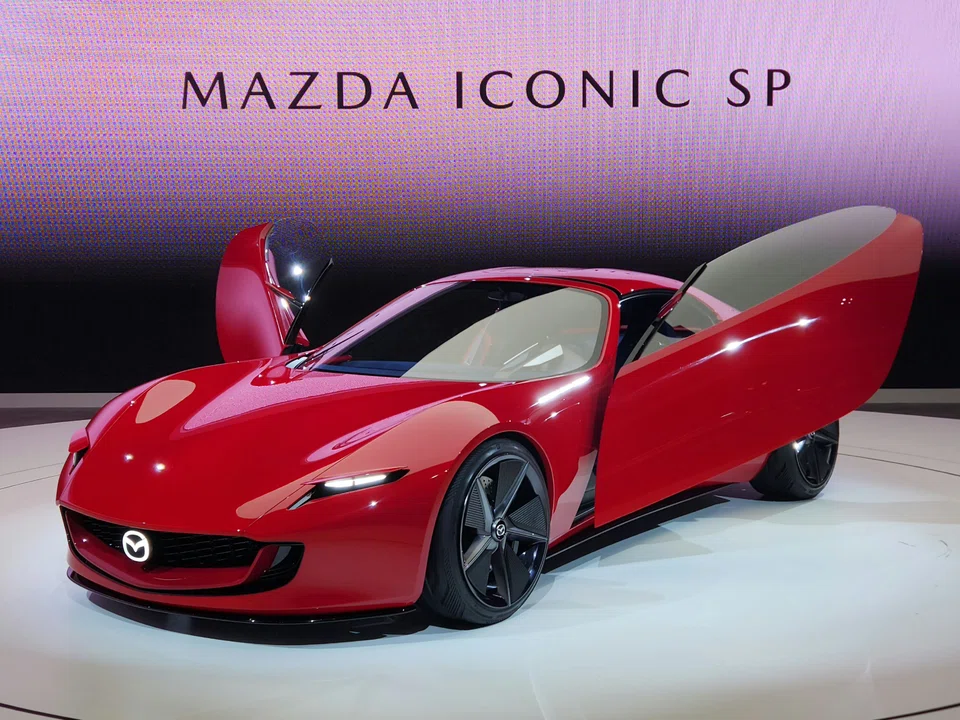
THIS year’s Japan Mobility Show, which ran from Oct 26 to Nov 5, featured such an array of sexy, sporty electric vehicles (EVs) that any attendee might be excused for eagerly anticipating a rush of Japanese sports cars into the market – riding a wave of electrons instead of petrol.
That fancy display, however, drew attention from a side of electrified motoring where Japan is making progress: commercial vehicles and motorcycles.
Almost every Japanese car manufacturer – including Toyota, Nissan, Subaru, and even smaller brands such as Daihatsu and Mazda – had sports car concepts on display at the show.
Their presence in a niche market is a reminder of the need for Japanese brands to make their mark in an industry that is changing. Electrification is reorganising the league table in the motor vehicle space.
Show ponies
The annual Japan Mobility Show is where the country’s manufacturers display their best ideas and entice potential buyers with a teaser of what’s to come.
Non-luxury sports cars are a low-volume segment, so it seems strange that Japanese brands have decided to dig their heels into it.
A more market-appropriate response would have been to showcase some next-generation mainstream EV models to entice would-be buyers.
One explanation is that sports cars are a way for Japanese carmakers to differentiate themselves.
Unlike the US and Europe, where EV sales have begun to slow, South-east Asia is on track to become a powerhouse in this area. Chinese carmakers sold three-quarters of all EVs in the region in the first quarter of this year, most of them mainstream models.
“Japanese carmakers believe it’s crucial to retain and continue conveying the joy of driving. There must be something unique that only they can bring to the table,” said Tomoyuki Suzuki, managing director at consultancy AlixPartners. “This is why, even in the age of EVs, there’s significance in creating sports cars.”
Joshua Cobb, senior automobiles analyst for BMI Research, said: “The profusion of sports car concepts could also indicate plans to spin off separate sub-brands, which could help finance electrification while the core brands continue with normal engines and hybrids.”
Ultimately, most of these sports concepts – especially the fully electric ones – are not likely to make it into series production soon.
Japanese carmakers believe a spectrum of electrified drivetrains – spanning hybrids, plug-in hybrids, and hydrogen fuel cells – is the way forward, rather than going all-in on EVs.
That is why Mazda’s and Honda’s concepts – which are both hybrids – are most likely to see production. In the former’s case, the hybrid powertrain with a rotary combustion engine has already been deployed to market in its MX-30 EV.
Sports cars are also the torch-bearers for Japan’s still-gestating EV breakthrough technology – solid-state batteries.
These will allow faster charging and longer range with less weight than current batteries. There are currently few fully electric sports cars because the weight of batteries dampens the performance.
Japanese carmakers are likely waiting for the solid-state breakthrough to begin producing fully electric sports cars, said BMI’s Cobb. Toyota is leading the research into solid-state batteries, and representatives of the company said they are expected to be market-ready only in 2026.
It is also possible that the car giant could license that technology to other Japanese carmakers.
Cut to commercial
In the meantime, Japanese brands look set to make their biggest marks with electric commercial vehicles and electric motorcycles.
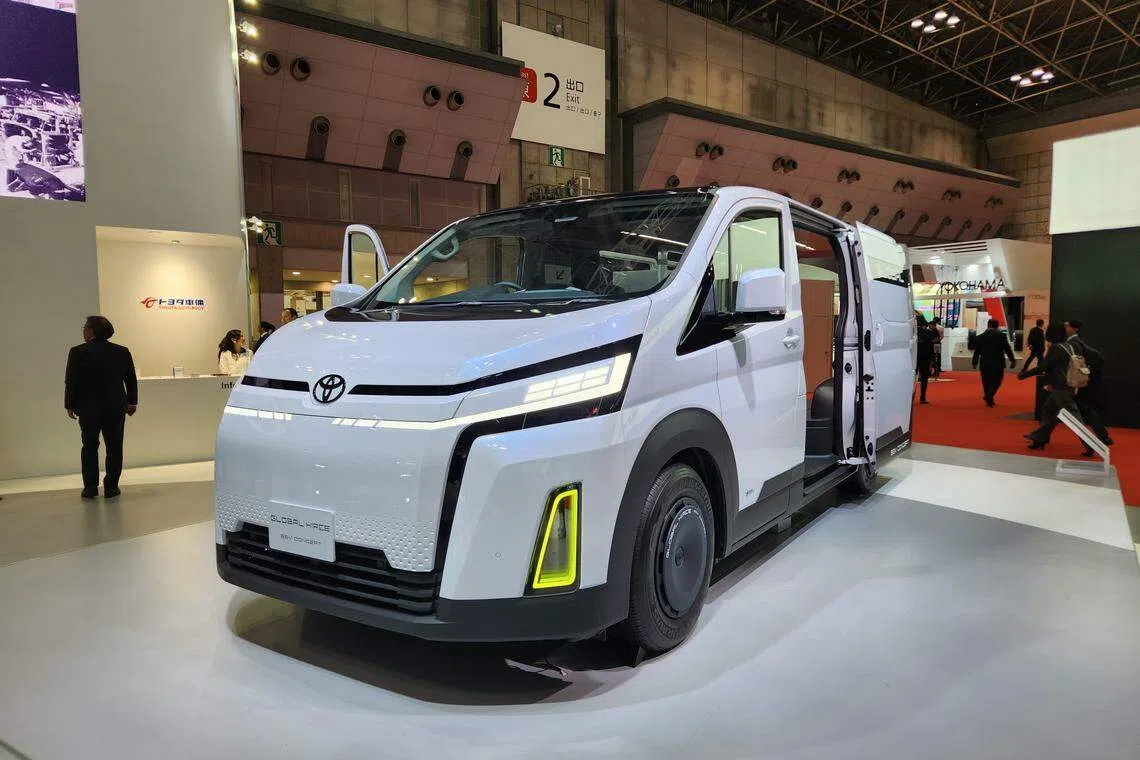
Toyota, for one, displayed two electric commercial vehicle concepts with regional relevance.
The first was the Global HiAce BEV Concept. It has a strong real-life precedent, since it is based on – and expected to be the replacement for – the H300 HiAce, which is currently sold in the region.
The second was its IMV 0/Rangga Concept, aimed at developing markets and first shown in Indonesia earlier this year. It is a modular light pickup truck that could be produced in electric, hybrid or internal-combustion engine versions and eventually replace the popular Hilux truck.
Honda has its MEV-Van, an electric micro-van concept that will undergo testing with Japan’s largest delivery company Yamato Transport. The van showcases Japan’s progress in electrified motorcycles, as it uses battery-swapping technology developed by a consortium of the country’s motorcycle manufacturers.
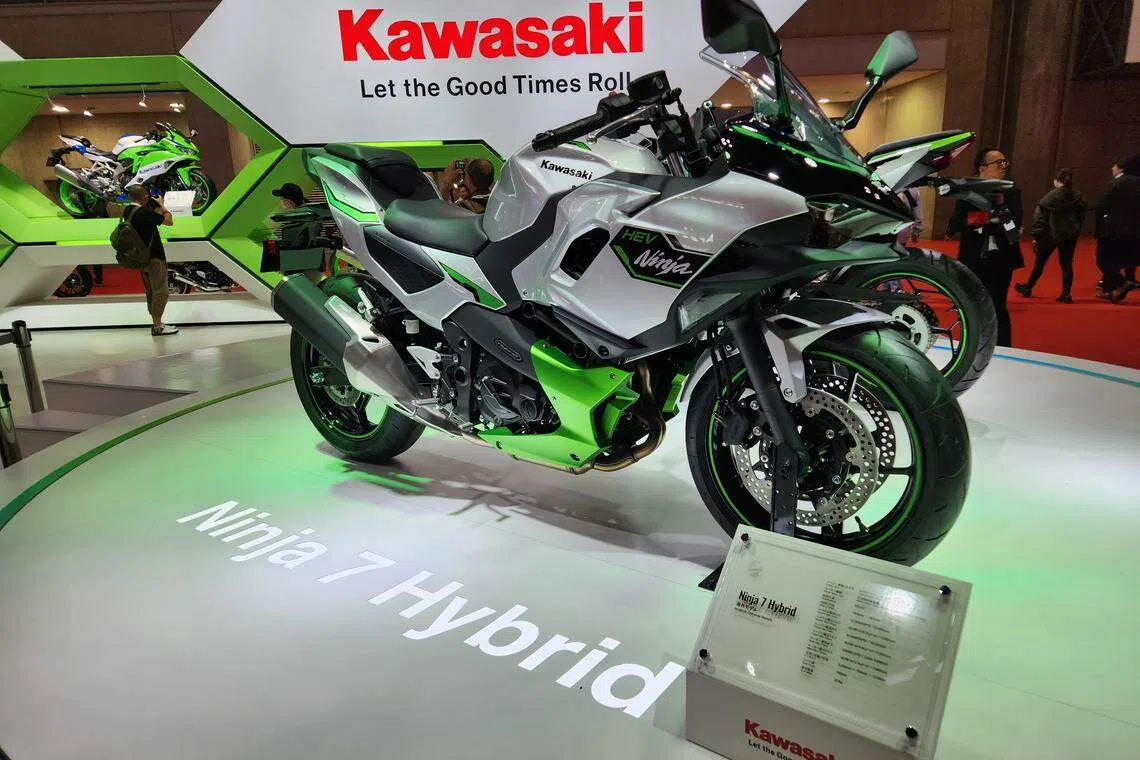
Honda, Suzuki and Kawasaki all displayed multiple electrified and electric motorcycles; some have already gone into production and others look close to production-readiness. Kawasaki, in a world first, debuted a ready-for-sale hybrid motorcycle in Tokyo.
BMI’s Cobb said: “Looking at the now accelerated electrification strategies from Japanese carmakers… we can see increased investment and focus on commercial EVs and electric motorcycles, as these two segments will see some of the strongest growth rates in the EV industry, especially in the Asia region for motorcycles, and in developing markets such as China for commercial EVs.”
Asia is the largest market for motorcycles. According to research company McKinsey and Company, the electrification rate of two-wheelers will be around 36 per cent in India and Asean by 2030, with India and Indonesia being the largest electric-motorcycle markets in the world.
Research company Mordor Intelligence reported that the hybrid and electric-commercial-vehicle market in Asia-Pacific is expected to grow from US$15.4 billion in 2021 to US$24.8 billion by 2028.
Japanese manufacturers’ strong position in the Asian market in both commercial vehicles and motorcycles means their brand power and dealer network could give them a strategic edge. This is despite being on the back foot in the more visible passenger EV segment.
In other words, Japan’s fictional sports cars are symbolic of its efforts to charge ahead in electrification – just not in terms of real-life sports car sales in the near term.
TRENDING NOW

Two Singapore-listed palm oil firms named in Greenpeace report on Indonesian plantation fires

Singapore Airlines flight returns to San Francisco after ‘unruly’ passenger incident

Singapore looking into which companies responsible for haze-causing fires: PM Wong
Deluge IPO 3.86 times subscribed ahead of SGX debut

