Japan’s warming Western relations

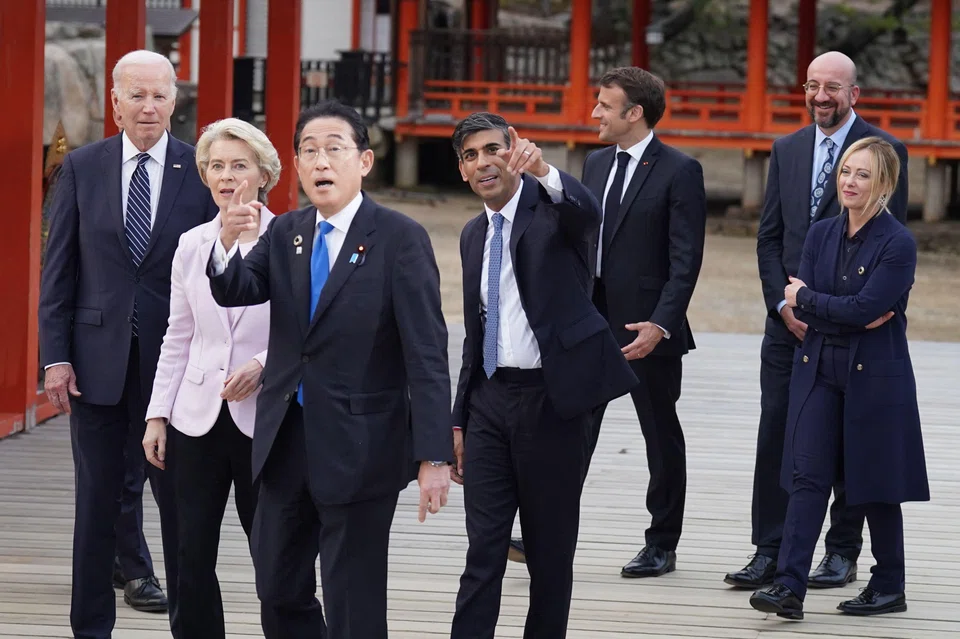
    • (Left to right:) US President Joe Biden, European Commission President Ursula von der Leyen, Japan's Prime Minister Fumio Kishida, Britain's Prime Minister Rishi Sunak, France's President Emmanuel Macron, European Council President Charles Michel and Italy's Premier Giorgia Meloni arrive for a group photo during a visit to the Itsukushima Shrine on Miyajima Island, at the start of the G7 summit, May 19, 2023.
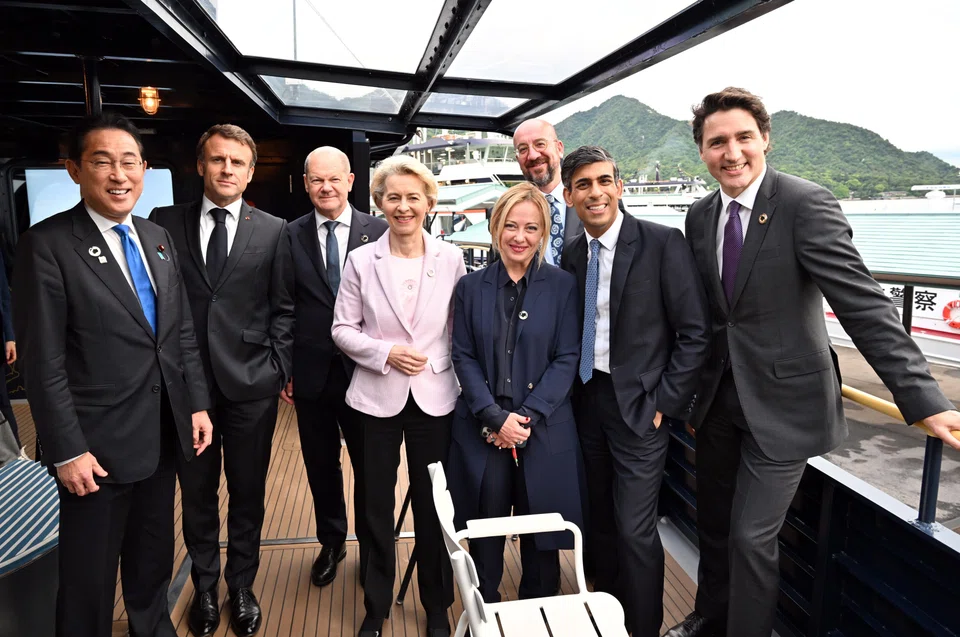
    • Japan's Prime Minister Fumio Kishida (first from left) and some G7 leaders on a boat trip to visit the Itsukushima Shrine on Miyajima island, on May 19 during the G7 Hiroshima Summit in Japan.
    • (Left to right:) US President Joe Biden, European Commission President Ursula von der Leyen, Japan's Prime Minister Fumio Kishida, Britain's Prime Minister Rishi Sunak, France's President Emmanuel Macron, European Council President Charles Michel and Italy's Premier Giorgia Meloni arrive for a group photo during a visit to the Itsukushima Shrine on Miyajima Island, at the start of the G7 summit, May 19, 2023. PHOTO: AFP
    • Japan's Prime Minister Fumio Kishida (first from left) and some G7 leaders on a boat trip to visit the Itsukushima Shrine on Miyajima island, on May 19 during the G7 Hiroshima Summit in Japan. PHOTO: EPA-EFE
    Published Tue, May 30, 2023 · 03:00 AM

    ONE of the standout features of international relations since Russia’s invasion of Ukraine has been the warming of Western relations with Japan.

    This was showcased again at the recent Group of Seven (G7) leadership summit, which notched up significant achievements, including in the geopolitical arena. Moreover, last year Fumio Kishida became the first Japanese prime minister to attend a North Atlantic Treaty Organization leadership meeting, and there is even speculation of Tokyo being invited into Western intelligence forums such as the “Five Eyes” alliance of the United States, Canada, United Kingdom, Australia and New Zealand.

    These examples illustrate that much of the attention around warming ties has focused on the defence and intelligence arenas. In part, this reflects Japan’s ambition, since the Ukraine war began, to try to tie together the threats from Russia in Europe with its own concerns about the rise of China in the Asia-Pacific where it wants to ensure Western support vis-a-vis Beijing.

    Below that security policy radar screen, however, another far less commented area of enhanced cooperation since the Ukraine war began is centred around the sustainability agenda. In May 2021, for instance, Tokyo and Brussels agreed on a “Green Alliance” to accelerate the transition of both the European Union (EU) and Japanese economies towards becoming climate-neutral, circular and resource-efficient in the coming decades by better protecting the environment, enhancing conservation of biodiversity and stepping up the fight against climate change.

    In recent weeks, too, Japan and Canada have held talks, with Kishida meeting Prime Minister Justin Trudeau in Ottawa to explore how the two sides can better help each other with their energy transitions, including working together to make their nuclear supply chains more resilient. The Canadian government will lead a delegation to Japan this autumn to further this agenda, and Japanese companies interested in areas such as electric-vehicle battery components plan to visit Canada next spring.

    However, the most recent agreement in this area came just before the recent G7 leadership summit with the announcement by Kishida and Prime Minister Rishi Sunak of a new UK-Japan “Renewable Energy Partnership”, similar in nature to the Green Alliance between Brussels and Tokyo. This commits to strengthening UK and Japanese long-term support for energy security by diversifying supply sources through the advancement of clean technologies, particularly offshore wind, and reducing dependency on fossil fuels.

    London now has a blossoming relationship with Tokyo. For instance, the Japanese government has been one of the strongest supporters of the United Kingdom’s accession to the Comprehensive and Progressive Trans-Pacific Partnership trade and investment agreement, a free trade pact that links 11 countries including Singapore.

    The new UK-Japan sustainability deal will deepen not only bilateral political ties, but also economic ones, triggering a new wave of investment between the two markets. Take the example of the United Kingdom, which has huge incentives to drive this agenda forward with Japan and other key nations following the US Inflation Reduction Act (IRA), and counter-subsidies from the EU’s Green Deal Industrial Plan for the Net-Zero Age.

    There are growing concerns from UK stakeholders that the nation could miss on an increasing wave of green investment as the global economy grows from around US$90 trillion today to a forecast US$190 trillion by the mid-21st century, when the world may hit net-zero emissions. UK industry and trade bodies, including EnergyUK and RenewablesUK, warned earlier this year about this outcome.

    Moreover, the UK government’s own Skidmore Net Zero Review, released in January, highlights that the United Kingdom risks losing out on more green investment, with the author Chris Skidmore asserting “people are telling us they want to invest the money in the United Kingdom, but they’re not willing to commit just yet because they don’t feel that the investment environment is there. This has been accelerated by the IRA’s passage”.

    Despite these challenges, however, the United Kingdom does have some longstanding strengths in the energy arena that Japan recognises and appreciates. For instance, London tends to have a more pragmatic approach than Brussels to sustainable and green issues, including technology implementation in energy and chemical platforms.

    So, in general, this offers a good partnership model for Japan to provide a market or proving ground for Japanese technology and/or a source for better, more pragmatic solutions. For example, in chemicals, “blue” ammonia, hydrogen and methanol may be more realistic economically and in terms of rapid scalability than its “green” counterparts as a stepping stone. The United Kingdom appears generally more accepting of those interim solutions, which appeal to many Japanese businesses.

    In the case of the circular economy in plastics, for example, the EU is pressing forward with binding legal targets for reuse and recycling, which are often not supported by the reality of supply infrastructure, nor business appetite for investment at scale. In contrast, UK legislators are widely viewed to be more likely to be pragmatic implementers of “better” rather than “ideal” solutions that take account of current economic pressures.

    Moreover, the high level of wind-power generation capacity already installed in the United Kingdom means that the nation could be a good proving ground for innovation in areas such as power distribution infrastructure and large-scale storage to balance and manage the intermittent nature of wind power. This may lead to the emergence of differentiated UK-based technology and/or the need for such tech to be brought by Japanese companies.

    The United Kingdom also benefits from strength and flexibility in its financial industry, via the City of London, which is of interest to Japan given that it sometimes struggles to attract money from overseas. The energy transition requires much capital and Japan could learn from UK best practices, and vice versa, too. For instance, the United Kingdom has a good track record in using fintech to support the development of innovative green technologies.

    Wider examples where such Japan-UK corporate collaboration could be mutually beneficial, in Asia and other geographies, are in the energy transition, including carbon capture and storage, nuclear power and digital solution fields. It is difficult for Japan to have all the technologies necessary for nuclear power supply chains on its own, and there is potential to join nations with common values like the United Kingdom, including around Small Modular Reactor nuclear development.

    Taken together, the West’s warming relationship with Japan is therefore the highest profile in the “hard” security area. However, the scope of better ties is broader, including “softer” areas such as sustainability and green issues – as the EU, Canadian and UK examples show – which could help drive a significant new wave of clean energy investment in the years to come.

    The writer is an associate at LSE IDEAS at the London School of Economics.