JB-Singapore RTS Link a key bilateral project that will accelerate regional connectivity
THE festive season at the end of the year is usually when scores of people are travelling, and that includes the thousands of Singaporeans heading across the Causeway each day to visit Johor Bahru and other parts of Malaysia.
And with a large chunk of the 300,000 or so Malaysians who work in Singapore commuting to and fro by land, it’s little surprise that there are massive bottleneck jams at both the Woodlands and Tuas Checkpoints throughout the day.
Last week, the Immigration & Checkpoints Authority (ICA) said it expects to see very heavy traffic at the two land checkpoints until the end of 2023, especially during the two long holiday weekends. It also warned that those who are clearing immigration by car may have to wait for as long as three hours.
In a sign of just how bad the congestion is, ICA reported that traffic flow over the Dec 15 to 17 weekend at both checkpoints exceeded pre-Covid levels with more than 1.3 million travellers passing through, or an average of 435,000 crossings on each of the three days. Compared with the same three-day period in 2019, this was an increase of nearly 30,000 travellers in total.
The numbers are likely to be even higher for the recent Christmas weekend and the upcoming New Year’s Day weekend.
With connectivity being so important, it’s easy to see why many are eagerly counting down the months until the Johor Bahru-Singapore Rapid Transit System (RTS) Link – a 4 km-long cross-border rail shuttle service that was first announced in 2010 – finally becomes operational.
The four-carriage RTS Link – which connects the Woodlands North MRT station in Singapore and the Bukit Chagar station in Johor Bahru – will have a peak capacity of 10,000 people per hour per direction. In comparison, the existing KTM Tebrau shuttle has a maximum capacity of less than 10,000 people per day.
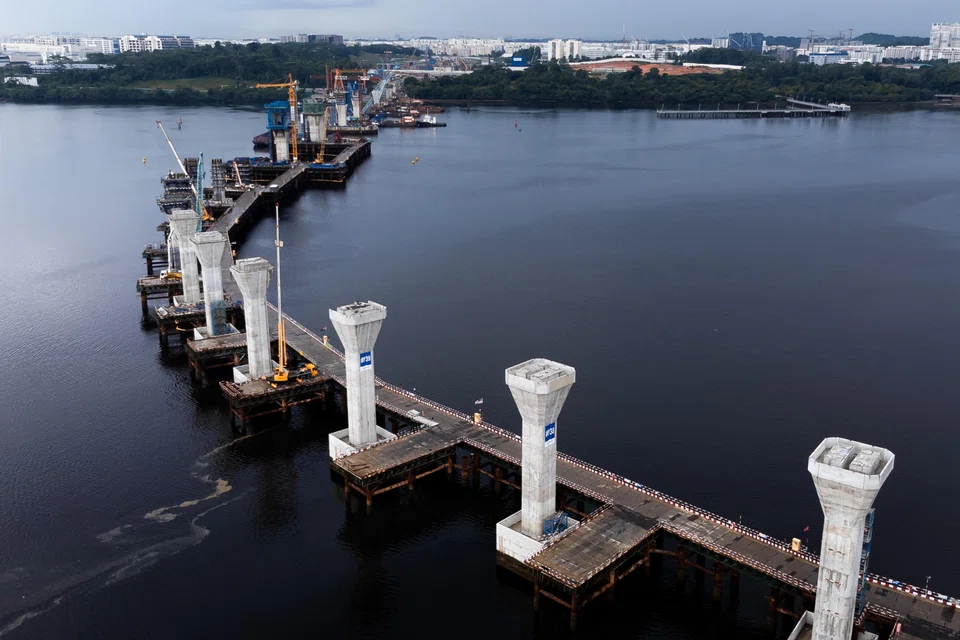
The latest update is that construction of the RTS Link has passed the halfway mark, with plans on track for passenger services to commence by the end of 2026. Already, the project’s rail viaduct and trestle bridge are taking shape, and the next big milestone is a ceremony that will soon take place to mark the completion of the drop-in span that will connect the RTS Link’s viaduct across the Strait of Johor.
There are several considerations in order for this important bilateral project, estimated to cost some RM10 billion (S$2.9 billion), to succeed over the long haul.
First, it has to be completed without any further delay.
Second, the flow of passengers must be as smooth as possible, and this requires a seamless experience at the joint Customs, Immigration and Quarantine facilities at both RTS Link stations.
Third, the fares should be kept affordable in order for the project to be viable, especially as there will be a sizeable number – in particular the Malaysians who work in Singapore – who will want to use the service on a daily basis.
While the start date of the RTS Link is still a good 36 months away, there is a growing sense of optimism that this faster commute will go a long way in alleviating the jams at the checkpoints, and deliver a boost to the economies of Singapore and Malaysia in more ways than one.