

King’s speech shows Sunak’s cupboard is bare
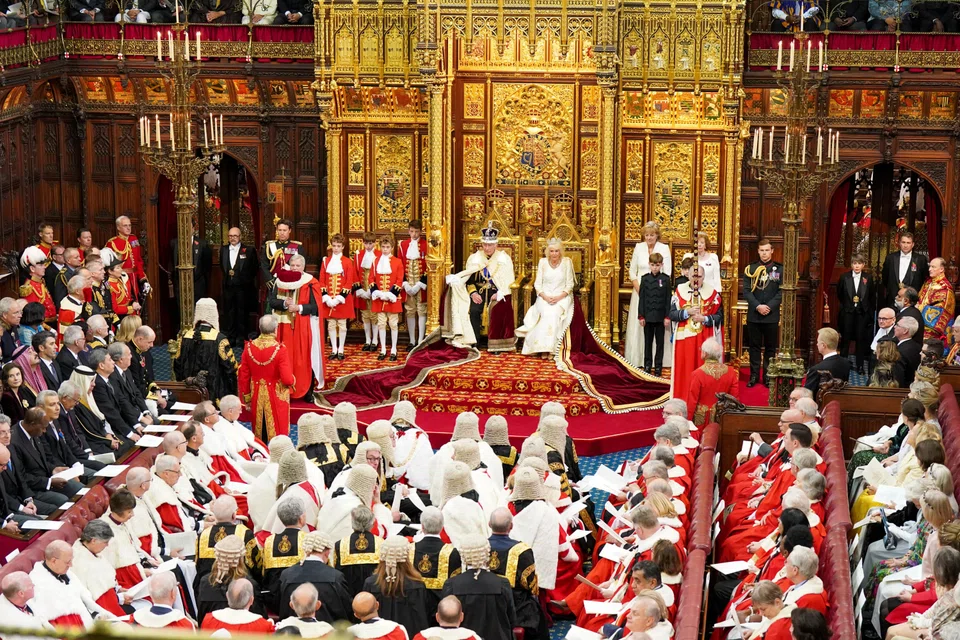
KING Charles III gave the UK’s first King’s Speech in parliament in over seven decades on Tuesday (Nov 7). Yet the address – which is traditionally written by the government of the day for the monarch – will not be remembered in the history books for its contents.
To be sure, the speech was big on words, and was the longest such address by a monarch since 2005. However, all the more shame that it was so short on new ideas, especially for domestic policy where the emphasis appeared more on a series of short-term measures designed to try to win headlines.
Even senior Conservatives criticised the lack of ambition. Former Cabinet minister Greg Clark, now the chair of the House of Commons Science and Technology Select Committee, condemned the “disappointing” failure to include an artificial intelligence Bill that would help regulate the sector following last week’s big summit on this topic.
Moreover, former prime minister Theresa May warned her successor but two in 10 Downing Street, Rishi Sunak, that “what we need to do now is press the accelerator on the transition to a green economy, not try to draw back. I fear that… the King’s Speech… is not sufficiently strong in ambition from the government to make sure that they are making that transition quickly enough to ensure that we reach net zero in 2050”.
The ruling Conservatives have now been in office for the best part of a decade and a half. Five prime ministers later, including May, and the party seems intellectually exhausted, with little that is genuinely novel announced on Tuesday.
So much so that calls are growing for the United Kingdom, now around four years into a maximum five-year parliament, to hold a general election. However, with the Conservatives trailing badly in the opinion polls, Sunak may well resist calling a ballot till the second half of 2024 to see if something “turns up” for his troubled political fortunes.
The King’s Speech signals not only the state opening of parliament, but also a new UK law-making cycle, potentially the last full one for the Sunak government. While Tuesday’s provisions are mainly domestically focused, some have implications for international audiences too, cementing the details of prior government announcements made, in some cases, years ago.
One example is a new trade Bill focused on the UK’s pending membership of the Comprehensive and Progressive Agreement for Trans-Pacific Partnership (CPTPP), which involves 11 countries spanning the Asia-Pacific and the Americas (Australia, Brunei, Canada, Chile, Japan, Malaysia, Mexico, New Zealand, Peru, Singapore and Vietnam). The Bill will ensure that the United Kingdom can meet international commitments under the CPTPP when the nation formally accedes, probably next year.
The legislation is the latest move in the UK’s pivot toward the Asia-Pacific following Brexit.
At present, the deal does not nearly get close to replacing the UK’s lost trade from the 27 European Union states in recent years given the existing economic patterns. It does, nonetheless, deepen the UK’s access to some of the world’s most dynamic economies that will account for the majority of global growth between now and 2050, and some £12 trillion (S$20 trillion) of gross domestic product once the United Kingdom accedes.
The UK will be the third G7 member to join CPTPP, and the second-largest economy in the bloc. Trade between the UK and CPTPP countries was worth £113.4 billion (or 6.6 per cent of total UK trade) in 2022, while total UK exports of goods and services to CPTPP countries were worth £61.3 billion in the same year.
With the COP28 climate summit in Dubai fast approaching, another Bill with potentially key international consequences is the new Offshore Petroleum Licensing Bill.
For around two decades, the United Kingdom has led the world on climate-change issues with valuable bipartisan consensus around the energy transition and tackling global warming that has seen the nation cut emissions further and faster than any other major economy.
However, that precious political consensus, and the goal of delivering net zero by no later than 2050, is threatened by Sunak’s future licensing of new oil and gas fields in the North Sea. To be sure, the prime minister claims this will boost energy security by reducing dependence on higher-emission imports from overseas, including Russia.
However, laudable as these goals may be in the wake of the Ukraine war, critics such as the UK’s Climate Change Committee assert that the global warming emergency means that the United Kingdom must go further to deliver net zero.
This call is echoed by respected international bodies too, like the International Energy Agency – which, this autumn, called on as many advanced nations as possible, including the UK, to deliver on net zero five years “early” in 2045, thus providing developing countries with a bigger window to make their transition.
Especially in light of the current crisis in the Middle East, the Economic Activity of Public Bodies (Overseas Matters) Bill will be of interest to international audiences. This aims to stop UK public bodies from imposing their own views about international relations, through preventing boycott, divestment or sanctions campaigns against foreign countries.
The government is concerned that some public bodies such as councils, universities, cultural institutions, using public funds, are imposing their own approach to international relations via their own boycott, divestment or sanctions campaigns. This is especially in relation to Israel, given concerns that such actions may legitimise anti-Semitism.
Examples that the government cited on Tuesday include the Lancaster City Council’s vote in 2021 to express its support for the Boycott, Divestment and Sanctions movement’s demands and to write to its pension fund urging it to divest from companies active in Israeli settlements.
Plus, in 2014, Leicester City Council, Swansea City Council and Gwynedd County Council also passed boycott motions vis-a-vis the Israeli government.
The legislation prevents public institutions carrying out independent boycotts, divestments and sanctions against: foreign countries, or those linked to them; the sale of goods and services from foreign countries; and UK firms which trade with such countries, where such an approach is not in line with UK government sanctions. The measures will cover purchasing, procurement and investment decisions that undermine cohesion and integration.
Taken overall, Tuesday’s address therefore has international implications, but is lacking in the domestic ambition needed to navigate key issues like climate change. It is becoming ever clearer that a new government will be needed to deliver on that important, generational mission.
The writer is an associate at LSE IDEAS at the London School of Economics






