

The Labubu craze is not just a fad. Singapore businesses are taking notes
More brands are turning to ‘blind-box marketing’, which combines mystery, surprise and collectability to draw customers


IN EARLY 2024, Xavier Lum bought his first blind box from toymaker Pop Mart, in an attempt to get matching figurines with his friends. Each toy series by Pop Mart typically contains 12 variations, but there is a caveat: They come in sealed packaging and are sold randomly.
And unfortunately for the 30-year-old marketing executive, he and his friends got duplicates of the same design.
Lum tried his luck with more blind boxes in a bid to get a different design. Soon enough, this evolved into collecting designs from different series, and completing each one.
“It feels very incomplete if I have only one design in a whole series. In particular, if I really like that whole series, I want to have the entire collection,” he says.
It has been less than a year since he started, and Lum currently owns more than 200 Pop Mart figurines, comprising four complete sets and several individual pieces. And he is still looking to collect more.
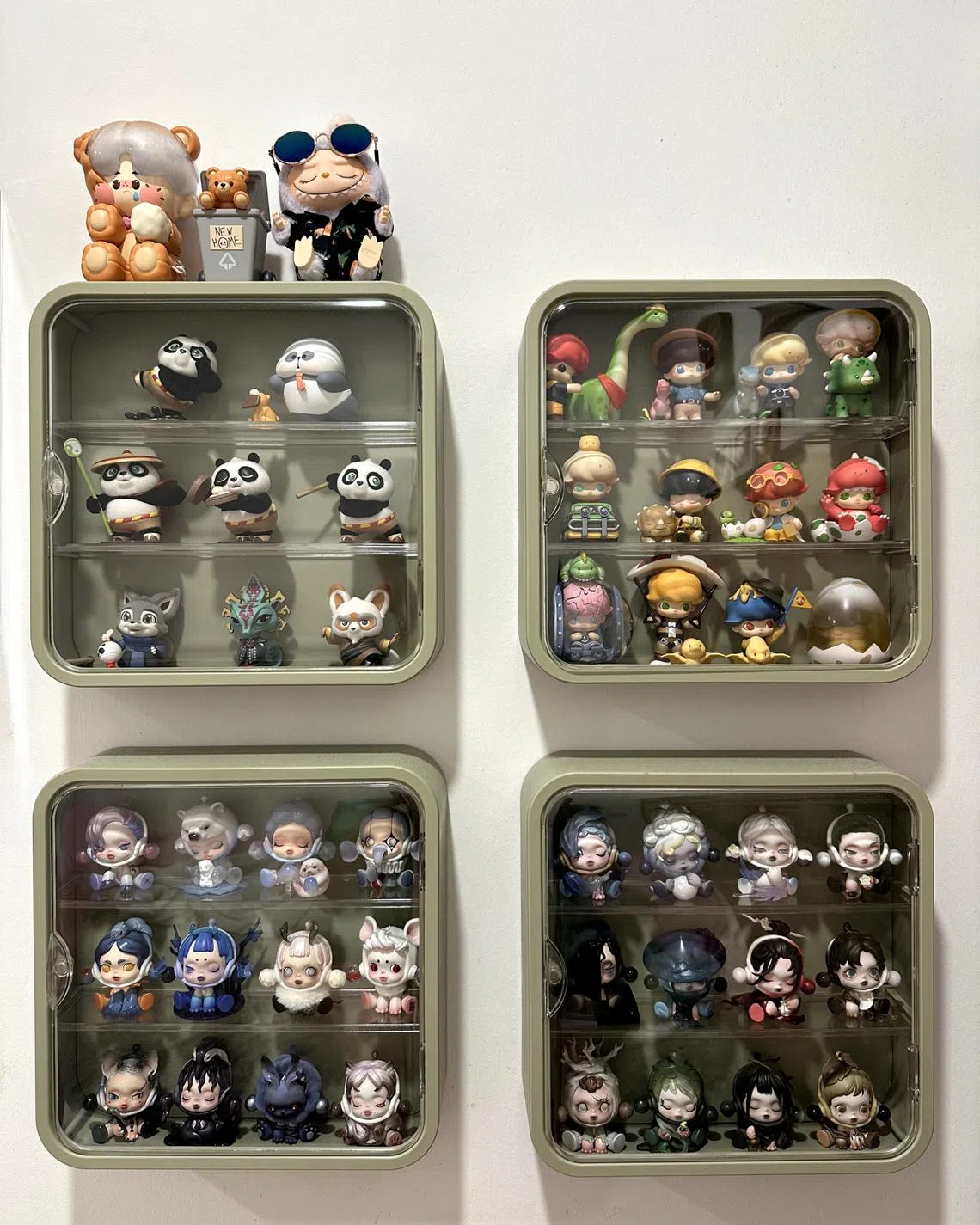
Lum is one of many who have jumped on the trend of collecting blind boxes, a market that has taken the world by storm in recent years.
The size of the global blind-box toy market reached US$14.3 billion in 2024, and is projected to expand at a compound annual growth rate of 6 per cent from 2024 to 2031, according to a report by Cognitive Market Research.
While the contents of the blind boxes often refer to toys, these mystery boxes have spread to other industries, setting off a wave of “blind-box marketing”.
For better or worse, blind boxes have enabled companies to step up their marketing game as it raises consumer engagement with the brand. Yet, the market is also linked to impulsive buying behaviour, which puts it at risk of further regulations.
Unpacking the blind-box strategy
“The appeal of blind boxes… lies in their combination of excitement, surprise and collectability,” says Joe Escobedo, adjunct lecturer from the department of marketing at the National University of Singapore (NUS) Business School.
“Consumers are drawn to the mystery element and the thrill of discovering what’s inside, which triggers dopamine responses,” he adds.
Escobedo notes that some of the demand may have also been pandemic-driven – during Covid-19 lockdowns, many people turned to hobbies such as collecting, and blind boxes provided an affordable, accessible form of entertainment.
In Singapore, this has manifested in the form of Labubu – a character under Pop Mart’s The Monsters intellectual property (IP) franchise.
Pop Mart has made products under the IP for The Monsters since 2015. But Labubu became viral only in April 2024, when Lisa of K-pop band Blackpink posted a picture of the elf character on her Instagram account.
“Labubu” was the top-searched keyword on consumer marketplace Carousell in September and October; search of the keyword grew more than nine times in September from May.
It also leads far ahead of Pop Mart’s second-most popular character Crybaby, which has a keyword that ranked 54th on the overall platform, says a Carousell spokesperson.
Increasingly, non-toymakers in Singapore are also making their own collectables and selling them via blind boxes, or marketing their products through such means.
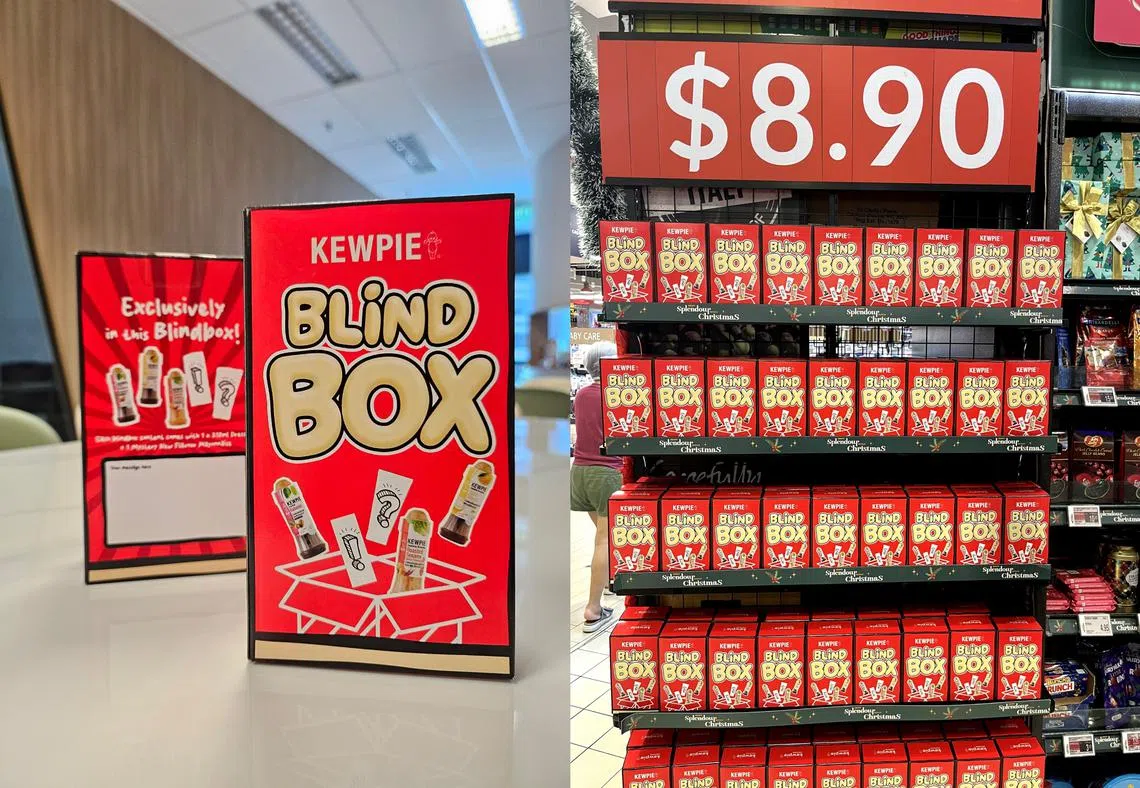
Condiments manufacturer Kewpie used blind boxes to promote its new mayonnaise flavours. It packaged its two new mayonnaise varieties – truffle and wasabi – into sealed, random boxes and stocked them in supermarkets across Singapore.
Anna Yee, marketing and brand manager at Kewpie Singapore, notes that it is challenging to capture consumers’ attention by simply listing new products on the market.
“We wanted to try something different, because condiments are often seen as a boring category, and we wanted to make it more engaging for consumers,” Yee says.
“The blind-box packaging is more eye-catching; we also wanted consumers to take a leap of faith and try new dressing flavours, rather than stick to their usual choices,” she adds.
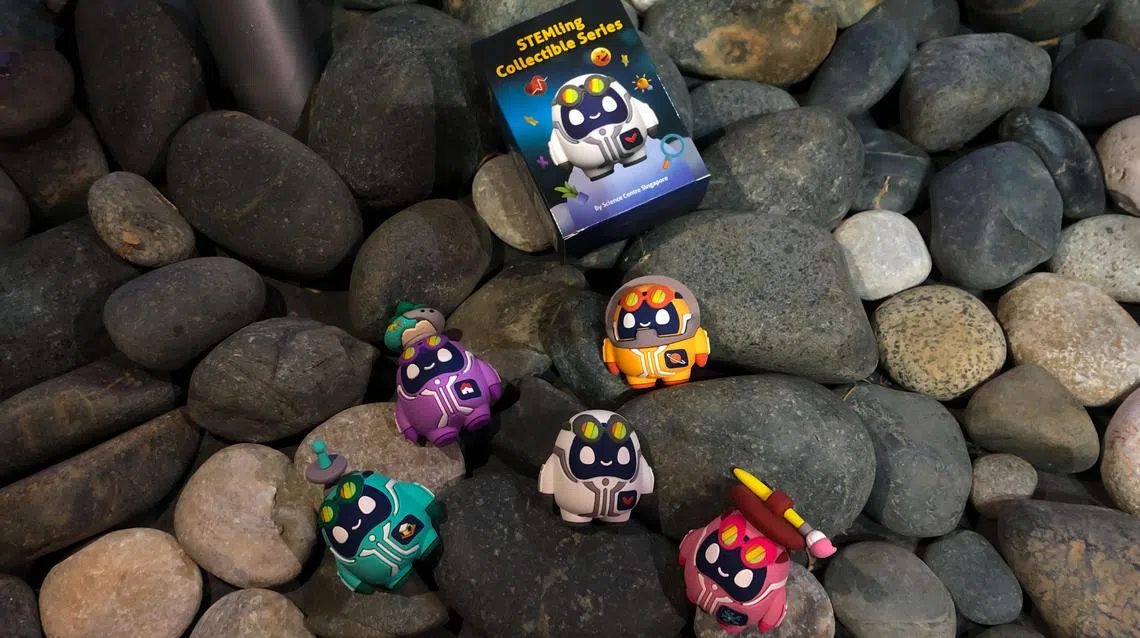
Meanwhile, Science Centre Singapore also has its own variation of collectables, called Stemling, which it has sold in blind packages since 2022.
A spokesperson for the centre explains that blind boxes were a great way for it to connect with its audiences in the 15 to 30 age group, since blind boxes particularly appeal to this demographic.
“Science Centre Singapore is always on the lookout for innovative ways to promote interest, learning and creativity in science, technology, engineering and mathematics (Stem),” the spokesperson says.
Escobedo notes that the blind-box format can be easily adapted to products such as cosmetics or limited-edition merchandise, with brands adopting the model to create buzz and encourage repeat purchases.
“Non-toymakers are leveraging the blind-box trend to capitalise on the same psychological triggers – surprise, rarity and collectability – found in traditional blind boxes,” he says.
Why now?
To be sure, blind boxes are by no means a fresh way to market products.
Retailers have sold toys in similar mystery forms over the years, such as with Japanese “gachapon” vending machines, and chocolate-maker Ferrero’s Kinder Joy series.
But there are modern elements that have contributed to its recent burst of popularity, especially in South-east Asia, market observers say.
Nowadays, the toys are marketed in different series, with each series comprising a storyline, says Li Jianggan, founder and chief executive of venture builder and research company Momentum Works.
Social media has also made it easy to share these products, he adds.
“There are some players, like Pop Mart, who know how to operate this market and create IPs really well, that have changed the dynamics of this market,” Li says.
Jeremy Lee, Pop Mart’s go-to-market director for South-east Asia, also notes how social media has played a “very big part” in the blind-box market.
“It’s not just about the blind box… Social media has amplified this whole ritual of unboxing and the thrill of not knowing what you’re going to get. The unboxing ritual is part of the magic in terms of gaining popularity,” he says.
The social media aspect of the blind boxes is what kept Kewpie’s Yee interested in the marketing strategy.
While sales did not meet expectations, Yee says the campaign raised Kewpie’s brand awareness by more than 10 per cent, with several unboxing videos appearing on TikTok and Instagram.
“It’s rare to see social media content about condiments unless it’s part of a collaboration; so we were pleased to know that these were organic posts, and people genuinely enjoyed the new products,” she observes.
Lifestyle retailer Miniso also notes that a high proportion of its sales in Thailand are from its blind boxes, and it even has a dedicated blind-box local community group on Facebook with 25,000 members.
Global cumulative sales volume for Miniso’s blind boxes passed 30 million by the end of the third quarter of 2024. Its blind boxes have generated global sales approaching two billion yuan (S$371.5 million), with more than 200 new products introduced each year worldwide.
Says a Miniso spokesperson: “Blind boxes possess high growth potential, significant emotional value, and a competitive edge in the market, aligning with the rising trend of interest-driven consumption.”
Momentum Works’ Li also notes that modern infrastructure can support a resale market for blind-box collectables.
Pop Mart collector Lum notes that he is a member of a community group on Telegram, where members buy, sell and trade their figurines.
“If I really wanted a particular design, then I would buy it through the Telegram group, because I don’t want to spend money to randomly get a toy (I may not want),” he says.
Meanwhile, David Dubois, associate professor of marketing at Insead, points out that the blind-box economy likely gained popularity recently because it offers a new spin on gift-giving, which is quite big in Asia.
“The idea that ‘you may get lucky’ also adds an emotional, highly engaging angle to purchasing products,” he says.
At the Science Centre, its Stemling collectables have become one of its most sought-after products among international visitors.
Apart from its usual customers that are aged between nine and 16 years old, the centre has also received requests from travel agents who purchase them as gifts for students and children attending workshops there.
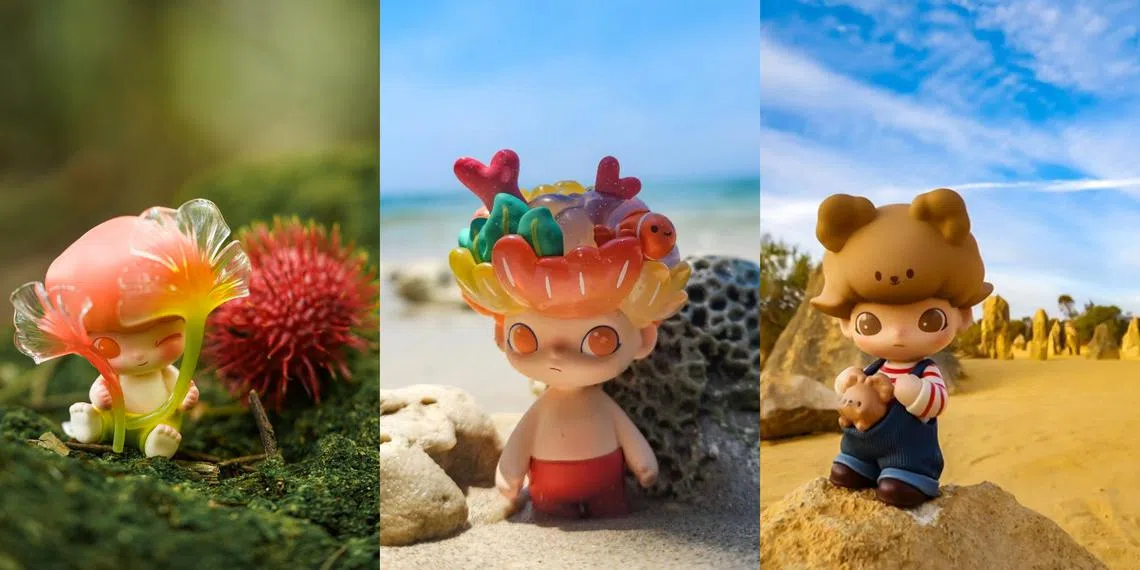
For Chan Wan Ting, 25, who is another collector of blind boxes, more than a third of her collection of 40 figurines were gifts from others. Most of her collection are figurines from Pop Mart’s Dimoo IP, while she also has collectables from other brands.
“They probably realised that I liked this particular character from Pop Mart, so it was an easy gift to give,” says the animal researcher.
Behavioural shift of consumers
The buzz within the toy community may have shifted consumers’ perception towards these blind boxes in general, note observers.
For Singapore-based toymaker Mighty Jaxx, the different companies in the blind-box market have educated the consumer base about collectables and the hobby of collecting, says Victor Tan, chief investment officer.
“(The large players) are helping to make our industry more known, because collecting is a learnt habit. It is not something you’re born with; someone has to help the consumer base understand this idea of collecting,” explains Tan.
Mighty Jaxx started off as a designer toymaker, targeting the mid-to-high market segment with its figurines that can cost hundreds and thousands of dollars.
In 2015, it started producing blind boxes that cost around US$10 to US$15 each, to appeal to the mass market.
Today, these blind boxes are its key revenue drivers, accounting for around 70 per cent of the company’s revenue, in part due to its aggressive expansion in the segment.
“We started mainly to expand the types of product lines we have, and it also allows us to reach a much larger fan base,” Tan says.
“Blind boxes are a sort of low-hanging fruit – it’s affordable, I can put it into as many retail stores as possible, and it’s also very relatable,” he adds.
To expand its reach, Mighty Jaxx works with known IPs such as Sanrio, Disney and One Piece, but adapts them to the company’s signature styles.
“These are IPs that people know, at a price they can afford, so we are using that to expand our market aggressively,” Tan says.
Making use of known IPs is a good way to capture fans who are otherwise agnostic to the makers behind a blind box.
This is why a brand such as Pop Mart calls itself a manager of IPs, where its core business is to create a following for its own designs and franchises, says its go-to-market director Lee.
“Once you get the IP right, then the products that you can churn out from the IP are up to your imagination – it could be blind boxes, pendant plushies, video games, even animation,” he notes.
Shi Chu Ying, 31, who started buying blind boxes two years ago after being influenced by her colleagues, says she has bought from a variety of brands but prefers Pop Mart and Miniso’s Top Toy, as they produce styles that she is interested in.
“As long as the style appeals to me, I don’t care which brand it is – but Pop Mart and Top Toy are usually the ones with a wider range of styles,” says the graphic designer.
Gambling and regulation
The quick rise of the industry has caught the attention of authorities globally, who have started to crack down on the otherwise loosely regulated market amid negative side effects.
In China, where Pop Mart originates from, businesses are now banned from selling blind boxes to children under the age of eight years, while a guardian’s consent is required for older children.
In 2023, the authorities set new rules for blind-box sellers, which include the ban of certain products; prohibiting the use of blind boxes to engage in or disguise gambling activities; and the need for reasonable pricing.
In Singapore, the Ministry of Home Affairs in 2021 proposed a S$100 prize limit on mystery boxes, arcade games and claw machines – all of which are deemed as games with gambling elements.
In 2018, police told merchants to stop operating vending machines dispensing mystery items as they were deemed a form of public lottery, which is prohibited without a licence.
Says NUS adjunct lecturer Escobedo: “The blind-box economy is at risk of further regulatory intervention in South-east Asia… there are growing concerns about the parallels between blind boxes and gambling, particularly the potential for addiction and exploitation of young consumers.”
Escobedo notes that blind boxes can foster impulsive buying behaviours and create dissatisfaction when consumers do not get the desired item, leading to buyer’s remorse.
“For younger consumers, it may even encourage habits linked to gambling, and some may feel pressured to buy more to complete a collection,” he says.
He expects future regulations could focus on age restrictions, clearer odds disclosures, or even limiting the value and price points of blind boxes, while governments may also address counterfeit products and require transparency around product authenticity.
This could dampen the growth of the blind-box economy, particularly if the most profitable demographic – children and young adults – faces purchasing restrictions, he notes.
To combat this, brands will need to pivot, possibly by focusing on more adult-centric products or creating new forms of engagement, adds Escobedo.
The road ahead for blind boxes
Nevertheless, observers expect the market is here to stay.
While regulations might slow momentum, blind boxes could remain popular in niche markets or become more curated and premium, Escobedo says.
Insead’s Prof Dubois also notes that blind boxes offer different ways to connect with customers.
“People engage with or generate videos about blind boxes, which is a very effective way to do marketing as we move from a world where people approach brands less and less through words, (and) more and more though videos and visual content,” he says.
As for Mighty Jaxx, the company is aggressively expanding into North America and Europe, where the blind-box market is still in its early stages.
And with non-toymakers, the trend may continue to present opportunities to grow an audience – least for the brands that have tasted some success from blind boxes.
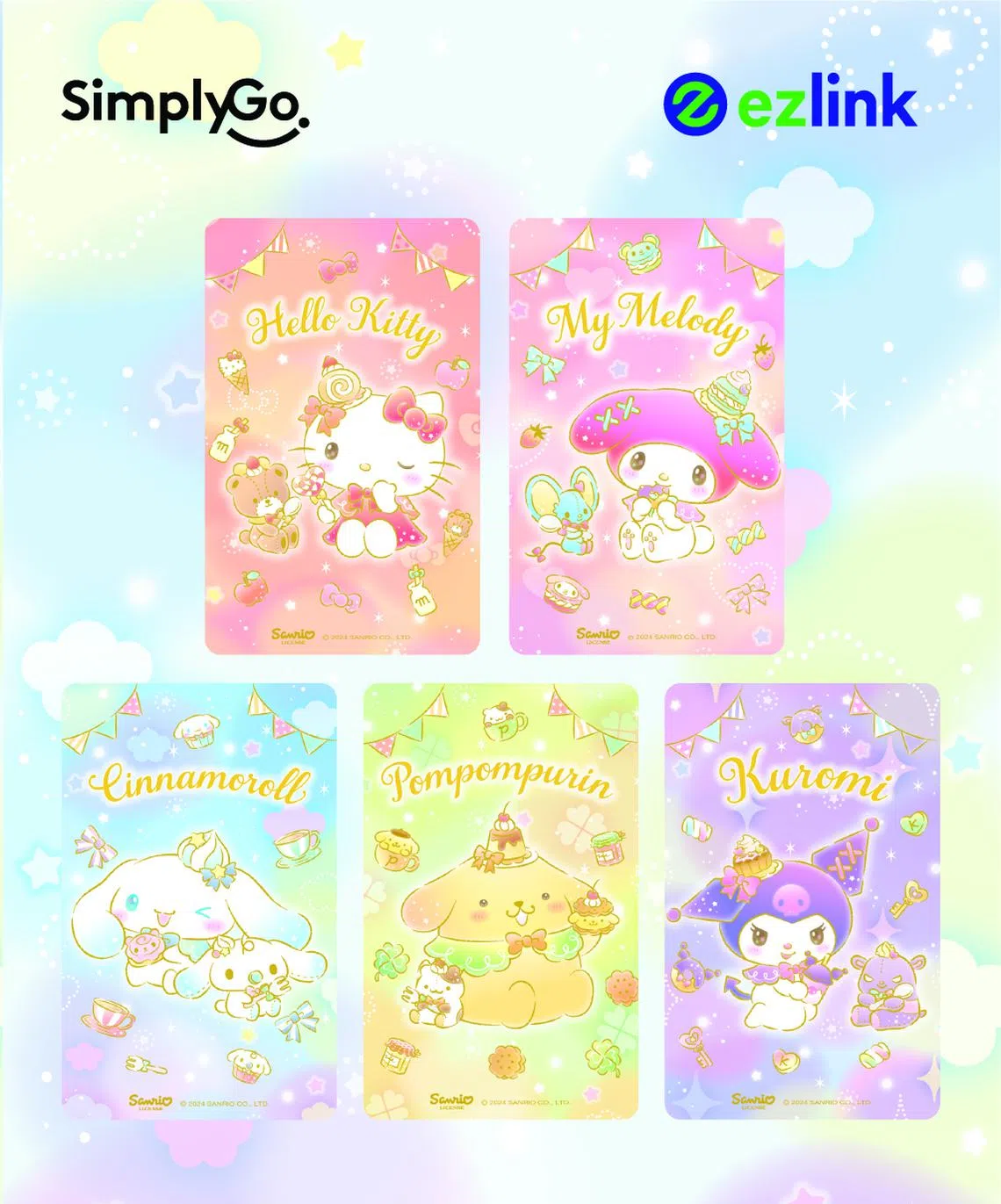
Travel card and ticketing service provider SimplyGo introduced its first blind-pack EZ-Link card series, featuring Sanrio characters, in 2021, to ride on the growing popularity of blind boxes.
Having launched another blind-pack series with Sanrio this year that was well-received by customers, the company says it will continue to expand the concept in the future, to include other card series and charm packs.
Kewpie’s Yee says the condiments maker also has a similar blind-box campaign planned for January 2025, as the company looks to capitalise on the trend while it is still popular.
Momentum Works’ Li notes that consumers may get used to any new concept after a while, making it harder to excite the same consumers with the same things.
“It will become more and more demanding for people to come out with things which consumers find exciting,” he says.
Nevertheless, he expects that the trend of brands adding an element of surprise and shareability into their products is here to stay for a while.
“Whether that’s manifested in a form of blind boxes or something else, I don’t know – maybe there will be a more advanced version of blind boxes in the future,” he says.
TRENDING NOW

From legacy to launch: Francis Yeoh and Yeoh Pei Xien on family unity and YTL’s next‑gen ventures

Things to know about DBS’ incoming chairman Anthony Lim

Wealthy Indonesians snap up government bonds as yields near 8%: OCBC

From local AI partnerships to global opportunities: How MNCs help Singapore firms scale

