Lagging China stocks may be an opportunity

Ben Paul
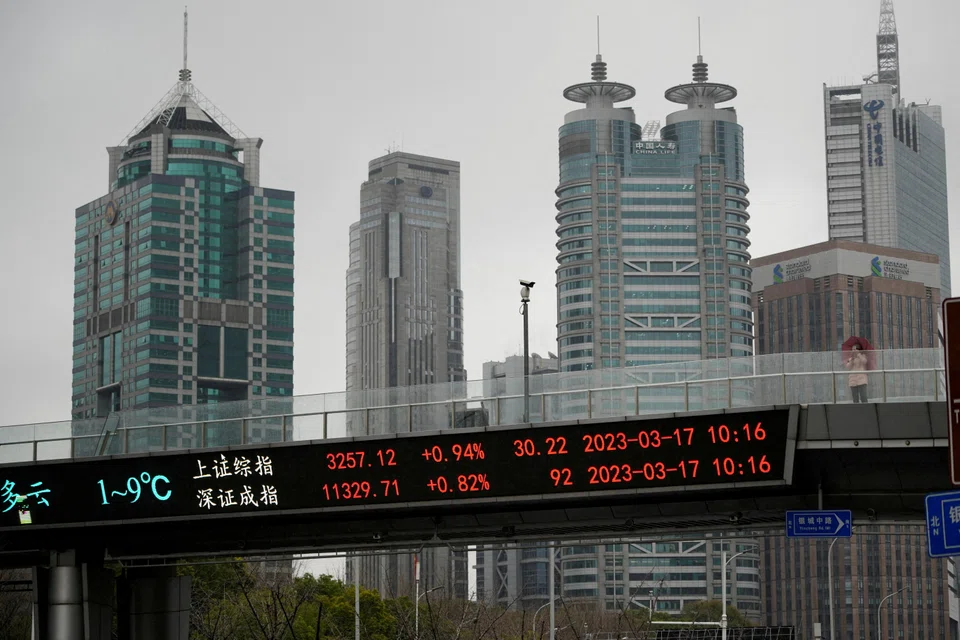
JUST before Christmas last month, China unveiled what seemed to be a fresh regulatory assault on the online gaming sector.
The raft of new proposed measures – aimed at curbing practices that encourage gamers to spend time and money online, among other things – sent share prices of companies such as Tencent and NetEase reeling.
For investors with exposure to China stocks, it was a disappointing end to a disappointing year.
At the beginning of 2023, many analysts and investors were expecting China to be a standout performer as it brought its zero-Covid policy to an end.
Instead, China stocks continued sliding from their peaks in 2021 as investors fretted about weak consumption, a real estate sector slump, geopolitical tensions, as well as seemingly authoritarian policymaking.
The CSI 300 Index delivered a negative total return of 9.1 per cent in 2023, after chalking up a negative total return of 19.8 per cent in 2022.
The Hang Seng Index returned minus 10.5 per cent in 2023, and minus 12.6 per cent in 2022.
By contrast, the S&P 500 came back strongly in 2023 with a positive total return of 26.3 per cent after a negative total return of 18.1 per cent in 2022.
Closer to home, the Straits Times Index delivered a positive total return of 4.7 per cent in 2023, and 8.4 per cent for 2022.
This might be the wrong moment for investors to abandon China stocks, though.
For one thing, China stocks are relatively inexpensive after languishing for so long. The CSI 300 Index is trading at only 12.4 times earnings, while the Hang Seng Index is trading at 8.6 times.
The S&P 500 is trading at 22 times earnings.
China stocks also appear to be unusually cheap versus bonds. The CSI 300’s earnings yield (the reciprocal of its P/E ratio) of 8.1 per cent is now about 5.6 percentage points above the 10-year China bond yield of 2.5 per cent.
This stock-bond yield gap is said to rarely breach 5.5 percentage points; and, when it does, it is often followed by a strong recovery in stocks.
Low stock valuations alone are not sufficient to drive the market, of course. A key concern is that economic activity is sluggish.
China’s official manufacturing purchasing managers’ index (PMI) for December unexpectedly fell to 49, from 49.4 in November – marking the third consecutive month of a reading below 50 that indicates a contraction.
The official non-manufacturing PMI for December came in at 50.4, up from 50.2 in November. However, this reading was also below market expectations, said UOB’s global economics and markets research unit earlier this month.
“Overall, the December PMIs suggest that China’s economic momentum has stayed weak,” UOB said.
Heightened risk aversion in the midst of a real estate debt crisis might also be hampering the flow of credit in China’s financial system. Earlier this month, China’s largest banks were reportedly limiting interbank lending to their smaller peers.
Ironically, this could be an opportune moment for value investors. Faced with such frightening developments, China’s government may well be more inclined to set aside competing priorities and take more aggressive measures to support its economy and financial system in the months ahead.
Analysts are expecting China to continue lowering interest rates this year, and further cut its reserve requirement ratio. Targeted liquidity support to the financial system might also be on the cards.
Following the big sell-off in Tencent and NetEase, China has also been trying to walk back some of its tougher proposals to rein in online gaming activity. A top official overseeing China’s gaming sector has reportedly been removed from his post.
What does all this mean for investors? Maintaining some exposure to battered down China stocks could improve the risk adjusted returns of an investment portfolio.
Within the Singapore market, there are a number of exchange-traded funds (ETFs) that offer exposure to China stocks.
Among the more established ones is the XTrackers MSCI China UCITS ETF. The S$1.74 billion ETF is exposed to more than 700 stocks and counts Tencent, Alibaba, China Construction Bank, Meituan and Baidu among its largest holdings.
A narrower play is the United SSE 50 China ETF, which tracks the 50 largest companies listed on the Shanghai Stock Exchange. Among them are Kweichow Moutai, Ping An Insurance, China Merchants Banks, China Yangtze Power and Jiangsu Hengrui Pharmaceutical.
Lion-OCBC Securities Hang Seng Tech ETF is a more specialised technology-focused play. It tracks the 30 largest technology companies listed in Hong Kong, including Xiaomi, Li Auto, SenseTime, EastBuy and Weibo.
A relatively recent addition to the local market is the UOB Ping An ChiNext ETF. Launched in Singapore in 2022, it tracks the 100 largest and most liquid A-shares listed on the ChiNext Market of the Shenzhen Stock Exchange – including Contemporary Amperex Technology, East Money Information, Shenzhen Mindray Bio-Medical Electronics, Shenzhen Inovance Technology, and Wens Foodstuffs Group.
The ETF was launched after a deal struck by SGX and the Shenzhen Stock Exchange in 2021 that enables Singaporean and Chinese investors to access feeder ETFs listed locally on each other’s exchanges.