Last rides and last rites: The rise of the limousine hearse
Luxury hearses have arrived as funeral traditions change and taboos surrounding death lessen

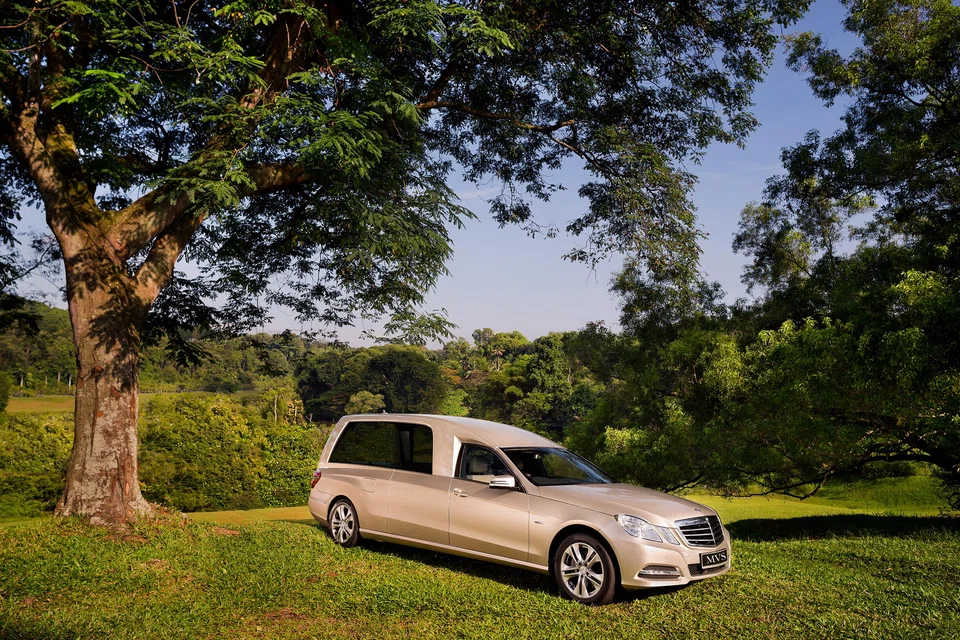
IT IS now commonplace for the dead in Singapore to take their final trip in a vehicle that costs half a million dollars or more.
These are highly-customised limousine hearses made based on luxury cars from brands including Mercedes-Benz, Jaguar and Maserati.
“When we first introduced our limousine hearse, clients would say ‘No need for luxury.’ Now they will say ‘Har, you give me (a) van hearse?’ if I offer them one,” says Ang Ziqian, managing director of Ang Chin Moh Funeral Directors (ACM).
The shift to luxurious hearses underpins the changing attitudes and expectations of people, who are less tied down to traditions and treat death as less of a taboo.
From bread vans to Benzes
Over the past decade, the number of limousine hearses based on luxury cars has increased and it’s no longer an unusual sight.
There is no official data on the number of these hearses in Singapore, but checks by The Business Times show there are at least seven currently in operation.
There are also two limousine hearses created based on Japanese cars from Toyota and Mitsuoka.
These hearses are slowly displacing van-based hearses and traditional “guan ta”, which are lorries decorated and used in traditional Chinese funerals.
A Singapore Casket representative says that around 40 per cent of their clients choose a limo hearse. The others opt for the company’s fleet of hearses based on Mercedes-Benz Vito vans, and only one or two clients per annum opt for guan ta, or decorated lorries.
ACM’s Ang says that a limousine hearses are a “norm” for funerals now and that 70 per cent of his clients choose one, while 25 per cent choose a van hearse, and only 5 per cent guan ta.
Two operators – Singapore Funeral Services (SFS) and Serenity Casket – say that the majority of their clients opt for a limo hearse.
They declined to provide a single price for limo hearse services, as the cost of the limo hearse is typically folded into a package.
Hock Koon Casket and Funeral Service’s website show they charge S$650 for the use of a limo hearse, compared with S$450 for a van-based hearse.
Singapore Casket was the first to use a limousine hearse here. Based on a Volvo S80, it was imported into Singapore in 2000.
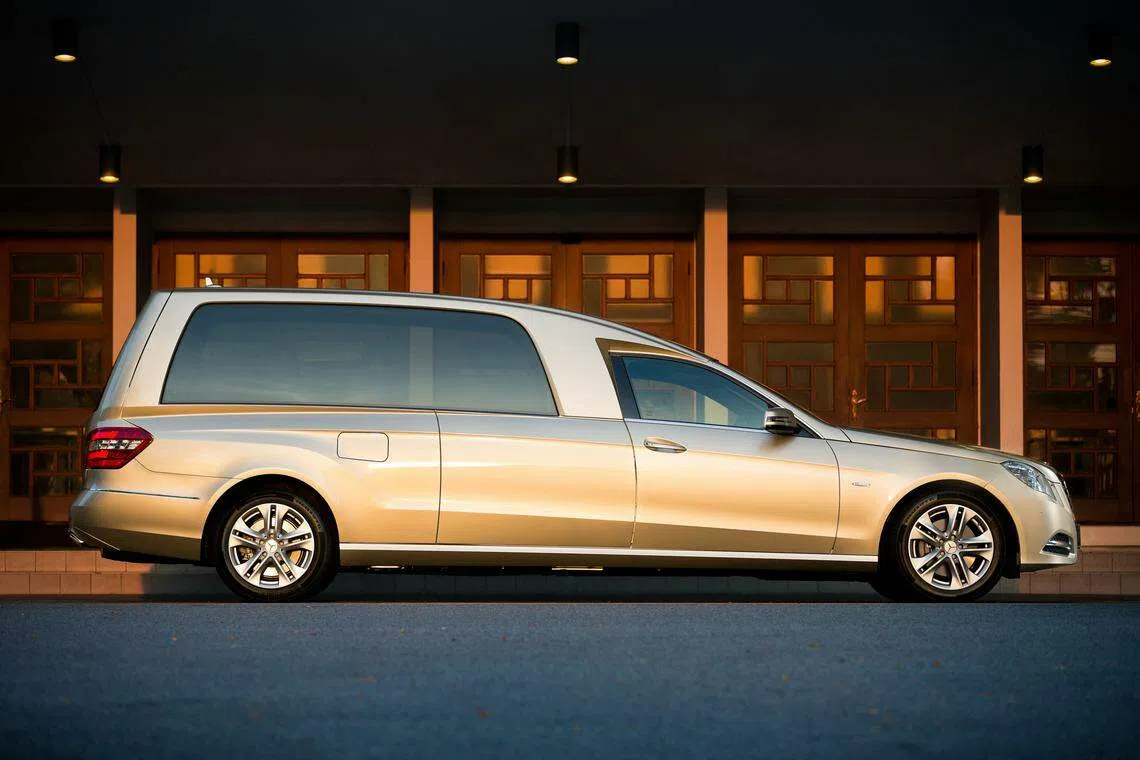
SFS’ founder Hoo Hung Chye says that his company was one of the first to import a luxury limo hearse in 2011, a Mercedes-Benz.
“At the time there wasn’t much competition, so we couldn’t gauge market acceptance. But once you see your competition start to bring in their own limo hearses, like now, that means it’s been accepted by the market,” he says.
The funeral directors interviewed by BT cater mostly to Christian, Catholic, Buddhist, Taoist and non-religious denominations, and their hearses are sometimes leased to smaller operators as well.
In the past decade or so, they replaced their fleet of vans with limo hearses to reflect changing demand.
For ACM’s Ang, manpower issues and fleet economics were also factors.
His company switched from a fleet of around 10 van hearses a decade ago to a single Mercedes-Benz hearse now.
Van hearses were modified locally, but it became more difficult over the years to find skilled workers to carry out the work, so importing a limousine hearse as an alternative was a natural move, he says.
His decision was also driven by rising costs in fleet management, including Certificate of Entitlement premiums, high operating costs and lower utilisation.
The lower usage of hearses ties in with a decreasing number of burials and an increasing number of cremations. Burials take more time, he says, so hearses can make fewer trips per day.
Repairs and maintenance for hearses can cost up to 50 per cent more than normal vehicles, as few workshops are willing to handle them on grounds of superstition.
“Even if we go to a car wash and offer double the money, they refuse to do it saying ‘I won’t wash a dead man’s car (si ren che)’,” says Ang.
I ain’t superstitious
But industry observers say that public attitudes towards funerals and death have changed, and funerals have become less traditional and more influenced by both Western culture and practices in other Asian countries.
Dr Lye Kit Ying, senior lecturer at Singapore University of Social Sciences (SUSS), says that a lack of awareness of funeral or death traditions – such as guan ta – from the younger generations also contributes to the preference for most “Western-style” hearses, which in turn affects the demand of traditional hearses.
Dr Lye, who is also principal investigator on the National Heritage Board’s Heritage research grant project “Chinese Funeral Practices in Singapore”, adds: “We’ve learnt and observed that there is an increasing preference for minimalist or clean funeral setups and aesthetics. The declining number of craftsmen who could build elaborate hearses also means that there are fewer of these more traditional vehicles in circulation.”
The decision to introduce a limo hearse was to acknowledge the changing demographics and cultural dynamics shaping funeral customs, says Elson Chong, who founded Serenity Casket in 2009.
“I think it’s evolved through the years… death is no longer a taboo topic. That’s when you can start to have a different way of thinking. Clients now want to incorporate more luxury and to be a bit different from others,” adds Chong.
When he first started out, a funeral was “just a funeral with a casket” but now clients have numerous requests and will shop around depending on the level of service provided.
Luxury hearses are just one of these aspects, which can now include video montages and even food or wine tasting.
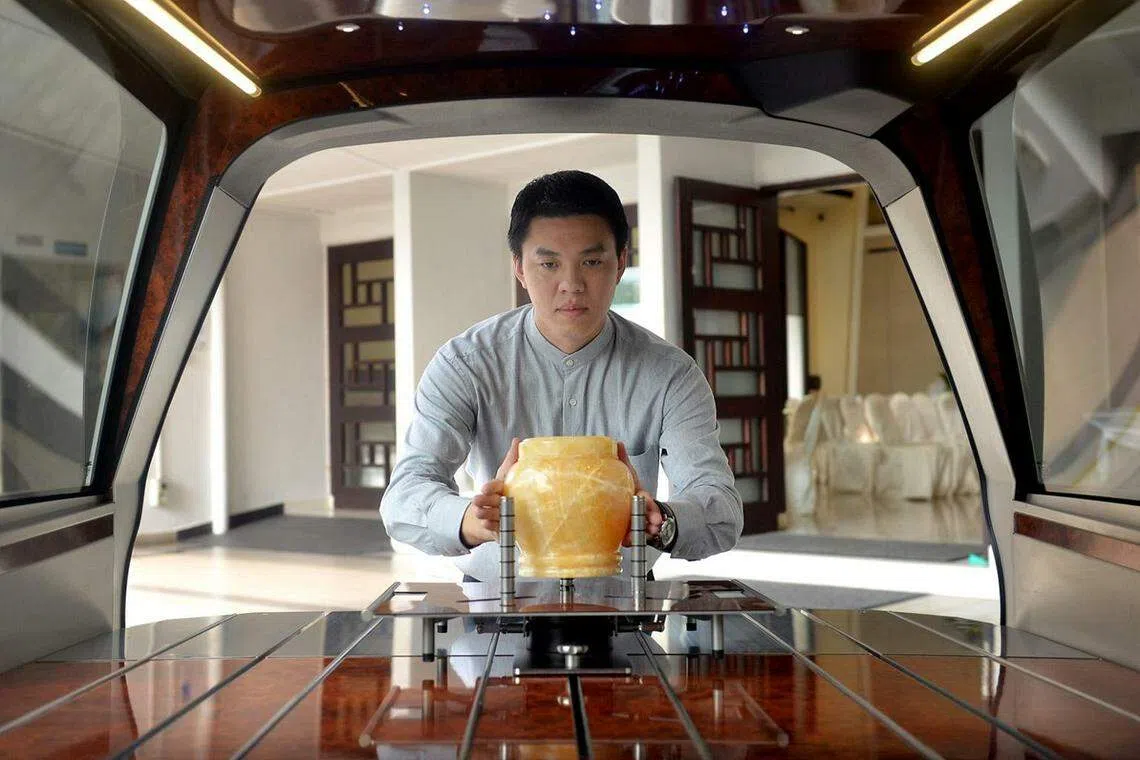
ACM’s Ang says that his company’s adoption of a limo hearse in 2013 was part of its decision to offer more comprehensive services for its clients.
For example, in 2010, it took over the operation of the Mount Vernon Sanctuary funeral parlour and began to offer air-conditioned halls, with private rooms and amenities for the bereaved.
SFS’ Hoo says that limo hearses are an example of how funeral operators have taken cues from other service industries and regions to evolve their own business.
He saw how Singapore’s airlines and hospitality industries enjoyed international success in the 2000s, and also observed funerals in Japan, Hong Kong, Malaysia and Taiwan.
“We realised that (funerals) can actually be done better, we emulated some of their practices and brought up the standards, improving the dignity for the family and the deceased,” he said.
He cites the examples of the early 2000s, when it was still common for undertakers to wear shorts and slippers. Now they wear blazers or a shirt, and clients can now opt for more elaborate setups that include Wi-Fi and coffee machines.
Luxurious last rides
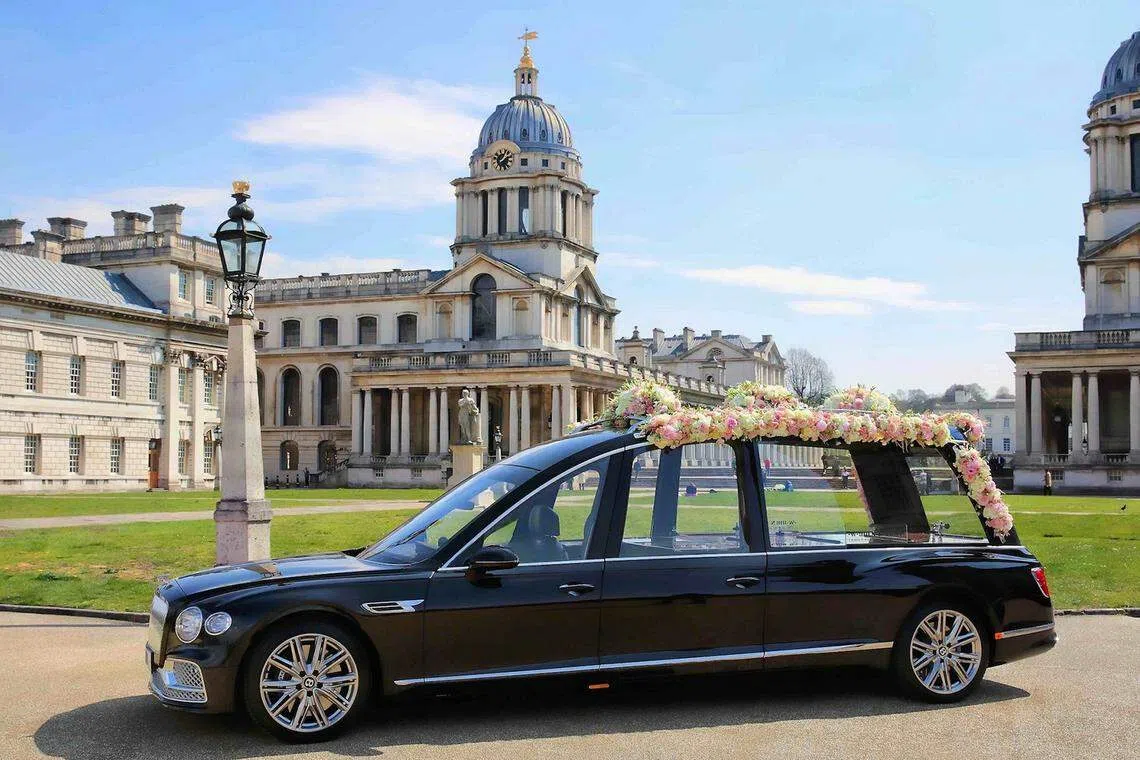
But there is also a deeper link between limo hearses and luxury: coachbuilders.
These are specialised car manufacturers that create custom bodies based on existing automobile chassis.
As the extensive modifications require similar skills and expertise, many coachbuilders that create ultra-luxurious stretch limousines also build hearses.
These include Binz from Germany as well as Duffy Coachbodies and Wilcox Limousines in the United Kingdom.
Founded in 1948, Wilcox manufactures stretch limousines and limo hearses based on cars from various brands, including Bentley, Mercedes-Benz and Jaguar. The company built the Jaguar hearse used in the funeral of Queen Elizabeth II.
Penny Wilcox, head of finance and administration for Wilcox Limousines, says it takes around 1,200 to 1,500 hours per vehicle, with a six to eight-month waiting time.
In contrast, a typical mass-produced car takes 15 to 30 hours to make.
The entire rear section is customised to accommodate a coffin, large glass panels for viewing, wooden veneer and interior lighting, and an electric-powered loading mechanism.
Funeral services companies BT spoke to say a limo hearse typically costs at least S$500,000 in Singapore.
In an era where a Mercedes-Benz large sedan costs around S$400,000 and a Rolls-Royce around S$2 million or more, this is not a particularly high price by luxury car standards.
But that is because they are registered as commercial vehicles and avoid the higher Additional Registration Fee taxes levied on luxury cars.
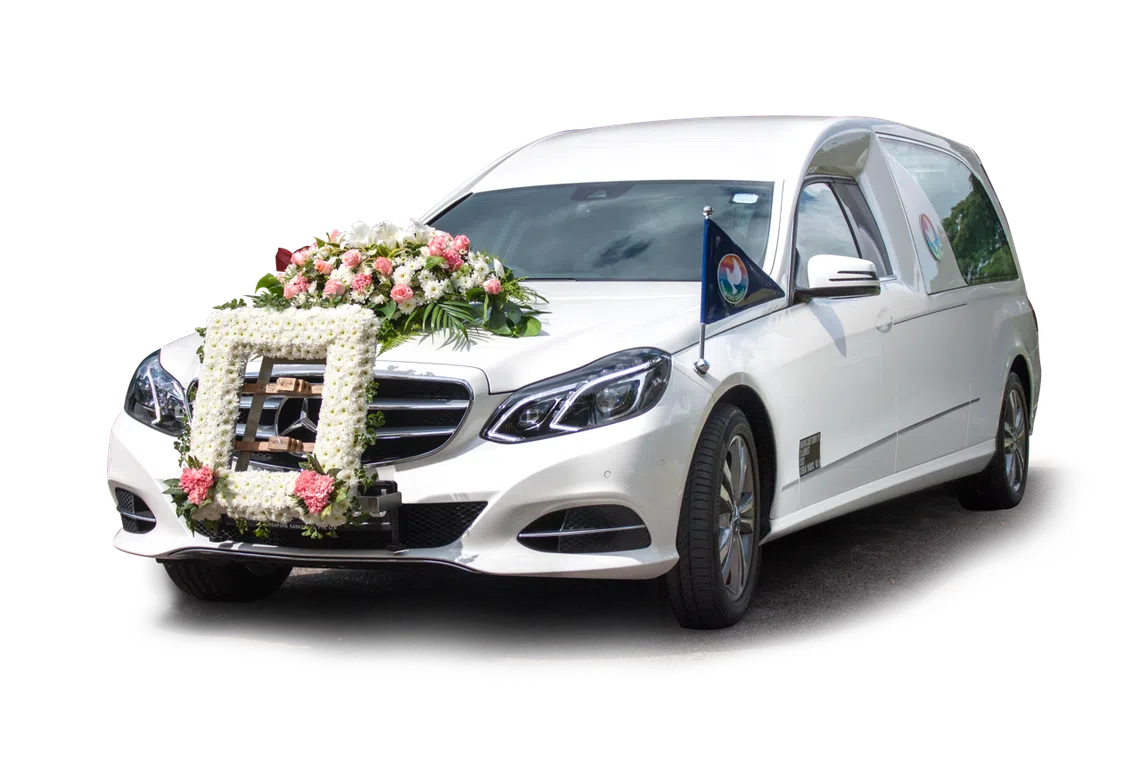
Still, they are likely among the most expensive commercial vehicles in their size and weight category, and at least five times more expensive than a van.
Limo hearses based on Mercedes-Benz sedans are still the most common, with at least four such vehicles in operation here.
Mercedes-Benz has consistently been the top-selling luxury car brand in Singapore in the past decade, and never been out of the top five in overall car sales in that period as well.
Funeral practices reflect trends in mainstream culture, says Dr Lye.
“We’ve learnt in our research that offerings made at funeral wakes or Qing Ming are often influenced by contemporary tastes and even pop culture. Mercedes-Benz cars in some ways, have been associated with success and affluence – and that is something many would want for the deceased even in the afterlife.”
Different shades
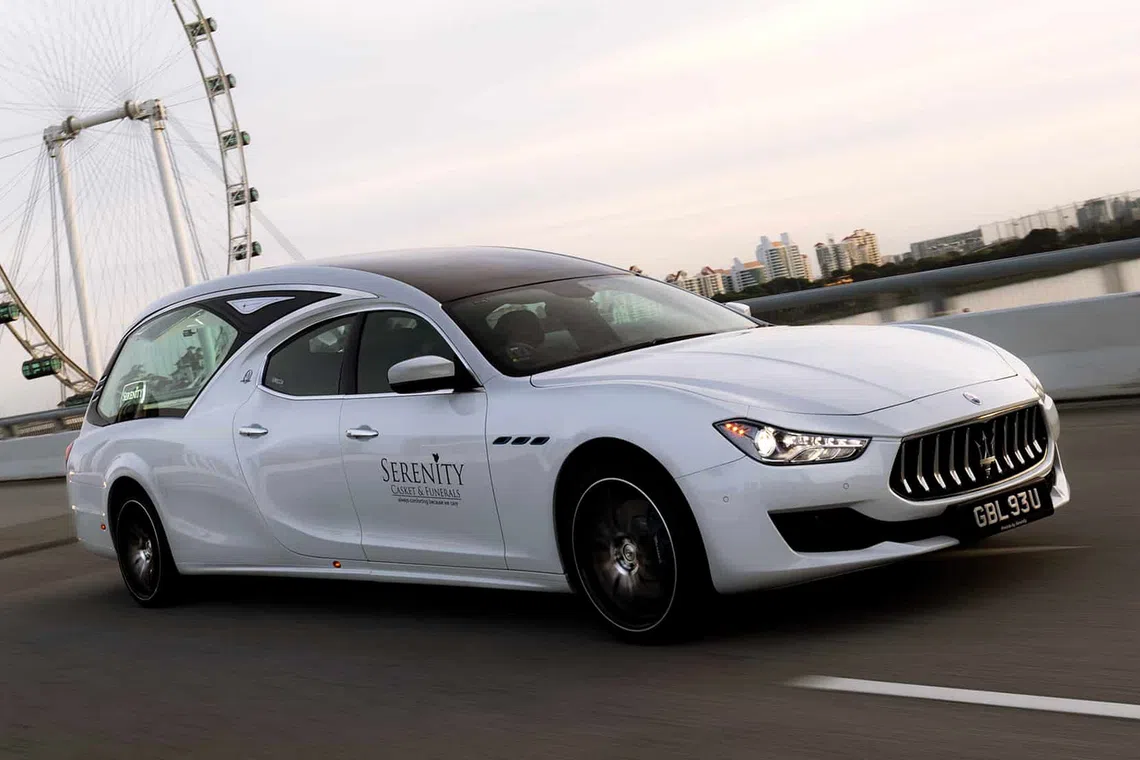
But just as Mercedes-Benz faces competition in the passenger car market, funeral operators are also testing new ways to stand out from the hearse limo crowd.
Serenity Casket, a relative newcomer to the industry (established in 2009), acquired a hearse based on a Maserati Ghibli sedan with a petrol-electric mild hybrid drivetrain in 2022.
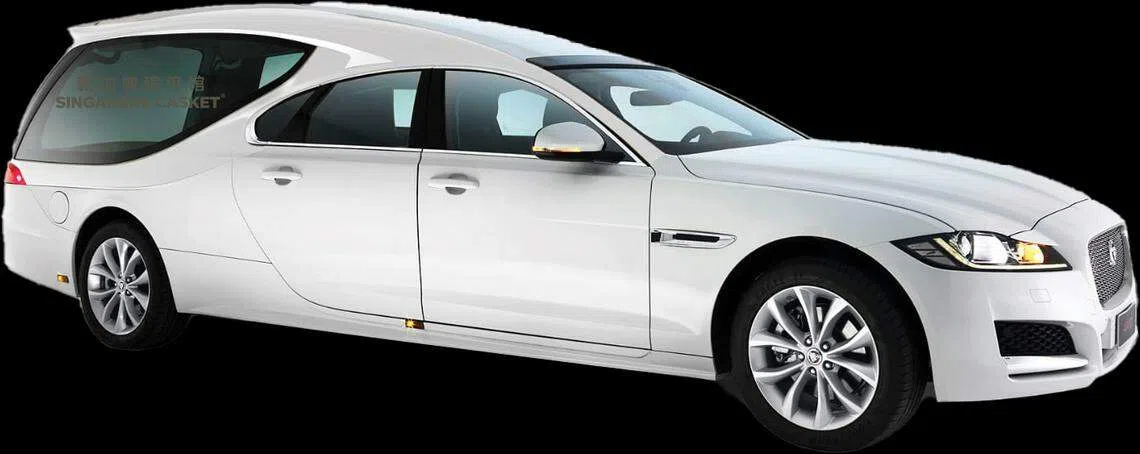
Meanwhile, Singapore Casket has a limousine hearse based on a Jaguar XF sedan from a similar time period.
Serenity Casket’s Chong says that the Maserati hearse first came to his attention after he saw the funeral of Italian footballer Davide Astori in 2018, and had received requests from a number of clients for something other than a Mercedes-Benz.
“We thought, why not get something a little bit different? It was also a hybrid, and we noticed that there weren’t many (Maserati) hearses in South-east Asia… so we could deliver a little more exclusivity to our clients,” said Chong.
Hearses based on electric vehicles – such as Teslas or Mercedes-Benz EV models – are being produced by coachbuilders abroad, but local funeral operators are not entirely convinced to make the switch yet because of range concerns.
The Singapore Casket representative says hearses are often required to travel long distances and can do two to three trips a day, so EV range and charging times are still a worry.
But we could see different types of hearses in future. With an ageing population, there is still scope for the funeral industry to expand.
In 2023, Singapore’s total deaths increased 35 per cent to 26,888, from 18,938 in 2013. (see Amendment note)
According to the Accounting and Corporate Regulatory Authority, there were 589 registered companies in the business of funerals and related activities in Singapore at the end of 2023, up from 507 at the end of 2020.
While the style of pomp and circumstance has changed dramatically from guan ta to limousine hearses, the sentiments driving them have not.
SUSS’ Dr Lye says that in the case of the Singaporean Chinese, they believe that the same care and gratitude provided by their parents should be reciprocated and repaid even after the parents have passed on.
“Ways of displaying this filial piety have expanded from performing the proper rites to providing elaborate funerals, so that the deceased can be sent off in a grand and respectable fashion within the children’s economic means,” she says.
This was echoed by SFS’ Hoo. “It’s still in the older generation’s psyche: ‘When I succeed, I want to get myself a Mercedes-Benz.’ So maybe when it comes to the end of life, it’s something their children try to fulfil for them,” he adds.
Amendment note: The figure has been updated to reflect the correct figure of Singapore’s total deaths.