

Local banks not recession-proof, but long-term growth prospects look good
DBS, OCBC and UOB benefit from rates staying relatively high for a prolonged period, which helps to sustain their net interest margins

Leslie Yee
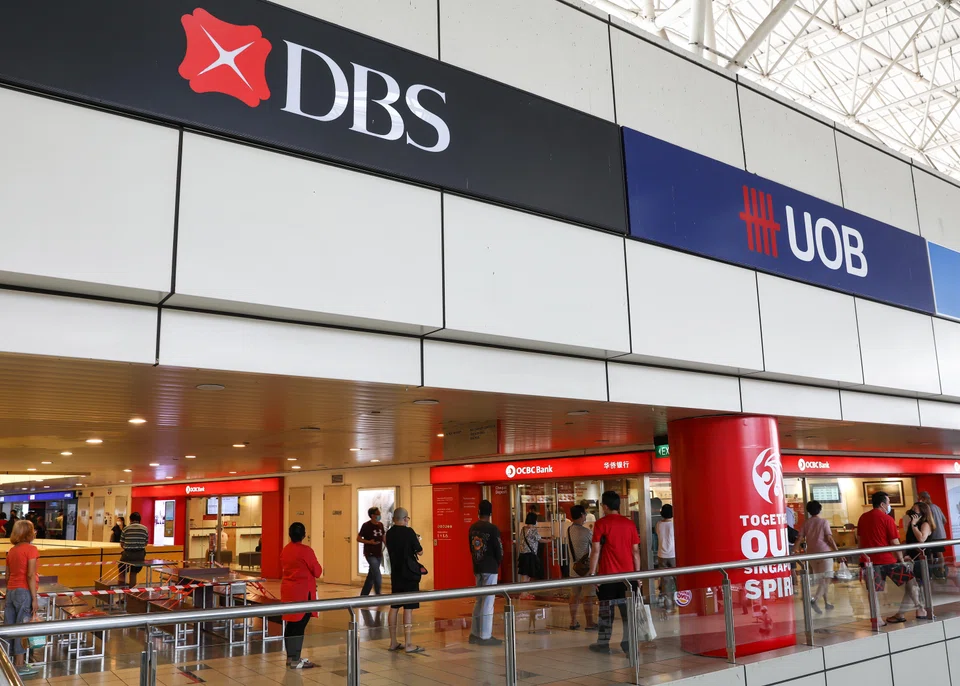
IN THE long run, staying invested in the equities market can pay off. Economies will grow as populations expand, and technological advances spur productivity gains. As consumer spending rises, businesses can enjoy profit growth.
While timing the market is tricky, buying Singapore equities merits serious consideration.
Singapore-dollar denominated investments enjoy the strength and stability of the currency. Many companies here serve a stable and wealthy home market, as well as faster-growing Asian markets.
In looking for high-quality businesses to invest in, one can consider the trio of Singapore banks – DBS , OCBC and UOB . The ultra-rich setting up family offices here, who are buying Singapore-listed equities to meet the criteria to qualify for permanent resident status, should look at the trio.
The banks benefit from rising interest rates. If the interest earned on loans rises faster than that paid on deposits, the net interest margin (NIM) of a lender expands.
Helped by strong growth in NIM, the trio prospered in 2022. DBS posted net profit of S$8.2 billion for 2022, up 20 per cent. Between the fourth quarter of 2021 and Q4 2022, the bank’s NIM grew from 1.43 per cent to 2.05 per cent. DBS’ board proposed a higher final dividend as well as a special dividend.
UOB’s net profit, including one-off expenses, rose 12 per cent to S$4.6 billion for 2022. The lender’s NIM was 2.22 per cent in Q4 2022 versus 1.56 per cent in Q4 2021. UOB’s total dividend for 2022 of S$1.35 per share exceeds the S$1.20 per share paid out for 2021.
For 2022, OCBC posted an 18 per cent growth in net profit to S$5.7 billion. The group’s NIM rose 79 basis points between Q4 2021 and Q4 2022. OCBC’s shareholders will receive a higher dividend for 2022 than in 2021.
Recession risk
However, the current environment of rising interest rates may not be all benign for banks. The Federal Reserve in the United States has been hiking interest rates to fight rising inflation.
Higher borrowing costs hurt businesses and consumers, as well as slow economic growth. Banks are affected if the economy contracts. The loan book may shrink and existing loans could turn bad when customers default on their loan repayments.
The three local banks are not immune from the effects of worsening credit conditions if the US leads the world into a recession. When banks fail in the US or elsewhere, ripples can be felt in the financial system here.
Still, the Singapore government has the tools to help businesses and individuals cope with slowing economic growth. And the financial system here is robust.
Moreover, the economic growth prospects of some Asian countries, including South-east Asian nations, appear brighter than for the US or Europe.
In recent years, trade agreements among Asian countries and between Asian countries and non-Asian partners have been expanded and strengthened. Many Asian companies have continued moving up the value chain and many Asian countries continue to see growing foreign direct investment.
Banks play many roles such as helping the community, championing sustainability, promoting diversity and fighting climate change. They are heavily scrutinised over their anti-money laundering efforts and safeguarding of customers from scammers and hackers.
Right geographic exposure
Nonetheless, what matters greatly to investors is that banks prosper largely by being intermediaries.
Banks win by helping business customers grow their businesses, and helping individuals grow their wealth. Banks which focus on the right markets will thrive as their clients prosper.
The markets of Singapore, South-east Asia and Greater China are key drivers for the banking trio. Deals were struck in 2022 by UOB to buy Citigroup’s consumer banking assets in Indonesia, Malaysia, Thailand and Vietnam, and by DBS to buy Citigroup’s consumer banking business in Taiwan.
The markets of Singapore, South-east Asia and Greater China offer solid growth opportunities.
Singapore is growing rapidly as a wealth-management hub. More wealthy families, not only from Asia but also from elsewhere, have set up family offices here.
Singapore secured a record S$22.5 billion in fixed-asset investment commitments last year. Taking confidence from Singapore’s safe-haven reputation, businesses are encouraged to grow their operations here.
Some South-east Asian economies are also gaining from supply-chain reconfigurations that reduce the reliance on China. The services sector, including tourism, is bouncing back in various South-east Asian countries amid relaxation of Covid-related restrictions.
In aggregate, the economies of the 10 Asean countries could be the fourth largest in the world by 2030, after the US, China and the European Union. The region houses a growing educated and young workforce, and an emerging middle class, with 60 per cent of its population aged 35 or younger.
Riding on positive demographic tailwinds, Asean’s share of global gross domestic product will likely grow.
Also, South-east Asian economies may gain from being courted by the two giants, US and China.
China’s economic growth is slowing substantially relative to the nearly double-digit pace it has achieved on average over the past four decades since the country opened up in 1978. Still, the world’s second-largest economy offers opportunities for banks.
Singapore banks can assist Chinese businesses in their regional growth ambitions. In the Guangdong-Hong Kong-Macau Greater Bay Area, Singapore banks can serve various small and medium-sized enterprises.
The growing wealth and sophistication of individuals in China offers opportunities for Singapore banks to work with Chinese partners to grow in consumer finance.
With the relaxation of movement restrictions and access to credit, China’s economy could bounce back strongly later this year.
The three local banks have a good track record in paying dividends. Dividend yield is decent – for example, OCBC traded at dividend yield of about 5.6 per cent based on its share price as at Mar 13. Also, trading liquidity in the shares of the three banks is good.
The banks are well-capitalised. They are headquartered in Singapore, which has robust regulations, and are investing heavily in technology to prepare for a disrupted future.
With attractive geographic footprints and strong governance, the local banks tick the boxes for investors seeking high-quality businesses in a tough investment environment.
Crucially, unlike many other businesses, the trio can gain from interest rates staying relatively high over a prolonged period, as this helps sustain high NIM.
The writer holds shares in DBS, OCBC and UOB.






