

Local property giants should aspire to pan-Asean leadership
The home market is mature and China real estate has its challenges

SINGAPORE’S property market is generally seen as stable. Projects have large gross development values that can make meaningful contributions to businesses. And housing developers look to sell out a large proportion of units off-plan way ahead of construction completion.
Still, limitations exist. The private housing market serves a fairly small catchment as Singapore’s population is tiny compared with many countries, and close to 80 per cent of resident households live in public housing.
Hence, property groups venture abroad to diversify as property cycles may vary across countries, as well as to scale up their business. Several leading players here built China as a core market and prospered as its economy transformed, households grew richer and there was rapid urbanisation.
China exposure
Temasek-linked CapitaLand Ltd had China, including Hong Kong, contributing 37 per cent of its total assets as at end-June 2021, and 52 per cent of earnings before interest and taxes for the first half of 2021. CapitaLand Limited has since been split into listed CapitaLand Investment (CLI) and unlisted CapitaLand Development (CLD).
Recently, CLI said it aims for China contributions to be 10 to 20 per cent of its targeted S$200 billion in funds under management (FUM) by 2028, compared with about 27 per cent of its FUM as at Nov 21, 2024.
Other Temasek-linked entities – Keppel and Mapletree Investments – have also been active in China’s property market for years. Groups such as GuocoLand and Metro have made large investments in the country’s property too.
However, looking ahead, the Chinese property sector may not be a dependable growth engine for local property groups. Resolving China’s housing market problems can take years. And prospects for Chinese property could be muted given an ageing and falling population, as well as slower economic growth.
Why Asean
Perhaps, local property groups should do more to grow Asean as a core market. Emulate banking group UOB , which scaled up its Asean presence, with a transformative acquisition of Citigroup’s consumer banking business in Indonesia, Malaysia, Thailand and Vietnam.
Sure, no single Asean country has China’s population or economic size. Nonetheless, many Asean countries have young populations and are rapidly climbing the economic value chain. The bloc could be the world’s fourth-largest economy by 2030.
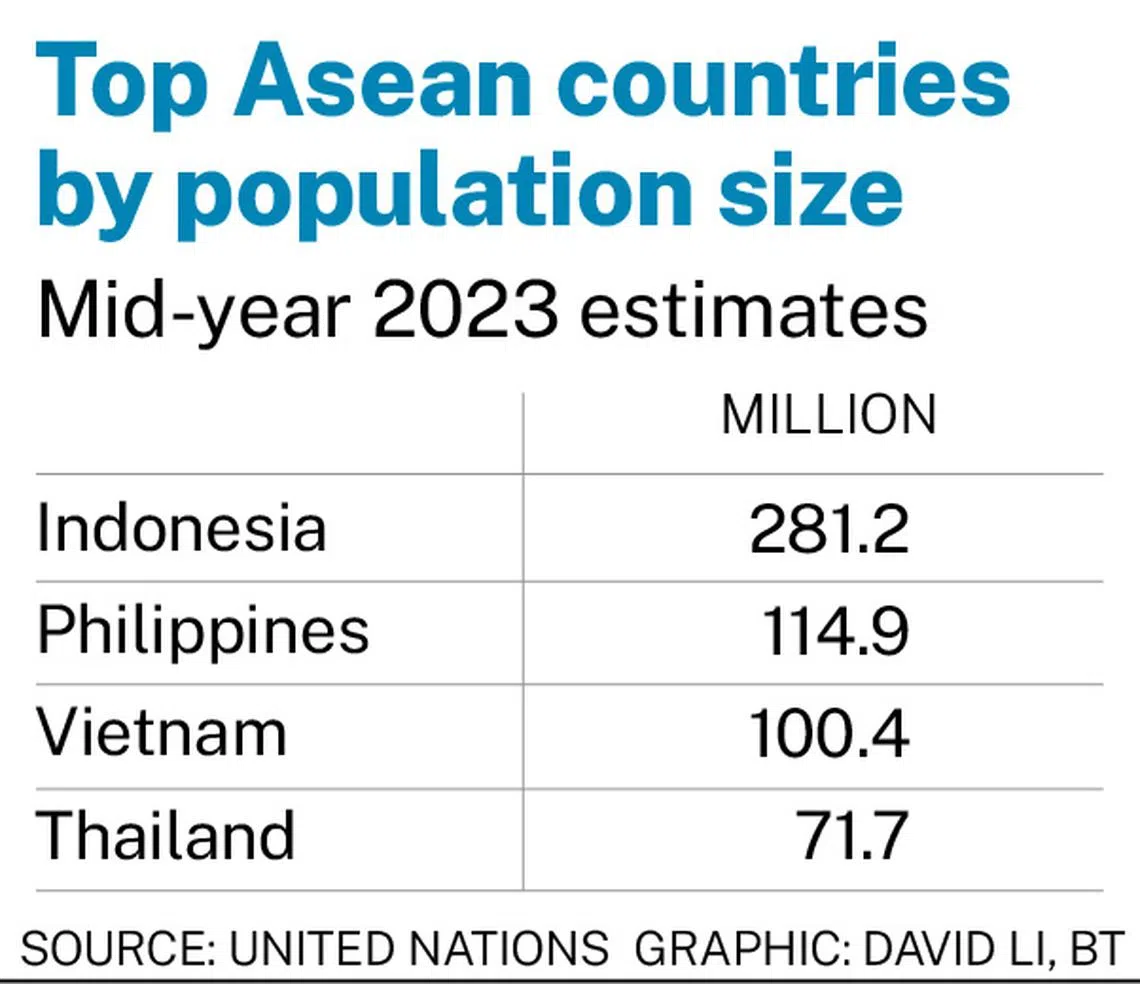
As it stands, some property groups are already active in certain Asean countries. CLD’s three core markets are Singapore, China and Vietnam. Keppel has also been operating in the Vietnam property market for years.
Frasers Property is active in Thailand. For example, it partnered its shareholder TCC Assets to develop the mega One Bangkok project in the heart of the Thai capital. Meanwhile, GuocoLand is active in the Malaysian property market.
The challenge for a Singapore property group is to be a pan-Asean leader. In turn, rich rewards await a group that is dominant across key Asean markets such as Indonesia, Malaysia, the Philippines, Singapore, Thailand and Vietnam.
One, pursuing property development in other Asean countries neatly complements doing property development and owning investment properties in Singapore.
The housing market here is stable and profit margins from development are generally thin. Meanwhile, investment properties here offer low yields but enjoy ample liquidity. On the other hand, one can target large volumes when building homes in some neighbouring countries and possibly fatter profit margins, although such markets could be more volatile and less transparent than Singapore.
Crucially, equity investors seeking to play Asean’s growth story might ascribe a valuation premium to a leading pan-Asean property group.
Two, a property group that leads across multiple Asean markets can enjoy a competitive edge.
For example, a multinational corporation may like to get a one-stop real estate solution for its office, warehouse, research and manufacturing facilities across various Asean locations. As many local and foreign businesses here prioritise growing in Asean, a party who can be the real estate partner of choice for such businesses could be well-rewarded.
Gaining an in-depth understanding of consumer behaviour in other Asean countries might help an owner of malls here better serve the needs of retailers and shoppers. Also, hotel owners who operate across multiple Asean countries can better leverage growing intra-Asean travel.
Three, a property group with strong Asean footprints will better attract and retain talent as it can offer varied and interesting career development opportunities. After all, bright and motivated young people in the region may seek to pursue careers that ride on Asean’s growth.
In turn, the right talent might better position and manage property assets, thereby generating stronger financial returns.
Four, growing capabilities across multiple key Asean markets makes much sense for a property group that is strong in Singapore.
As Asean capitals are generally easily reachable from here, Singapore-based management can commute efficiently to monitor operations and grow local relationships in Asean countries. Business can also benefit from the government’s efforts to strengthen ties with these countries and ease barriers to doing business within the bloc.
In addition, a group that is able to scale up in several major Asean countries will have a large addressable market.
Joining forces
However, growing a pan-Asean property business is tricky as each market has its nuances. Various markets have dominant players, including tycoon-owned groups. And any leader in a specific market will be keen to protect its turf.
Still, groups who lead in different Asean markets should explore joining forces to create a dominant pan-Asean property player. They can cede some control in exchange for building a stronger platform to ensure long term success.
Property can be a capital intensive business and ultra-low interest rates are a thing of the past. Competition for talent is fierce. Putting aside egos and cooperating to thrive makes sense for leading property-linked tycoon families from different Asean countries.
Amid a mature home market and much dimmer prospects in China property, a Temasek-owned or tycoon-owned Singapore property giant should aspire to be a pan-Asean leader. Go seize real estate opportunities from urbanisation, rising income levels and economic transformation in Asean.






