Macron’s Asean trip showcases EU’s Asia pivot
His visit to Vietnam, Indonesia and Singapore, which follows previous trips to the region by other European leaders, including the Spanish prime minister in April
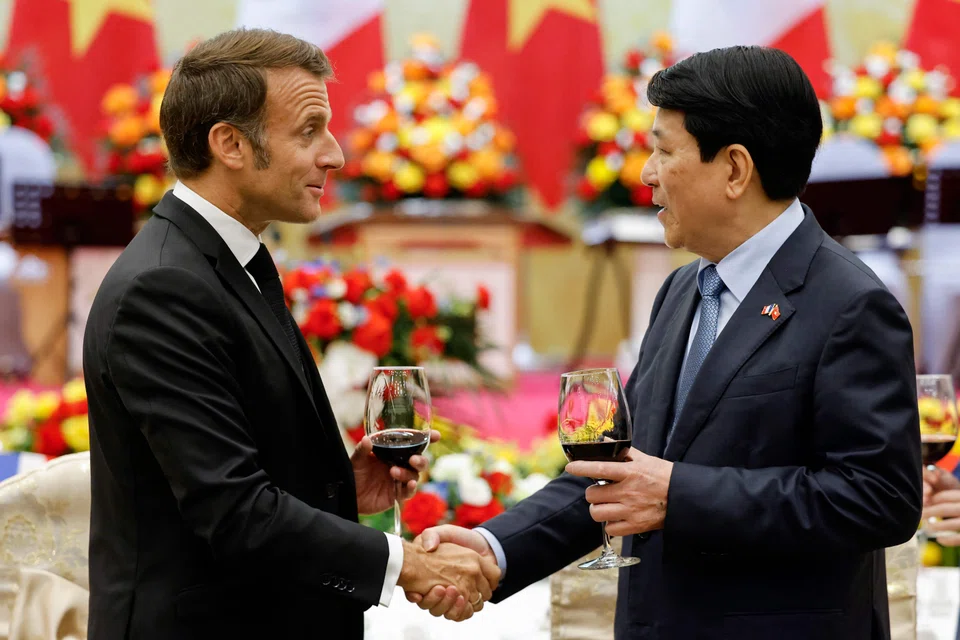
US PRESIDENTS since at least Bill Clinton have sought to re-orientate US foreign policy towards Asia. And more recently, Europe has sought to emulate this “pivot” to the world’s fastest-growing economic region, as showcased this week by French President Emmanuel Macron’s big trip to three Asean nations.
Macron’s visit to Vietnam, Indonesia and Singapore, which follows previous trips to the region by other European leaders including Spanish Prime Minister Pedro Sanchez in April, comes as the 27-member EU is under the threat of 50 per cent tariffs from the US President Donald Trump – now in abeyance following a weekend call between the American leader and EU chief Ursula von der Leyen. In any case, Europe is looking to bolster commercial ties in Asia, including diversifying supply chains.
The Asia and wider Pacific region is home to around three-fifths of the world’s population. It accounts for some 60 per cent of global gross domestic product, about two-thirds of global growth, around 40 per cent of the European Union’s total imports and, together with the EU-27, drives some 70 per cent of global trade too.
The big Macron trip began on Sunday (May 25) in Vietnam, the first visit by a French president there in about a decade. He wants to grow the existing 5.3 billion euro (S$7.7 billion) trade relationship with Vietnam, including in areas such as energy, technology and infrastructure, with Hanoi an increasingly important trade partner of Paris. Numerous business agreements have been signed on Sunday and Monday, including a power grid deal between the French Development Agency and Vietnam’s National Power Transmission Corporation.
In Indonesia from Tuesday, Macron will meet with both Indonesian President Prabowo Subianto and Asean Secretary General Kao Kim Hourn. The French president’s pitch to these two leaders is that France and Europe are defenders of the international rules-based order, in contrast to the Trump team’s approach in Washington.
Macron then moves onto Singapore, where his agenda includes speaking at the annual Shangri-La Dialogue, Asia’s top defence conference. Reportedly, he will argue that Russia is destabilising Asia by “making North Korean soldiers fight on European soil against Ukrainians and by supporting North Korea’s ballistic and nuclear programmes”.
Macron’s visit is only the latest European overture to Asia in recent weeks. The entire European Commission, including President von der Leyen, visited New Delhi recently to kick-start trade talks with India. In July, the EU will also hold its latest annual summit with China in Beijing.
The overall goal is to strengthen the partnership between the two regions based on mutual respect and equality, with respect to security, trade, global value chains, digitalisation, the green transition and energy security.
The EU’s underlying goal of engagement is to build a competitive advantage vis-a-vis other world powers. In von der Leyen’s first term as European Commission president, the Brussels-based club agreed on a new Asia-Pacific strategy to reinforce its strategic focus, presence and actions in this region of prime strategic importance. The aim is to bolster regional stability, security, prosperity and sustainable development, at a time of rising challenges and tensions in the region, in a bid to uphold democracy, human rights, the rule of law and respect for international law.
The EU’s approach and engagement have multiple goals. As Macron is emphasising this week, this includes seeking to foster a rules-based world order, an international level playing field, an open and fair environment for trade and investment, reciprocity, the strengthening of resilience, tackling climate change and supporting connectivity with Europe.
On the latter point, one reason that the EU is so keen to engage the Asia-Pacific more deeply is that it is at the cutting edge of digitalisation and technology. The EU has announced its intent to launch a regional branch for the Asia-Pacific region within the Digital for Development Hub with a view to fostering digital cooperation to support sustainable, inclusive digital transformation, plus new digital partnerships based on shared values and a common approach to a human-centric digital transformation
Outside of economics, free and open maritime supply routes in full compliance with international law are key, too. Europe is working increasingly closely with key partners in the Asia-Pacific on security and defence, including malicious cyber activities, terrorism, and organised crime.
Moreover, the EU has announced the extension of the concept of a coordinated maritime presence in the North-West Indian Ocean. This will allow the EU to further support stability and security in the Asia-Pacific, to optimise naval deployments, to promote coherence of European action and to facilitate the exchange of information and cooperation with partners in the region, including by conducting joint maritime exercises and port calls. Furthermore, the EU reaffirmed its determination to enhance its engagement in security and defence with partners in the region, for example, through strengthening its dialogues and bilateral relationships.
Beyond trips of individual leaders such as Macron, European intent towards the Asia-Pacific is manifest in the wider, growing number of EU annual conferences with key emerging market giants such as India, plus major industrialised nations including Japan. This is also already allowing the EU to make headway in the massive region.
One example is India, which forms the world’s two largest democracies with the EU-27 as a whole, with both keen to forge stronger ties. The Brussels-based club is already India’s largest single trade and investment partner, hence why the new proposed bilateral trade deal under discussion is a key potential prize for both parties. There are wider reasons behind converging interests, including a growing need to develop shared defence forums to discuss issues such as maritime security in the Indian Ocean, where two-fifths of bilateral trade passes.
Yet, important as Europe’s relations are with emerging markets, industrialised nations are important too. With Japan, for instance, the EU enjoys a growing agenda – for instance, the two powers have stepped up their leadership on international trade and the rules-based economic order.
Japan is one of Europe’s top export markets in the Asia-Pacific region. This agenda was given a fillip in 2019, when the EU-Japan Economic Partnership Agreement entered into force, covering around a third of global GDP and almost 650 million people. The accord took years to agree, and made headlines due to the scrapping of almost all duties on Japanese and European imports, respectively.
These examples showcase why Macron, von der Leyen and other key European leaders see such a big opportunity in Asia. The massive region is a growing priority for the EU as it tries to steal a march on others – not least the United States – to try and drive economic and political advantage in the next decade and beyond.
The writer is an associate at LSE Ideas at the London School of Economics