

Major surprise as French far right flounder and look to 2027
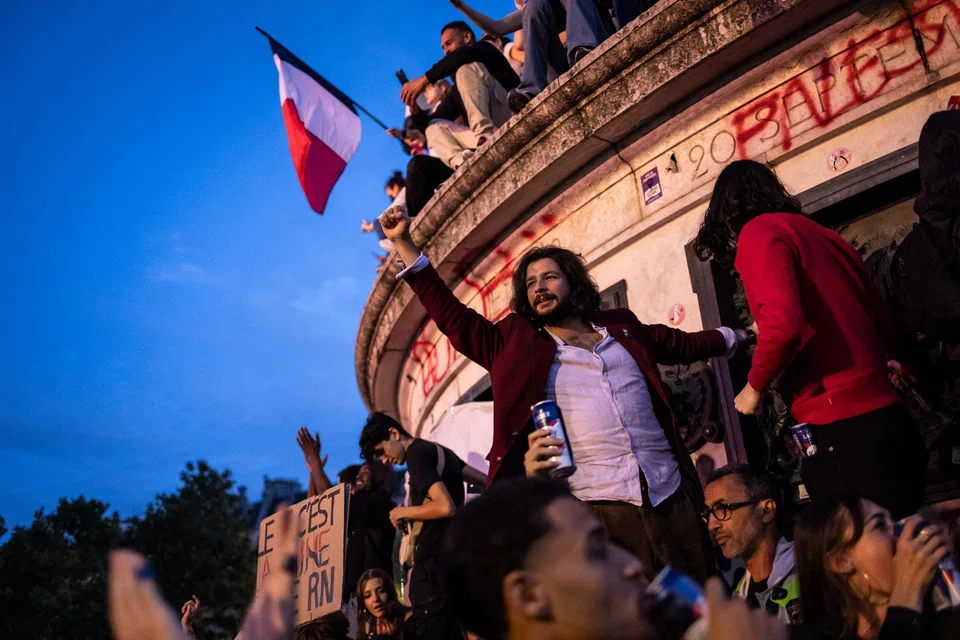
MANY French and international publics drew a big sigh of relief on Sunday (Jul 7) as the far right, pre-poll favourites National Rally (RN) finished third in the second round of voting. However, the country could still be consumed by political dysfunction with President Emmanuel Macron’s economic reforms probably derailed, and the RN potentially growing significantly in popularity ahead of the 2027 presidential election.
In a major plot twist, defying all the opinion polls, the left-green New Popular Front (NFP) alliance won the most seats on Sunday, albeit less than 200 in the 577-seat National Assembly. Macron’s centrist alliance finished second.
As late as Friday, opinion surveys indicated that the RN would probably comfortably emerge as the single largest bloc on Sunday, with warnings that the party was at the “gates of power”. However, this proved spectacularly wrong, and the huge uncertainty this has generated over France’s future governance may spook financial markets further in coming days.
What the result shows is the continuing power of what is known as the “republican front” in France. The design of the Fifth Republic, founded by Charles de Gaulle in 1958, has kept the far right largely on the margins of politics. In national elections, if candidates are perceived as too extreme, there is a still-powerful commitment by other parties to help each other to defeat the RN.
Last week, more than 200 candidates across the left and centre of the political spectrum withdrew their candidacies, to clear the path for whoever was best placed to defeat the RN candidate in each district. This appears to have decisively shifted the vote in favour of the NFP, even though it has fallen far short of a majority.
This voter shift towards the left seems also to have been strengthened by what was a very ugly election campaign. More than 50 candidates and campaign activists have been physically assaulted during the last four weeks, and 30,000 police, including 5,000 in Paris, were deployed at the weekend to head off violence.
While opponents of the far right are generally overjoyed by the result, it still provides a recipe for potential governmental instability, and no new election can be called for at least a year now. Moreover, Macron’s reform agenda for the French economy will now slow, if not come to a halt, with the national debt likely to rise.
Part of the reason why political paralysis may now reign is because of the very loose nature of the NFP coalition which might fragment in coming months, given the disparate and sometimes contradictory nature of the views held within that alliance, which includes the centre-left Socialists, Greens, Communists and hard-left France Unbowed led by Jean-Luc Melenchon, the ex-Trotskyite radical.
The Socialists and France Unbowed spent months attacking each other during last month’s European election campaign, and unlike the pro-Macron centrist coalition and RN, the NFP alliance did not put forward a name for who would be prime minister in the event of success.
At the time of writing, it is not clear what governmental outcome will ultimately materialise this summer. However, incumbent Prime Minister Gabriel Attal, who has offered his resignation, has also said he will stay on in post “as long as necessary” in a caretaker role, while Macron’s office is studying options to maintain some form of effective governance.
While the far-right RN is very disappointed by the result, there is a strong possibility that its popularity will now grow significantly ahead of the 2027 presidential election, in what is an increasingly polarised electorate.
France is one of only two big European Union nations, alongside Germany, that have not been governed by populists in the post-1945 era. But that could yet change with a victory for Marine Le Pen, who finished runner up to Macron in 2017 and 2022, in three years.
The RN’s surge since the last parliament election in 2022 is astonishing; it has clearly broadened its support beyond its traditional base along the French Mediterranean coast and the de-industrialised north, tapping into voter anger at Macron over tight household budgets, security and immigration worries.
In the first-round legislative elections on Jun 30, the party secured over 10 million ballots, more than a third of the overall vote share, compared to its tally of some 4.2 million ballots at the same stage in 2022.
Moreover, it should be remembered that the RN in 2022 leapt to 89 National Assembly seats from eight. Despite the poorer-than-expected result for the party on Sunday, it continued its momentum to get 142 seats.
The RN is already arguing that Sunday’s surprise election result is explained by the treachery of the political status quo, and that the system is fixed against it, in Donald Trump-style rhetoric, and this may only galvanise its support. RN president Jordan Bardella said: “Emmanuel Macron and Gabriel Attal’s alliance of dishonour with extreme-left parties has (robbed) the French people of a reform policy that they had widely called for.”
One of the reasons Macron last month called the snap elections is that he is concerned by the rise of the far right. He does not want his political legacy to be decimated by the election of a far-right president in 2027, potentially dealing a final, fatal blow to “Macronism” as a political project.
Le Pen pointed to this possibility on Sunday when she argued: “I have too much experience to be disappointed by a result where we (almost) double our number of MPs. The tide continues to rise... Our victory is only postponed (till 2027).”
Before Sunday’s results, Macron’s calculation appeared to have been that RN might win power, but the party then lose popularity in the build-up to 2027 as it gets confronted by the hard realities of governing.
This hypothesis was confirmed by Macron’s father, who said last week that “it’s better for France to experience (the RN in power) for three years than for five. If the RN shows in three years that it is completely incapable of governing, we can hope that it will go no further. That’s what my son told me two months before the (June) European elections.”
Taken together, the RN has lost this immediate battle, but there is an even bigger war in play now for the 2027 presidential elections. Despite Sunday’s result, a Le Pen, far-right presidential victory cannot be ruled out in three years, potentially decimating what remains of Macron’s political legacy.
The writer is an associate at LSE IDEAS at the London School of Economics
TRENDING NOW

Analysts cut DBS target price on lower 2027 earnings, but see buying opportunity after share price slide

China Investment Corp, PGIM’s 50% stake in Nex mall up for sale; asking about S$1.2 billion

Nvidia CEO Jensen Huang drops from world’s top 10 richest after chips sell-off

OCBC wealth clients turn defensive amid market volatility as Q3 profit rises 3%

