

Market income supports home affordability, but ensuring prices grow in line with wages still matters
Should the HDB income ceiling account for non-employment income as well?

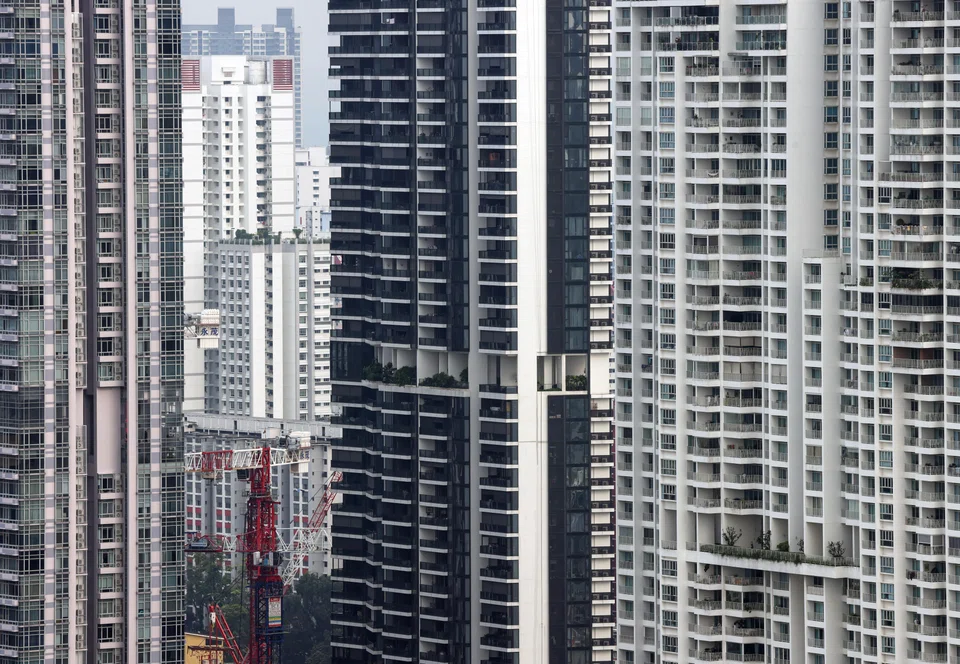
[SINGAPORE] Some young professionals fret over whether they can earn enough to buy a condominium unit in Singapore.
Yet, many young adults actively snap up units at new condo launches. In a suburban condo project, a two-bedroom unit of below 700 square feet (sq ft) and a three-bedroom unit of close to 900 sq ft might cost about S$1.5 million and S$2 million, respectively.
Besides relying on employment income and a loan to fund their condo purchases, some young buyers have financial help from their parents or profits from financial investments.
In short, looking at employment income alone to gauge whether condos are affordable may be misleading.
A better way to analyse housing affordability might be to track housing prices against a combination of a household’s employment as well as non-employment income.
Market income
With effect from the 2025 Key Household Income Trends (KHIT) report, the Department of Statistics Singapore expanded the measure of household income to that of market income, which includes employment and non-employment income. Previous KHIT reports documented household employment income.
Examples of non-employment income include revenue streams from investments, rentals, contributions from other households, pensions, annuities, and regular payouts from the Central Provident Fund (CPF) and insurance.
Also, the KHIT report was broadened to include resident households with no employed person, in addition to those with at least one employed person.
Certainly, several recent new condo launches have seen very strong take-up rates and set fresh benchmark prices across various locations. Some buyers may have been spurred by the fear of missing out.
However, tracking the growth in private home prices against household market income shows that the exuberance in the housing market is not irrational.
Healthy private home prices
The monthly household market income of the 50th percentile or the median of resident households grew 7.7 per cent from S$11,558 in 2024 to S$12,446 in 2025. This outpaced the 3.3 per cent increase in the Urban Redevelopment Authority’s (URA) property price index of private homes between the fourth quarter of 2024 and Q4 2025.
Nearly eight in 10 of resident households live in Housing & Development Board or HDB flats. For the 80th percentile of resident households, the monthly household market income in 2025 was S$24,673, up 7.1 per cent from S$23,040 in 2024.
Condo homes costing S$1.5 million and S$2 million work out to about 5.1 times and 6.8 times, respectively, of annual market income of S$296,076 (which is 12 times of S$24,673).
In 2024, the monthly household market income of the 50th and 80th percentiles of resident households grew by about 3.8 per cent each from the previous year. This was broadly similar to the 3.9 per cent rise in URA’s private residential property price index between Q4 2023 and Q4 2024.
Over a longer time frame, the URA’s private residential property price index rose faster than the household market income of resident households.
Between 2015 and 2025, the monthly household market income of the 50th and 80th percentiles of resident households grew by 40.8 per cent and 41.5 per cent, respectively, or a compound annual growth rate (CAGR) of about 3.5 per cent each.
Meanwhile, private home prices climbed by 52.8 per cent between Q4 2015 and Q4 2025 or a CAGR of about 4.3 per cent.
Between 2020 and 2025, the monthly household market income of the 50th and 80th percentiles of resident households grew by a faster CAGR of 6.5 per cent and 5.8 per cent, respectively. However, the URA’s private home price index jumped by an even faster CAGR of 6.6 per cent between Q4 2020 and Q4 2025.
Focusing on household market income and private property price growth in 2024 and 2025 suggests that the private housing market’s prevailing supply-demand dynamics are healthy, with home prices rising but hardly out of reach for resident households.
This, in turn, may imply there is little need to either tighten or loosen existing residential property cooling measures.
Looking at both employment and non-employment income seems sensible.
Many people may be doing more to earn investment and rental income as well as higher annuities. Moreover, if Singapore-listed companies do more to reward shareholders, individuals invested in local equities could see a substantial boost in their dividend income.
Importantly, with an ageing population, there will be more households comprising solely of persons with no employment income, but who have income from non-employment sources such as rental, investments and annuities.
HDB income ceiling
Possibly, market income can be increasingly relied on when setting housing policies.
For example, could it now make sense to look at market income when assessing a household’s eligibility to buy a flat from the HDB, receive CPF housing grants and take an HDB housing loan?
Currently, among other criteria, a couple needs to meet the monthly household income ceiling of S$14,000 to buy a flat from the HDB at a subsidised price.
For salaried workers, all components from employment, including an employee’s CPF deductions and excluding the employer’s CPF contributions and bonuses are taken into consideration. Also, non-employment income such as rental income, alimony/maintenance fee, dividend income and interest income from savings accounts and fixed deposits are excluded from consideration.
Perhaps, looking at household market income would provide a fairer picture about who should qualify to buy subsidised HDB flats and enjoy housing benefits.
Possibly, when the income ceiling to buy a new HDB flat is raised, the computation of income could be revised to account for household market income.
Still, while household market income might provide an accurate picture of a household’s buying power, policymakers should continue to be laser-focused on creating good paying jobs.
After all, many young people may rely almost entirely on employment income to fund both the equity and debt portions of a home purchase.
Anchoring young local talent to a home matters, so that they can bring up children here and contribute to the economy. Ensuring that young people can use their growing income from career progression to realise their condo ownership dreams will help anchor them to Singapore.
Ultimately, while using household market income data of resident households provides a valuable new dimension in analysing housing affordability, ensuring that private home prices generally rise in line with the growth in the employment income of residents remains critical.






