THE LEVEL GROUND

Meet rental demand by letting developers keep ownership of some condo units without hefty penalties

With the ABSD regime curbing investment demand, fewer private homes may be available for lease in future 

Summarise
Leslie Yee
Published Mon, Jun 22, 2026 · 12:15 PM
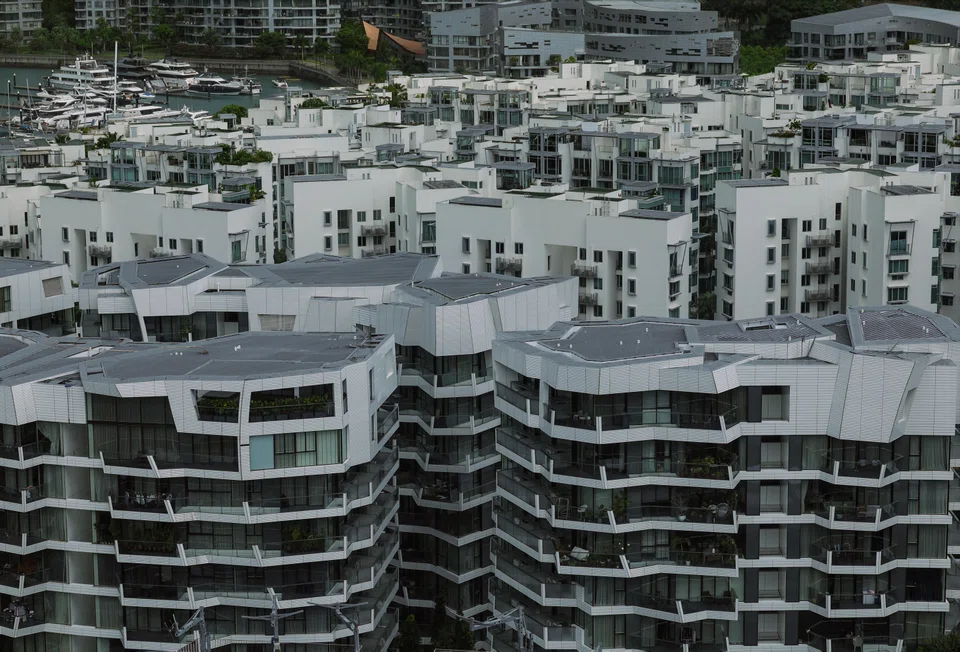
    • With private homes largely bought for owner-occupation, might a future shortage of rental homes loom?
    • With private homes largely bought for owner-occupation, might a future shortage of rental homes loom? PHOTO: YEN MENG JIIN, BT

    [SINGAPORE] Building wealth from investing in private homes in Singapore can make sense given the country’s safe haven status in a turbulent world.

    However, building ownership of a portfolio of private homes for leasing out and achieving capital gains via divestments is tricky.

    A Singapore citizen pays additional buyer’s stamp duty (ABSD) of 20 per cent for buying a second home and 30 per cent for buying a third and subsequent home.

    A foreigner who is not a permanent resident pays 60 per cent ABSD for purchasing any home here.

    Liable buyers pay ABSD on top of buyer’s stamp duty (BSD). ABSD and BSD are computed on the purchase price or the market value of the property, whichever is the higher amount. 

    Of course, building a Singapore property portfolio can be done without incurring ABSD when locals and foreigners purchase non-residential properties.  

    Investors seeking exposure to Singapore property can also do so without incurring hefty transaction taxes by buying shares of listed property groups or units in real estate investment trusts.

    That the ABSD regime tilts the playing field in private homeownership heavily in favour of Singapore citizen and PR first home buyers is laudable. A citizen buying a first home does not pay ABSD while a PR purchasing a first home pays 5 per cent ABSD.

    Still, in a market where private homes are largely being bought by citizens and PRs for owner-occupation, might a future shortage of rental housing for skilled non-PR foreigners working here loom?

    As at December 2025, there were 203,300 Employment Pass (EP) holders, up 15 per cent from 177,100 EP holders in December 2020.

    Having ample private rental housing options available matters in the Republic’s quest to attract foreign talent to augment the local workforce and grow the economy. Also, while many locals live in owner-occupied homes, some locals may have private rental housing needs.

    In perspective, the Urban Redevelopment Authority’s (URA) rental index of private homes in Q1 2026 rose 1.8 per cent year on year and is 55.3 per cent higher than in Q4 2020.

    Long-stay serviced apartments

    In late 2023, then minister for national development Desmond Lee unveiled the introduction of long-stay serviced apartments with a three-month minimum stay period to better meet rental demand and add more diversity to the products available. 

    Other serviced apartments have a seven-day minimum stay period, while the minimum stay period for private homes is three months.

    However, developers have appeared cool to long-stay serviced apartments.

    A tender for a government land sale (GLS) site with a mix of private homes and long-stay serviced apartments in Upper Thomson Road closed in June 2024 with zero bids. This site was subsequently sold after it was relaunched for sale without the need to provide long-stay serviced apartments.

    A tender for a Media Circle GLS site slated predominantly for building long-stay serviced apartments drew one bid when the tender closed in September 2024. URA did not award the sole bidder this site as the bid was assessed to be too low. 

    A tender for a Zion Road GLS site largely for private housing as well as long-stay serviced apartments was awarded to its sole bidder – a City Developments Ltd-Mitsui Fudosan tie-up – in April 2024.

    The GLS programme for 2026 does not offer any confirmed list sites with long-stay serviced apartment components.

    Given there may be little new supply of long-stay serviced apartments and purchases of private homes are largely for owner-occupation, perhaps policies can be tweaked pre-emptively to help ensure adequate supply of private rental homes going forward.

    Currently, developers of projects with five or more housing units are subject to 40 per cent ABSD with upfront 35 per cent remission.

    Typically, among various conditions, a developer needs to sell out all of a project’s homes within five years of acquiring a site to avoid any ABSD remission clawback.

    Long-term ownership of homes by developers

    Perhaps consider allowing developers of projects with housing inventory to retain a small proportion of units – say, up to 5 per cent of housing inventory – for the purpose of leasing out, without being hit by ABSD remission clawback.

    Developers who retain ownership of homes can be subject to holding on to the units for at least 10 years.

    There are several benefits to developers holding a small proportion of homes in their developments for the long term.

    One, developers who are keen to build up recurrent income can potentially do so from those properties.

    At the same time, developers would still be able to count on housing development projects to largely generate trading profit.

    Two, developers may have even greater incentive to ensure that the homes they build are of a high quality when they retain ownership of some units post-completion for the long term.

    As developers may hold only a small proportion of a condo development’s units long-term, they will not cannibalise demand for rental housing from individual owners who may be looking to lease out their units, nor will the developers be able to control the management corporation strata title of the condo developments.  

    Three, most importantly, if developers hold on to a small portion of homes in new condo developments islandwide, private rental housing demand from foreigners as well as locals will be better met.

    Imagine having ample supply of units in various types of condo developments across the Core Central Region, Rest of Central Region and Outside Central Region to suit diverse preferences and budgets of renters.

    Certainly, there are locals and foreigners who own multiple homes that were bought before the introduction of ABSD in December 2011 or when ABSD rates were much lower than today’s for various buyer profiles.

    Still, the private residential property landlord may become an increasingly rare species over time as homes get largely bought for owner-occupation.

    In land scarce Singapore, ensuring housing developers sell units in their projects expeditiously so that locals are better able to achieve their condo ownership aspirations matters.

    Nevertheless, it may be prudent to act now to ensure there is adequate supply and choice of private rental homes in future.

    Consider letting developers hold a small proportion of units in condo projects post-completion for the long term without being hit by hefty penalties to help meet rental demand.