Meloni’s trip aims to reset Italy-China relations after Belt and Road snub
But the question of Ukraine may continue to be a source of tension
US SECRETARY of State Antony Blinken’s visits to Asian allies – including Singapore on Tuesday (Jul 30) and Wednesday – dominated headlines this week, but two “under the radar” tours by senior European politicians may have significant consequences too for the region.
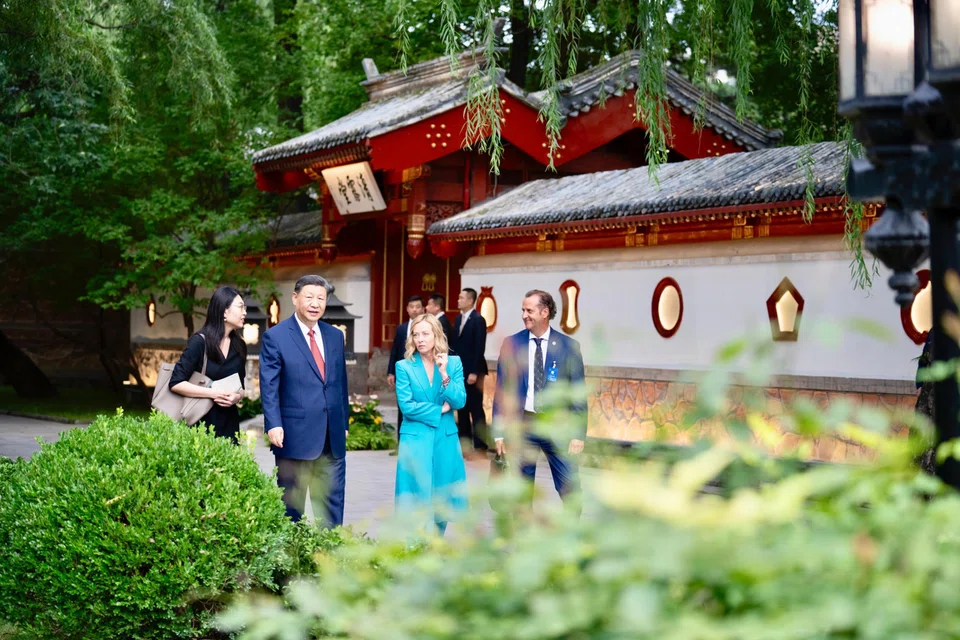
On Wednesday, Italian Prime Minister and current Group of Seven (G7) chair Giorgia Meloni concluded a five-day trip to Beijing. Meanwhile, the European Union’s (EU) most senior diplomat, Joseph Borrell, was in Vietnam to try to upgrade diplomatic relations, offering the bloc’s help in boosting maritime security and cybersecurity capabilities, as well as funding the reduction of coal use.
With Borrell soon to leave office, it was Meloni’s trip that received more attention. Her overriding goal in Beijing, which was only partially achieved, was to reset relations after her decision last year to pull Italy out of the Belt and Road agreement.
Her rationale for U-turning on this pact is not just related to Western security; there is little evidence that Italy benefited economically from the deal.
During Meloni’s trip, both countries confirmed the importance of mutually beneficial and more balanced trade relations. To this end, they signed a three-year plan to strengthen collaboration in areas such as trade, investment, education and food security.
This comes in the context of two-way trade reaching 66.8 billion euros (S$96.9 billion) in 2023, making China Italy’s largest non-EU trading partner after the US. Italy is also China’s fourth-largest trading partner in the 27-member EU.
Meloni stressed the need for more balanced trade to decision-makers in Beijing. Noting that Italy’s investment in China is about three times larger than China’s investment in Italy, she said she “wants to work to remove obstacles for our products to access the Chinese market”.
During her trip, she attended a meeting of Italian and Chinese business leaders that showcased recent bilateral successes such as automaker Stellantis, which has a joint venture with Chinese electric vehicle (EV) startup Leapmotor to sell EVs in Europe.
Significance and suspicion
While Italy is not always seen as being in the front rank of world powers, it is of significant strategic importance to China – not least as its 2019 decision to join the Belt and Road showed that it can sometimes be an outlier in the West.
Italy became the only G7 state to sign up to the scheme under then-prime minister Giuseppe Conte, sending shockwaves across the Western world. This earned a strong rebuke from the Trump administration, with then-National Security Council spokesperson Garrett Marquis asserting that there was “no need for the Italian government to lend legitimacy to China’s infrastructure vanity project”.
Looking ahead, China hopes that Meloni – who is in a stronger domestic position than her French and German counterparts – might be a moderating voice in the EU as the bloc considers key upcoming decisions related to Beijing, including tariffs on Chinese EVs.
However, despite the recent warm diplomatic atmosphere between Meloni and Chinese President Xi Jinping, relations are still very much in recovery mode. Beijing continues to harbour suspicions about her.
It should be remembered that in 2008, when Meloni was youth minister in one of the governments of former Italian prime minister Silvio Berlusconi, she urged Italian athletes to boycott the opening ceremony of the Beijing Olympics. This was in protest of China’s human rights record, especially in Tibet.
Besides withdrawing from the Belt and Road, Meloni’s government has also reduced the influence of China’s Sinochem as the largest shareholder in iconic Italian tyre maker Pirelli, citing national security concerns.
The Ukraine question
Before Meloni became prime minister in 2022, there were widespread uncertainties about her politics and suitability for high office, given her far-right political pedigree.
However, she has – so far – proven a deft foreign policy operator whose actions have surpassed expectations in key Western capitals. This is particularly with her strong support for Ukraine, despite Italian public opinion being more sympathetic to Russia compared to the rest of Europe.
Before the Ukraine conflict, anti-establishment political parties such as The League – part of Italy’s governing coalition – had sought a re-evaluation of Rome’s relationship with Moscow, including calling for the lifting of pre-2022 EU sanctions.
Yet in chairing this year’s G7 sessions, Meloni has reaffirmed the group’s strong unity in support of Ukraine, as well as its determination to continue providing Kyiv with assistance and strengthening sanctions against Moscow.
She even declared that one priority of this year’s G7 is “working on the reconstruction of Ukraine as a way to bet on a future of peace, freedom and Euro-Atlantic prosperity for this nation”.
In so doing, she has built up a particularly good relationship with US President Joe Biden, who initially had significant concerns about her far-right political roots. However, if his predecessor Donald Trump is elected in November, it is not clear how deeply felt Meloni’s current stance towards Kyiv will prove to be.
The Ukraine issue may continue to colour Italy’s bilateral relationship with China, given Beijing’s strong support for Moscow. However, Meloni’s recent trip had a significant economic dimension, and she is placing high hopes on the possibility that a stronger and more balanced trade relationship may now ensue.
The writer is an associate at LSE IDEAS at the London School of Economics