

Middle East war sends economic tremors across the globe
As the US-Israel strikes on Iran escalate into a regional conflict, global markets grapple with energy vulnerabilities amid shipping disruption
IT IS now half a century since the major energy shock from the Middle East in the early 1970s, which ended some 25 years of uninterrupted growth for the global oil industry. This crisis rattled big energy firms and sparked a major shock that rocked the global economy.
Fast-forward 50 years, and analogies to the 1970s are surfacing. The current crisis will likely have key economic and political implications well beyond the Middle East, including Asia, even with Opec+ countries announcing last weekend that they will increase output by over 206,000 barrels per day from April.
Alan Gelder, senior vice-president at Wood Mackenzie, asserts that the nearest historical parallel is the early 1970s Middle East oil embargo by Arab oil-producing nations in response to US support for Israel during the Yom Kippur War. This saw oil prices nearly quadruple in less than a year.
Goldman Sachs has flagged that European natural gas prices could more than double, with European gas prices and Asian spot liquefied natural gas (LNG) up by 130 per cent to around US$25 per million British thermal units if shipping is halted for a month through the Strait of Hormuz.
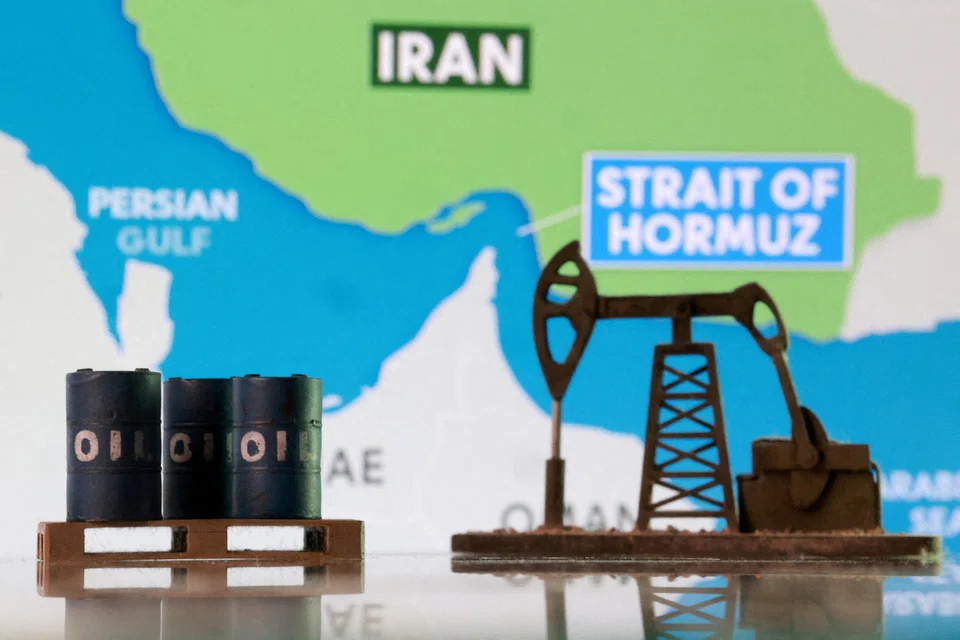
The Strait of Hormuz – between Iran, the United Arab Emirates and Oman – is the key chokepoint for the global energy trade. An estimated 19 million barrels of oil per day, about 20 per cent of global oil trade, and about 20 per cent of global LNG had long passed through this channel, which is just over 30 km at its narrowest point.
A more-than-two-month disruption could see European gas prices rocketing above US$100 per megawatt-hour, notes Goldman Sachs. Meanwhile, Gelder expects oil prices could top US$100 per barrel. Last year, JPMorgan suggested a surge to US$120 to US$130 a barrel following regional escalations.
This highlights the severe downside risk of the conflict. US President Donald Trump asserted on Monday (Mar 2) that joint military operations with Israel could continue for four to five weeks, and potentially longer. Meanwhile, Iran has warned Washington and Tel Aviv of further retaliation.
Nonetheless, there is still no extensive consideration of the possibility of a 1973-to-1974-style oil shock, despite some early warning signs.
Impact for Asia
The world has evolved since the 1970s, but the Middle East remains a major global oil-producing region. Iran is the third-largest oil producer in the region, behind Saudi Arabia and Iraq. Despite significant international sanctions, Teheran still exports large amounts of crude, including to key Asian economies such as China and India.
China buys an estimated one to 1.5 million barrels per day of Iranian crude, by far the largest volume of any other country, representing some 10 per cent of the country’s seaborne imports.
If this is imperilled, Beijing would lose a key source of relatively cheap oil, compounding challenges it faces in Venezuela after the US captured then president Nicolas Maduro.
This could leave China more dependent on Russian energy. Geopolitically, this could deepen the Moscow-Beijing partnership with potential implications for the Ukraine war.
An even bigger challenge for Beijing is that around half of all oil imports – from countries such as Iraq, the United Arab Emirates and Saudi Arabia – pass through the vulnerable Strait of Hormuz.
India is similarly exposed. Though the country’s total stocks, including refineries, last roughly 74 days, it falls short of the International Energy Agency’s 90-day benchmark. Its strategic petroleum reserves hold only nine to 10 days of supply (around 9.5 million barrels).
Beyond energy, many airline shares, across Asia and beyond, have fallen significantly since the weekend. The travel sector has been rattled by thousands of flight and wider transport cancellations.
With the situation in the Strait of Hormuz, shipping is under direct threat. Iran’s Islamic Revolutionary Guard Corps claims that multiple US and UK oil tankers have been struck in the Gulf and the Strait of Hormuz, alongside missile and drone attacks on wider land-based infrastructure.
Marine-tracking data shows the region’s traffic slowing as shipowners and insurers reassess transit risks. A growing number of shipping firms are thinking of rerouting via the Cape of Good Hope on the Atlantic coast of South Africa.
Wider market impact
The global growth outlook in 2026 could be dented by persistent inflationary pressures from higher energy prices. This may put further grit in the wheels for major central banks cutting interest rates.
Yet, as nations send more military assets to the Middle East, for offensive or defensive purposes, there is a growing, non-trivial possibility of a protracted war.
With Iran’s leadership under potential existential risk amid calls from Trump and Israeli Prime Minister Benjamin Netanyahu for “regime change”, long-held assumptions about strategic restraint may no longer hold.
These downside risks are part of a broader cocktail of global fissures. The previous era of globalisation and geopolitical stability has given way to a riskier era – a “poly-crisis” with numerous, overlapping challenges.
The sense that crisis is a new normal has implications not just for politics, but also for financial markets. Investors have already begun a flight to risk-off assets, including gold.
Most asset classes, including commodities, had posted year-to-date gains before the weekend, despite some historically high valuations. However, that risk-on sentiment could now shift significantly.
There could yet be significantly more economic turmoil as hostilities continue in the Middle East. Much now depends on not only whether the conflict intensifies, but also how long it will take to reach any clear conclusion.
The writer is an associate at LSE Ideas at the London School of Economics






