Might a US-China mini thaw be underway?
Trump’s 90-day trade truce with Xi holds a chance to reset bilateral ties
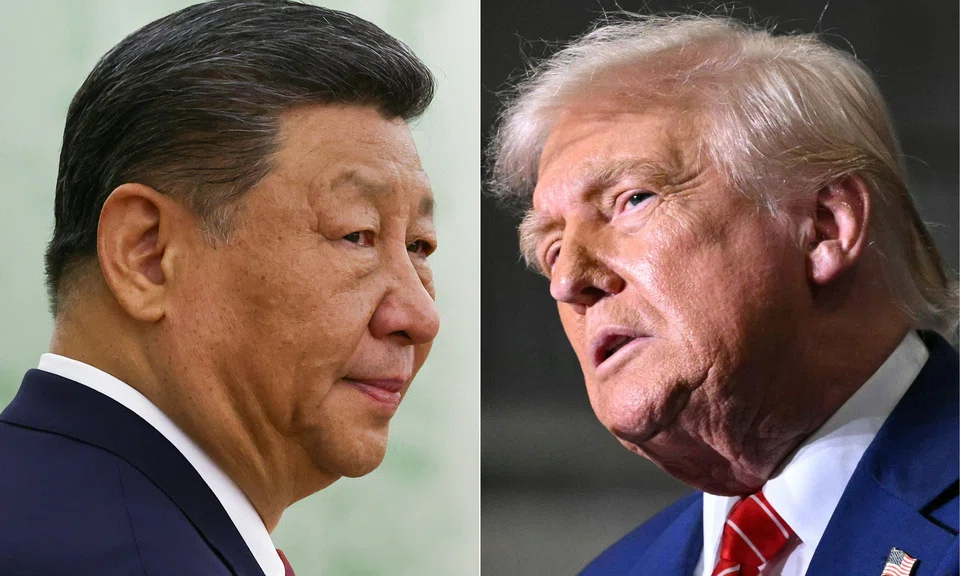
ONE of the key elements of Donald Trump’s foreign policy has been concern about China’s rising power. Yet, the US president on Monday (Aug 11) extended his tariff truce with Beijing for another 90 days, raising the possibility that the two powers might potentially agree to a wider grand economic bargain in 2025 or beyond.
The executive order was signed just hours before the previous tariff pause was set to expire, providing relief to financial markets around the world. Trump had previously increased tariffs on Chinese imports to 145 per cent, with Beijing reciprocating. An initial 90-day truce in May saw the US lower its levies to 30 per cent while Beijing reduced tariffs on US goods to 10 per cent and agreed to ramp up rare earth exports.
The news comes soon after chip giants Nvidia and AMD agreed to pay the US government 15 per cent of Chinese revenues. This is part of what has been called an “unprecedented” deal to secure export licences to China.
The US had earlier banned the sale of powerful chips used in areas like AI to China under export controls usually related to national security. Some security experts, including a number from Trump’s first term, recently expressed deep concern that Nvidia’s H20 chip was “a potent accelerator” of China’s AI capabilities.
Window of opportunity
The new 90-day pause allows time for a potential Trump meeting with President Xi Jinping at the Asia-Pacific Economic Cooperation summit in South Korea this October. Depending on the mood music this autumn, it is even possible that the US president may offer a visit to China at much the same time.
This provides a window of opportunity for US and Chinese officials to finalise not only a tariff deal, but possibly the framework for a wider economic bargain that could include issues such as fentanyl trafficking and Chinese purchases of sanctioned Russian and Iranian oil.
A key question, therefore, is whether this truce presages a mini thaw in ties, as part of an effort to responsibly manage the competition between the two powers. While it is too early to tell, the answer will be decided largely by the personal chemistry of Trump and Xi.
While economic and security fundamentals will mostly determine the long-term course of relations, both leaders are politically dominant in their nations and likely to remain in office until 2029 at least. With the two sides far apart on many issues, a Xi-Trump meeting would offer an opportunity for each leader to gauge the other’s intent.
The importance of this personal factor was shown during Trump’s first term when his erratic nature accentuated the volatility in US-China ties.
During Barack Obama’s presidency, relations remained generally cordial, reflecting the commitment of Xi and Obama to bilateral stability. Both leaders appeared to recognise the super-priority of the relationship. Washington pursued a strategy that promoted cooperation on shared interests such as climate change, while constructively engaging on harder issues such as South China Sea tensions. It is sometimes forgotten that a key precursor for the Paris climate deal in 2015 was a US-China agreement in this area brokered by Obama and Xi.
Renewing bilateral relations
However, this engagement approach is perceived by Trump as having failed to shape Beijing’s long-term behaviour.
If and when Trump and Xi meet this autumn, the goal would be to find a framework to renew bilateral relations in the second half of the 2020s. Both appear to know that a stable relationship could have a broad, positive effect on global affairs, and potentially forestall further disruptive tensions.
Yet, significant hazards in the US-China bilateral landscape remain.
The future of Taiwan is a major point of uncertainty, and a tough framework of US measures against China carries over from the Trump and Joe Biden eras. These include sanctions over human rights abuses in Xinjiang and Hong Kong, and the rejection of nearly all of Beijing’s maritime claims in the South China Sea.
Ultimately, the new pause in the tariff war indicates that US-China relations need not inevitably be a force for greater global tension. Instead, it might yet show there is still a small, precious window of opportunity to evolve a strategic partnership to help underpin bilateral relations in the second half of the decade.
The writer is an associate at LSE IDEAS at the London School of Economics