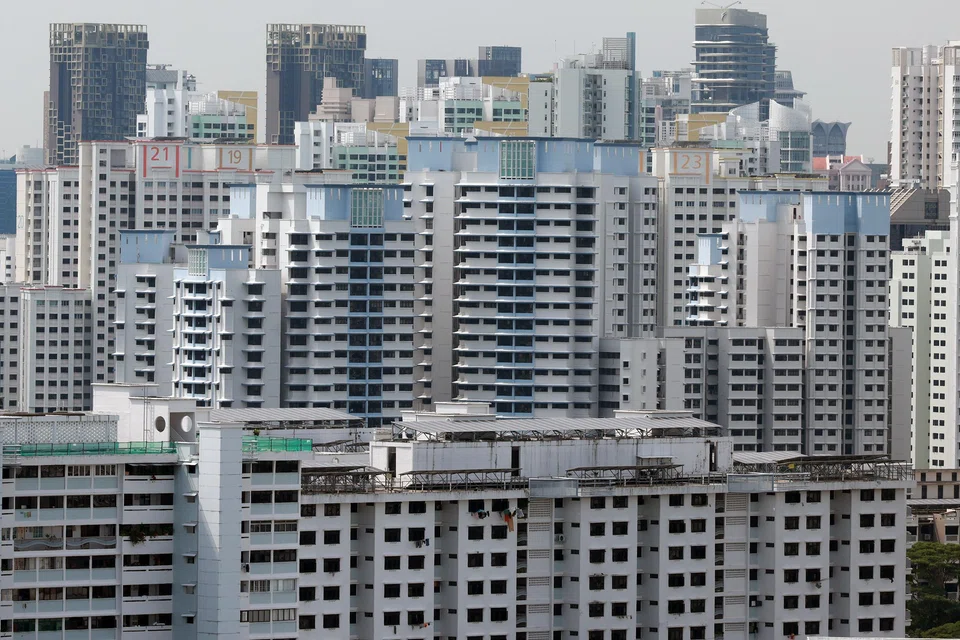
Mind the gap opening up as HDB resale market slows while million-dollar sales spike
Watch out for inequality and negative wealth effects as prices moderate broadly, but the premier segment strengthens

[SINGAPORE] According to the Housing & Development Board’s (HDB) latest data, resale flat prices fell in the second quarter, with the HDB Resale Price Index moderating by 0.3 per cent quarter on quarter following a 0.1 per cent quarterly decline in Q1.
Resale volume in Q2 was up slightly versus that in the first quarter, but was down on a year-on-year basis.
An increase in the supply of HDB Build-To-Order (BTO) flats, including units with shorter waiting times, has likely helped moderate demand for resale units.
In perspective, resale prices have climbed sharply over recent years. As at Q2, the HDB index has risen 54 per cent versus the fourth quarter in 2019.
Still, while resale HDB flat prices moderate overall, the premier segment of the market continues to be strong.
The number of transactions of resale HDB flats costing S$1 million or more each reached 491 in Q2, up 19.5 per cent quarter on quarter and 18.3 per cent year on year, based on ERA Singapore.
Deals involving million-dollar or more flats accounted for 7.7 per cent of all HDB resale transactions in Q2, up from 6.5 per cent in Q1. In Q2, the highest number of such transactions were in Toa Payoh, Queenstown and Bukit Merah.
High-flying, high-end
Will strength in the million-dollar segment of resale HDB flats abate? Perhaps not, as there are strong demand drivers for resale units in sought-after locations that have fewer resale restrictions.
With HDB offering more housing in central locations to cater to demand, new flats coming up in such locations may be classified as Plus or Prime units under the new HDB framework.
Buyers of Plus and Prime flats are subject to tighter conditions including a 10-year minimum occupation period (MOP). The MOP is five years for Standard and unclassified flats.
One factor that can drive interest in the public-housing resale market is that many high-earning local couples who cannot buy new HDB homes could look to purchase a resale HDB flat instead. These include couples who are eligible to buy new executive condominium (EC) units.
The monthly household income ceiling for a couple is S$14,000 to buy a new HDB flat and S$16,000 to purchase an EC unit from a developer.
Premier resale HDB flats are a cost-effective option for high-income first-time homebuyers.
A local couple earning S$16,000 a month or S$192,000 annually may qualify to buy a new EC home. However, a new 900 square foot (sq ft) EC unit could cost around S$1.6 million or 8.3 times of annual income.
In comparison, a resale HDB four-room flat with more than 90 years of remaining land lease costing S$1.2 million could offer more space, a superior location and better affordability.
For a couple who busts the income ceiling to buy a new HDB or EC unit, a well-located resale flat can trump a condo home. For one, a new suburban 900 sq ft condo home might cost more than S$2 million.
Two, high-income permanent resident (PR) households may look to purchase premier resale HDB flats.
While a PR couple cannot buy a new HDB home, a couple comprising partners who have been PRs for at least three years can buy HDB resale unclassified or Standard flats, excluding 3Gen flats.
To combat a low birth rate, Singapore is looking to gradually raise the intake of new immigrants. For example, the government expects to take in roughly 40,000 PRs annually in the next five years, slightly more than the 35,000 granted in 2025.
In an unstable world, wealthy and skilled foreigners might clamour to become Singapore PRs and citizens. And some highly skilled PRs could buy premier resale HDB flats.
Three, as the population rapidly ages, seniors could be an important source of demand for high-end resale HDB flats.
Affluent retirees might trade private homes for public housing to free up capital to better ensure retirement financial adequacy. Also, the recurring costs of owning an HDB flat are generally lower compared with those of a condo unit.
Meanwhile, a spacious well-located HDB unit can provide a comfortable abode which is comprehensively served by amenities and public transport.
The wait-out period of 15 months that applies to private property “downgraders” does not apply to a local couple aged 55 years and above, under certain conditions.
Four, despite qualifying to buy new HDB flats, some young local buyers with access to liquidity may choose a premier resale unclassified HDB unit instead.
With a resale flat, one generally gets a home to live in faster than with a BTO unit and avoids going through the lottery of the ballot to snare one’s dream flat.
In addition, eligible first-timer local couples can receive grants when buying resale HDB flats.
Five, the housing upgrading aspiration among Singapore residents is strong as homeownership has historically been a key source of wealth creation.
With a large gap between condo and HDB resale home prices, much upgrading activity will happen within the public-housing market.
A household may trade a smaller or less well-located HDB BTO flat for a larger HDB resale flat in a more convenient location as household income grows or the household size increases.
Regarding the investment value of a centrally located HDB flat, an unclassified unit can trump a Plus or Prime one. Besides having a longer MOP, owners of Plus or Prime flats cannot rent out their whole flat and have to sell their units to a smaller pool of eligible buyers.
Effect on inequality and consumption
Ultimately, while the resale price index might remain relatively flat, the share of transactions of million-dollar or more resale HDB flats could rise.
If such a scenario unfolds, might inequality among households rise? Perhaps owners of less-sought-after resale HDB flats will feel aggrieved at the greater wealth creation of those owning far more coveted units.
Crucially, if prices of many resale HDB homes hardly grow in the near term, this could dampen domestic consumption. After all, rising resale flat prices can generate a positive wealth effect among owners, which in turn boosts consumer confidence and spending.
Moreover, some HDB owners may need to relook their financial plans to correct the assumption of monetising a home at an ever-rising price to fund retirement needs.
As the resale HDB market evolves, the risks stemming from a high-flying, high-end segment within a possibly more sluggish market in general should be monitored.
TRENDING NOW
Grab CEO’s wife Chloe Tong on life with Anthony Tan and finding her purpose
HDB reviewing ‘jumbo’ flat scheme after Telok Blangah unit listed for sale at S$2.18m
He built the Vingroup empire. Now South-east Asia’s richest man is handing some key roles to his sons
Singapore judge raises doubts iron ore trader Radiant World is owed US$1 billion