

Modi and Macron’s ‘contract of the century’: A new anchor for India-Europe trade
The two leaders sign a huge aerospace accord and key tax treaty changes, highlighting the warming of business relations after a hat-trick of trade deals
INDIA and the European Union, the world’s two largest democracies, have long had a distant economic relationship. However, the last two years have seen a warming of relations, opening enhanced business opportunities for firms across both regions.
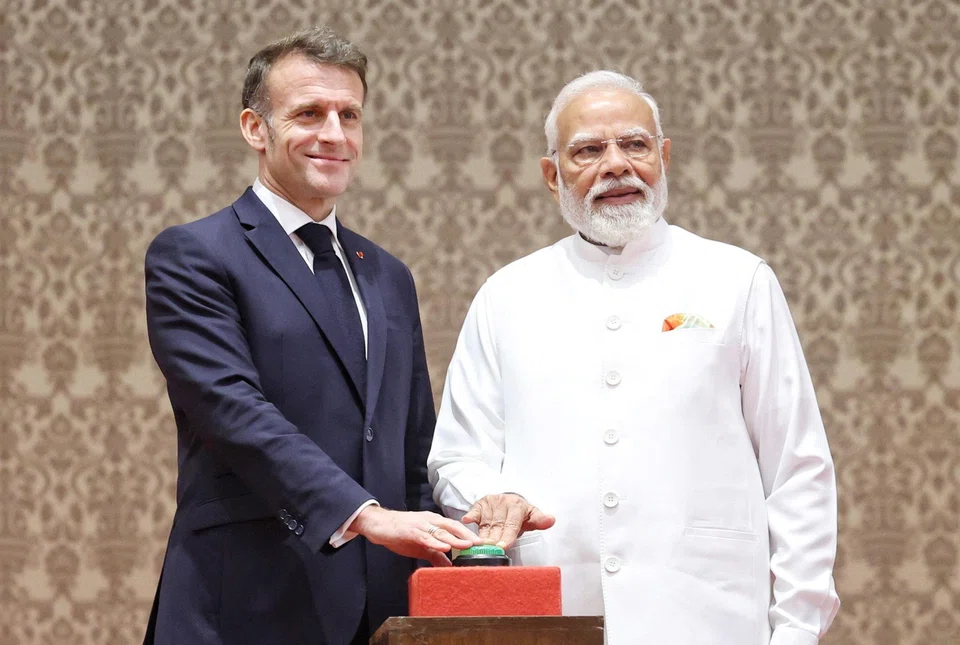
This shift was showcased during French President Emmanuel Macron’s visit to India from Feb 17 to 19 – his fourth since taking office in 2017. Macron praised the “remarkable acceleration” of New Delhi’s ties with Paris in response to a “changing international order”.
Key business deliverables
One key deliverable is India’s agreement to revise its 30-year-old tax treaty with France. This aligns with New Delhi’s renegotiations of similar tax accords with other nations, including Singapore.
The changes broaden New Delhi’s powers to tax certain transactions, especially granting India the right to tax capital gains and any French entity’s share sale, even when it holds less than 10 per cent of an Indian company.
The trade-off for Macron is significant savings for French firms in dividend levies. Specifically, French companies holding at least 10 per cent in an Indian business will pay a 5 per cent tax on dividends, down from 10 per cent earlier. For minority French shareholdings of under 10 per cent in Indian companies, however, dividend tax will rise from 10 per cent to 15 per cent.
These revisions would impact large French firms that have boosted their geographical footprint, including portfolio investors and firms such as Sanofi, Pernod Ricard, Danone and L’Oreal.
“Crowning achievement”
Indian Prime Minister Narendra Modi and Macron also announced what has been called the “contract of the century” and a “crowning achievement” by Christophe Jaffrelot of the Sciences Po Center for International Studies in Paris.
The anticipated US$35.7 billion agreement propels India and France into a new era of defence cooperation, with plans to jointly produce Rafale fighter jets as well as helicopters. New Delhi is expected to order 114 Rafales under a co-production model with India – cooperation France hopes to replicate with submarines.
Bilateral trade currently stands at around US$18 billion annually. Defence and aerospace remain big drivers, supported by India’s commercial fleet which comprises a significant number of Airbus aircraft.
The new, anticipated big order comes months after the worst fighting in decades between India and Pakistan. Rafale jets flown by the the Indian Air Force were used during India’s ramp-up in tensions with Pakistan last May.
The order builds upon a prior India purchase of 36 Rafales for the air force and 26 marine versions for the navy. The Indian navy also operates six French Scorpene submarines.
During the visit, Macron and Modi also announced the first H125 helicopter assembly line in India, a joint venture between Airbus and Tata Advanced Systems, alongside a plan to jointly produce Hammer missiles in India, by Safran and India’s state-owned Bharat Electronics.
The personal warmth between the two leaders was evident at the AI Impact Summit in New Delhi. In Mumbai, India’s key commercial centre, the two leaders also inaugurated the India-France Year of Innovation.
Macron and Modi discussed emerging technologies, responsible artificial intelligence and digital cooperation through the lens of the France-India Horizon 2047 Roadmap. This is deepening cooperation across not only advanced technologies and defence, but also critical minerals, climate action, health and education.
India’s hat-trick of trade deals with Europe
The Macron visit is the latest example of the remarkable rise in warmth of Europe-India business ties.
An extraordinary economic liberalisation process began in March 2024 when an agreement was signed by India with the European Free Trade Association (EFTA), which comprises Norway, Switzerland, Iceland and Liechtenstein. This was followed by the conclusion of trade deals between India and the UK in July 2025, and the EU in January 2026 – after well over a decade of negotiations.
These three trade deals have different areas of focus. The UK-India agreement is centred around services, whereas the EU-India deal is more focused on goods.
The EFTA deal represents the first legal commitment made in any trade agreement, ever, about promoting target-oriented investment and creation of jobs.
Collectively, the EFTA has committed to increase its stock of foreign direct investments by US$100 billion in India in the next 15 years. It also agreed to facilitate the generation of one million direct jobs in India through such investments. There is also significant trade liberalisation offered by both sides.
Geopolitical realignment
This latest deal reflects not only Europe’s longstanding outward orientation, but also its strategy to double down on global economic links, following Russia’s invasion of Ukraine and uncertainties regarding US President Donald Trump’s policies, especially his tariffs.
For Europe, there is growing recognition that many large new business opportunities lie in Asia. Over the next five years, the global economy is forecast to increase by around US$40 trillion – a huge chunk of which will come from Asia, with India now the world’s fastest-growing economy with a gross domestic product soon to surpass US$4 trillion.
India is on track to surpass Japan and Germany to become the world’s third-largest economy, behind China and the US. The Indian middle-class consumer market alone will reach some 95 million by 2035 – larger than the population of Germany, Europe’s biggest economy.
Underpinning these accords is a political alignment, with New Delhi widely perceived in the West as an increasingly friendly, long-term geopolitical ally. There appears a shared commitment to a rules-based global order, effective multilateralism and sustainable development.
For New Delhi, the deals signal a shift towards high-income partners to deepen the integration of Indian industries into global supply chains. Other recent deals include that with New Zealand and Oman, which seek to balance domestic and global interests while sending a signal of greater openness to foreign investors.
While India has long been a high-tariff, highly regulated market, the three trade deals with Europe will allow for greater reciprocal market access. In the coming years, success for businesses will still depend on navigating sometimes complex rules of origin, customs compliance and regulatory requirements.
The writer is an associate at LSE Ideas at the London School of Economics
TRENDING NOW

LTA proposes combining car COE categories, adding rebate-surcharge system

StarHub to acquire MyRepublic’s mobile business amid ongoing telco consolidation

DBS, OCBC, UOB rout lops billions off STI as inflation, rate concerns spook investors

Grab CEO’s wife Chloe Tong on life with Anthony Tan and finding her purpose

