Is this the moment we change the way we think about economic growth?
Degrowth, unlike stagflation or recession, is an intentional, planned political shift away from GDP expansion

ECONOMIC growth, particularly in energy-intensive nations, is slowing as the Middle East war continues to throttle exports of oil, plastics and fertiliser.
The International Monetary Fund in its World Economic Outlook has forecast slowing economic growth in industrialised economies.
But perhaps the current crisis is an opportunity to discuss an alternative to the economic orthodoxy of constant growth.
Supporters of economic theories known as “degrowth” or “post-growth” say that capitalism’s pursuit of growth, along with the relentless consumption and production needed to sustain it, has run its course.
They point to rising inequality, exceeding natural planetary boundaries and geopolitical struggles over scarcer energy resources.
If slower economic growth is where we’re heading, degrowth and post-growth thinkers have already been exploring ways to make that transition smoother.
'%3e%3cpath%20d='M12.1475%2025.5262C13.7713%2025.4295%2014.94%2023.913%2014.94%2021.8832C14.94%2019.5359%2013.474%2018.093%2011.5917%2018.093C11.3745%2018.093%2010.9582%2018.093%2010.8393%2018.1413V25.2086L11.8891%2025.5745C11.8891%2025.5745%2012.207%2025.5262%2012.1475%2025.5262ZM11.4934%2017.6281C13.2567%2017.6281%2014.3843%2016.4292%2014.3843%2014.4501C14.3843%2012.372%2013.275%2011.2973%2011.4339%2011.2973H10.8393V17.6305H11.4934V17.6281ZM6.66078%2025.6482L7.39265%2025.5492C8.02617%2025.4502%208.26403%2025.3053%208.26403%2025.1097V11.6149C8.26403%2011.4193%208.1451%2011.3709%207.23484%2011.249L6.68137%2011.173L6.6219%2010.7588H11.9508C15.7153%2010.7588%2017.0624%2012.0797%2017.0624%2014.1578C17.0624%2015.9666%2015.7748%2017.1909%2013.4969%2017.6305V17.7041C16.111%2017.948%2017.6571%2019.5382%2017.6571%2021.7636C17.6571%2024.3318%2015.8937%2026.0417%2012.1109%2026.0417H6.60132L6.66078%2025.6482Z'%20fill='%232B2B2B'/%3e%3cpath%20d='M20.6287%2025.6505L21.5596%2025.5515C22.1725%2025.4779%2022.4104%2025.3076%2022.4104%2025.112V11.249H21.9346C20.073%2011.3479%2018.982%2013.0095%2018.408%2014.6227L18.1907%2015.5018H17.6555L18.1701%2010.7588H29.3837L29.6421%2015.4787H29.1664L28.9491%2014.6227C28.3728%2012.8645%2027.3047%2011.2743%2025.5002%2011.249H24.9856V25.1856C24.9856%2025.3812%2025.1251%2025.4548%2025.9965%2025.5515L26.7695%2025.6505L26.829%2026.0417H20.5693L20.6287%2025.6505Z'%20fill='%232B2B2B'/%3e%3c/g%3e%3cdefs%3e%3cclipPath%20id='clip0_5242_21648'%3e%3crect%20width='24'%20height='16.8'%20fill='white'%20transform='translate(6%2010)'/%3e%3c/clipPath%3e%3c/defs%3e%3c/svg%3e)
The push for reform
Leading post-growth and degrowth advocates include economists Tim Jackson and Giorgos Kallis. They see a radical departure from capitalism, especially in its current neoliberal form, as a necessary next step in economic and political reform.
Degrowth proposals seek to redirect policy and economic activity away from how fast or how much the economy grows. Instead, the focus is on:
- the quality and purpose of what is produced,
- who benefits, and
- whether growth genuinely improves people’s lives.
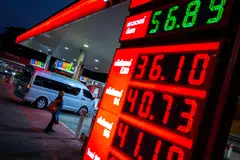
Global supply chains have been disrupted by the Strait of Hormuz closure. The prospects of energy shortages and usage restrictions may mean reorientation away from economic growth is happening out of necessity.


A planned policy shift
Degrowth proponents argue for sufficiency over constant growth in gross domestic product.
They want to see shorter supply chains and localised ownership of companies producing goods and services. This would simplify supply systems and reduce overall consumption.
In practical terms, this means fewer ships carrying cheap or single-use goods, a focus on localising food production and expanding the lifespan of the products we do consume. In degrowth, less is more.
To achieve this in an energy-constrained world, degrowth involves reducing or eliminating some resource-intensive industries, such as fast fashion, through taxation and regulation. The EU’s fast-fashion tax is a good example.
Scaling back is occurring already, with regional supply chain strategies for Asean and some pharmaceutical firms localising manufacturing to produce drugs and vaccines closer to end users.
What differentiates degrowth from stagflation or recession is an intentional, planned political shift away from GDP growth, to reorient economies around the idea of “buen vivir” (living well). This concept, originating from South America, is based on collective well-being and meeting basic needs.
It may be hard to pin down how much is enough and what a “decent” standard of living is for everyone.
But a recent study has suggested it is far less materially than we might think. It is more about ensuring universal access to the essentials such as food, housing, healthcare and education.
Basic needs for human well-being are defined in measures such as the United Nations’ Human Development Index and global happiness and well-being indices.
Environmental concern
The Iran war is leading to fuel shortages and rising food prices. Compounding this are concerns our current growth-dependant lifestyles are exceeding what Earth can support.
One study just released found 58 per cent of people in 92 countries surveyed placed a higher priority on environmental protection than economic growth.
Measures of economic growth such as GDP do not measure human well-being. In Australia, the government published an alternative set of measures known as Measuring What Matters, although wide policy influence has been limited.
Discussions on post-growth are happening at the international level of the Organisation for Economic Co-operation and Development and World Economic Forum.
The UN just held its first meeting of the Beyond GDP Global Alliance in April, where leaders discussed shifting the measures of economic success away from GDP.
Is it just a thought experiment?
Despite worthwhile aims, degrowth and post-growth theories face significant challenges to feasibility in our current capitalist economies.
No industrialised country has ever deliberately shrunk its economy – though some cities such as Amsterdam and Copenhagen and regions are trying it.
That means most ideas about what degrowth policies could achieve remain theoretical.
A saying within degrowth circles is that the end to economic growth will happen either “by design or by disaster”.
Does the slowing of economic growth in industrialised economies signal “degrowth by disaster”? And if so, perhaps it is time for businesses and governments to think about how to prepare for “degrowth by design”. THE CONVERSATION
The writer is senior lecturer at Graduate School of Business, Queensland University of Technology
Decoding Asia newsletter: your guide to navigating Asia in a new global order. Sign up here to get Decoding Asia newsletter. Delivered to your inbox. Free.
Share with us your feedback on BT's products and services