
‘Mr Japan’ bends the knee – and falls on his sword

Shigeru Ishiba’s trade deal with Donald Trump will be his last act as leader
Summarise
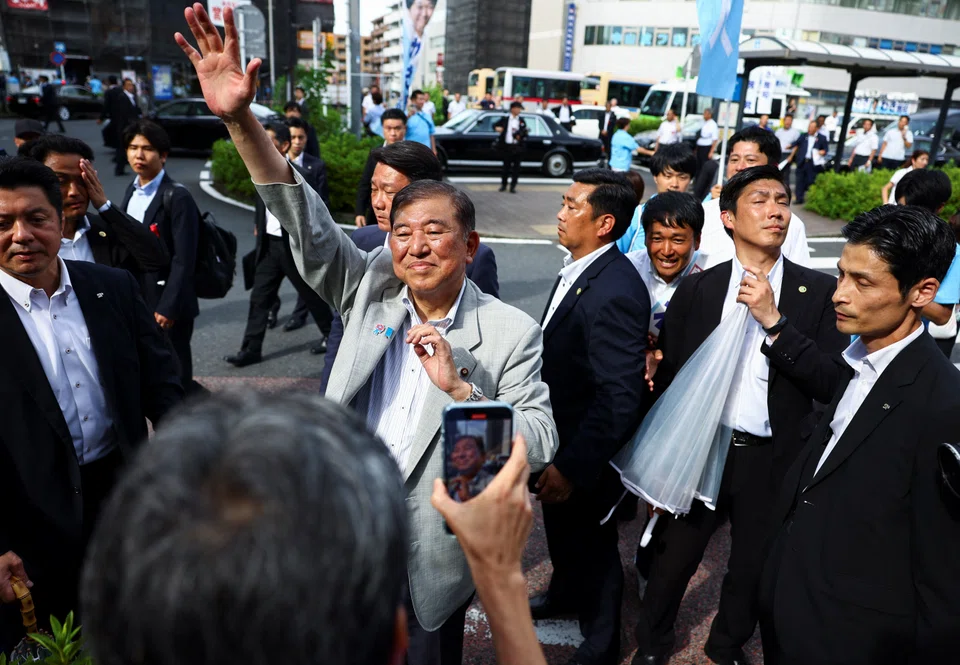
    • By removing the uncertainty around tariffs, Ishiba (centre, in grey) will finally have done some good for the country.
But he will leave Japan in a weaker position than when he took office.
    • By removing the uncertainty around tariffs, Ishiba (centre, in grey) will finally have done some good for the country. But he will leave Japan in a weaker position than when he took office. PHOTO: REUTERS
    Published Wed, Jul 23, 2025 · 08:00 PM

    “MR JAPAN” finally has his trade deal, after three months of talks. It looks like it will be his final act.

    After a third successive blow from the Japanese electorate, Prime Minister Shigeru Ishiba blinked in trade talks with the US. He spent months seeking a complete removal of the levies that President Donald Trump held over the country, including those already imposed on cars.

    “We will never accept tariffs, especially on autos,” Ishiba said in May, declaring the issue his red line. With vehicles long the main source of Trump’s ire – perhaps understandably, given that they account for more than three-quarters of the trade deficit – getting the president to back down was always going to be a tough ask, especially considering Japan’s lack of leverage.

    But after Sunday’s hammering in the upper house election, which has left the prime minister with a minority in both houses of parliament and arguably the worst electoral record of any Liberal Democratic Party (LDP) leader in history, Ishiba has seemingly accepted his fate. That’s why he agreed to the deal that will include 15 per cent tariffs across the board, including on cars.

    With this last piece of business concluded, local media indicates that less than a year into his term, Ishiba will soon announce his resignation. (The prime minister has subsequently denied the reports, which were made by multiple independent outlets.)

    Trade envoy and close aide Ryosei Akazawa painted a positive picture. It was “mission completed” in the tariff talks, he cheerfully said in a post on X, pointing to a picture hung in the White House of Ishiba and Trump speaking at the G7 meeting in Canada. He also denied any link between the agreement and the election results.

    Certainly, markets were pleased, with carmakers surging after being freed from months of uncertainty. Toyota Motor rose by the most in nearly 40 years; the Topix headed for an all-time high.

    And perhaps it’s as good a deal as Japan could expect. As with all these agreements, the devil is in the details: It still puts a 15 per cent levy across the board on imports. While that’s less than the 25 per cent “reciprocal” tariff that was threatened, and most importantly, less than the 25 per cent already imposed on car imports in May, it’ll still be damaging for exporters. There’s an odd promise of US$550 billion (S$703 billion) in investment in the US, and a more logical agreement for Japan to buy more US rice. The part about Japan opening “to trade including cars and trucks” is confusing, given that there are no barriers currently in place. But perhaps Ishiba has done what he should have in the beginning, and simply told Trump what he wants to hear – knowing it won’t, indeed can’t, be delivered.

    But the agreement also removes the last piece of leverage the prime minister had left – the “national crisis” he said must be prioritised ahead of infighting. That’s been enough to keep the target off his back, until now. But after Sunday’s results, it’s clear he can’t be allowed to do any more harm.

    In just 10 months, his weak leadership has resulted in an unstable political landscape that threatens to damage Japan for years. Conservative voters have deserted the LDP in droves – and headed to some disturbingly populist places. The landscape is so fractured that there also isn’t a viable opposition to take over, meaning the forecast is for parliamentary gridlock.

    That’s why the LDP needs to win voters back. With the trade deal about to be done, Ishiba should leave as soon as possible. Many conservatives are eyeing the anniversary of the end of World War II next month, fearing he will further alienate right-leaning voters by undoing the groundbreaking statement by the late Shinzo Abe on the 70th anniversary a decade ago.

    It’s not Ishiba’s fault that relations with the US have been so tarnished. That blame lies with Trump. And by removing the uncertainty around tariffs, he will finally have done some good for the country.

    But he will leave Japan in a weaker position than when he took office – and in search of direction once again.



