THE BROAD VIEW

Nato looks East amid squabbles in the West

Trump seems appeased at the summit, but member states must work to ensure the alliance’s continued relevance
Summarise
    • Nato secretary-general Mark Rutte has reportedly acknowledged the “massive build-up” of China’s military and noted that it “will have 1,000 nuclear warheads by 2030”.
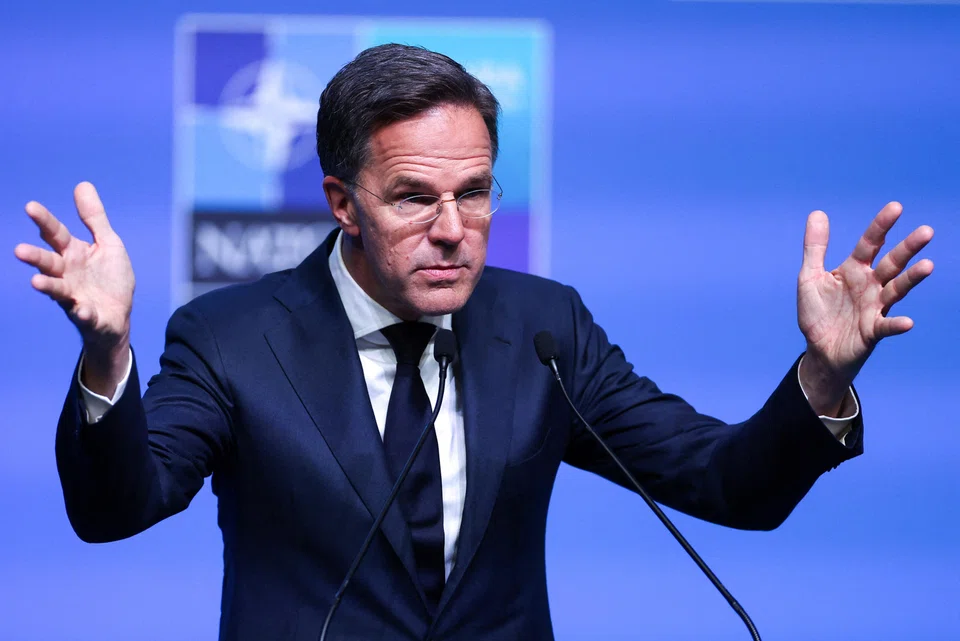
    • Nato secretary-general Mark Rutte has reportedly acknowledged the “massive build-up” of China’s military and noted that it “will have 1,000 nuclear warheads by 2030”. PHOTO: REUTERS
    Published Sat, Jul 11, 2026 · 07:00 AM

    NATO is the world’s most successful military alliance. Established in 1949, it has underpinned the longest period of sustained peace in modern history.

    Yet, the last decade has seen more squabbles than smooth summitry, aggravated by the two Donald Trump presidencies, which has caused the alliance’s gaze to shift in an eastward direction.

    On Tuesday (Jul 7) and Wednesday, Nato secretary-general Mark Rutte co-hosted the alliance’s latest annual leadership meeting in Turkey.

    Rather than being a celebration of Western unity, an overriding goal was ensuring that the event was “Trump-proofed”. This week, the US president renewed threats to pull all US troops out of Europe, and called again for Greenland to become the 51st American state.

    Tensions within the Western club have accelerated discussions about Nato’s future strategic direction.

    Perhaps the most important was articulated by Turkish President Recep Tayyip Erdogan, who, prior to the summit, said: “Today’s world is not a continuation of the old world in which Nato was founded.

    “A new world has been established, and within this new global architecture, Nato’s positioning must be fundamentally different.”

    What Erdogan alludes to here is the doctrine of strategic expansion through global partnerships. Embodied in the so-called Nato 3.0 concept brought up by US Secretary of War Pete Hegseth, it will be a major reform of the alliance, with Europe and Canada assuming greater responsibility for defence.

    Additionally, the group is seeking to enhance cooperation with Gulf states such as Bahrain, Kuwait, Qatar and the United Arab Emirates.

    However, the Asia-Pacific is the most consequential geography of interest for Nato. The region’s nations account for around half of global gross domestic product cumulatively, and have a collective population of over one billion. 

    It is also at the doorstep of China. In an early July interview to Turkey’s state-run media Anadolu Ajansi, Rutte said: “China is having a massive build-up of its own military (and) will have 1,000 nuclear warheads by 2030. So let’s not be naive about China.”

    In the light of these factors, Nato has in recent years formed closer ties with Japan, South Korea, Australia and New Zealand, which attended the Turkey-hosted meeting. The alliance is cultivating warmer relations with India too, which is part of the Quadrennial Security Dialogue with the US, Japan and Australia.

    Beyond these Asia-Pacific powers, Nato is also deepening collaboration with Asean nations, such as the Philippines, in particular. Since the Cold War, the nation has had links with Nato because of the US bases hosted on its soil.

    In a March meeting with Giuseppe Cavo Dragone, chair of Nato’s military committee, the Philippines’ Defence Secretary Gilberto Teodoro said that Manila is laying the groundwork for enhanced interoperability and cross-regional coordination with the Western military alliance.

    Beyond Nato 3.0

    Beyond this longer-term pivot to Nato 3.0, much of the big event in Turkey was focused on conducting crisis management of Trump.

    Upon arrival in Turkey, the White House leader, who is still vexed by a perceived lack of Nato support for his war in Iran, declared that he was only attending the summit because of his strong relationship with Erdogan.

    Above all else, Rutte and Nato officials were determined to avoid a repeat of the alliance’s 2018 summit in Brussels.

    It was then that Trump upended the meeting by threatening to withdraw the US from the alliance if other members did not get more serious about spending 2 per cent of GDP on defence, a benchmark they had agreed to some four years earlier.

    Trump’s disruption at that time made for one of the most remarkable of Nato’s summits, leading to cancellations of a series of press conferences and bilateral meetings. Remarkably, days later, he went on to have a very cordial meeting with Russian President Vladimir Putin in Helsinki, Finland.

    The situation looks different today. Canadian and European allies announced in Turkey that they are generally boosting spending on defence rapidly, even if not close yet to the 5 per cent of GDP target that Trump now advocates for.

    Rutte on both days of the summit also gave Trump the opportunity to have a victory lap, praising the US president and reflecting that this discussion has changed so significantly in the last decade.

    Trump has indeed influenced Canada and European countries to spend more on their military. But there are external factors at work too: Russian military assertiveness; instability in the Middle East and Africa; and concerns about the Asia-Pacific.

    More than anything else, Russia’s invasion of Ukraine in 2022 altered defence calculations for Europe. 

    In 2019, French President Emmanuel Macron said the alliance is experiencing “brain death” as a result of a rapidly changing geopolitical landscape, including the diminished commitment of the US to the continent under Trump. 

    But when Russia attacked Ukraine, it gave the alliance a revival with the “worst of electroshocks”, Macron said. It was a wake-up call which prompted Sweden and Finland, after decades of neutrality, to join Nato. 

    Nevertheless, there is no guarantee that Trump won’t again threaten to withdraw from Nato before the end of his second presidency. So, behind the scenes, there is still much scenario planning going on within the alliance.

    The best way for the alliance to withstand these US headwinds will be to continue to transform, including building more global partnerships – especially with the Asia-Pacific – and helping to provide strategic direction in a rapidly changing security environment.

    The writer is an associate at LSE IDEAS at the London School of Economics