

Never mind Trump, stocks may get a lift in 2025 from resilient US economy and corporate earnings
Singapore investing themes include riding elevated profitability at the banks; hunting for bargains among beaten down Reits; and watching for value unlocking initiatives

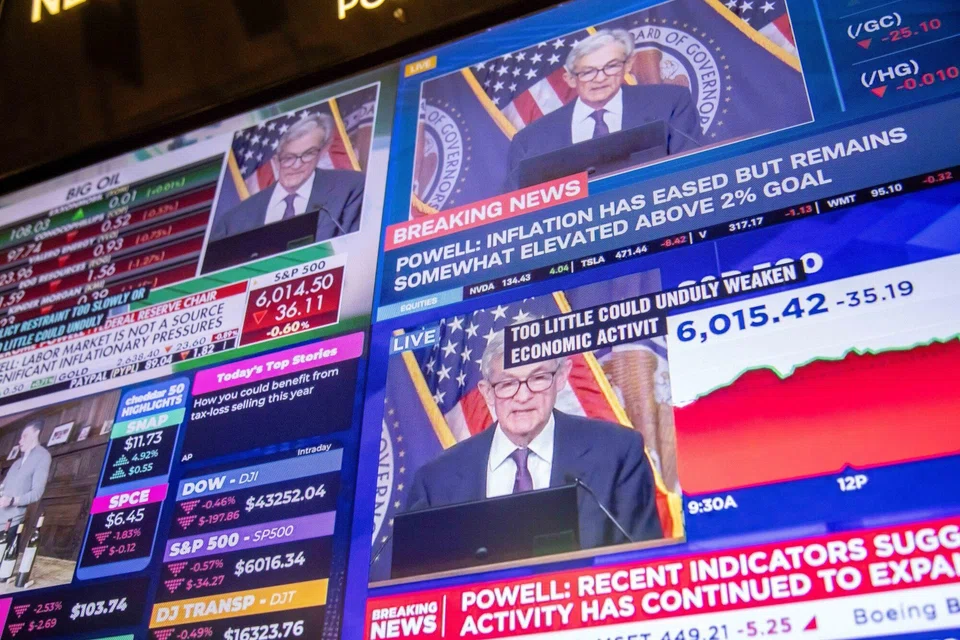
US FED chair Jerome Powell sounded almost ebullient when he responded to a question last week about whether he felt satisfied with the way 2024 is coming to an end.
“I think it’s pretty clear we have avoided a recession. Growth this year has been solid – it really has,” he said at a press conference on Dec 18, following the Federal Open Market Committee’s final meeting of 2024.
He added: “If you look around the world, there’s just a lot of slow growth and continued struggle with inflation. I feel very good about where the economy is, and the performance of the economy – and we want to keep that going.”
The market, however, seemed much less impressed than Powell. The S&P 500 Index, which has climbed strongly over the past year, closed last Friday (Dec 20) at 5,930.85 – up 24.3 per cent on a year-to date basis, but down 2 per cent for the week.
Clearly, the prospect of interest rates staying higher for longer is weighing heavily on market sentiment right now. The Fed announced a widely-anticipated 25 basis point cut in the federal funds rate last week, but indicated that there are likely to be fewer rate cuts in store for 2025.
Investors should be careful what they wish for, though. If the US economy had quickly fallen into recession when the Fed started its rate hiking cycle in 2022 – as expected by many market watchers, including myself – the S&P 500 would probably not be trading at near-record-high levels now.
Even as the Fed stays in inflation-fighting mode in 2025, continued economic expansion and corporate earnings growth may well support further advances in the S&P 500.
Indeed, the resilience of the US economy is still surprising forecasters. The median projection of participants at last week’s Fed meeting puts US gross domestic product growth at 2.5 per cent for 2024 and 2.1 per cent for 2025; and personal consumption expenditures (PCE) inflation at 2.4 per cent for 2024 and 2.5 per cent for 2025.
Back in September, Fed meeting participants were projecting US GDP growth of only 2 per cent for both 2024 and 2025; and PCE inflation of 2.3 per cent for 2024 and 2.1 per cent for 2025.
With expectations of stronger growth and inflation, participants at last week’s Fed meeting projected a federal funds rate of 3.9 per cent at end-2025, which implies two rate cuts of 25 basis points.
Back in September, Fed meeting participants had pencilled in four rate cuts for 2025.
More gains in 2025?
Exactly how much higher could the S&P 500 rise from its currently elevated levels?
FactSet offered an answer of sorts earlier this month by aggregating the median target price estimates of analysts covering the component stocks of the index. As at Dec 11, this bottom-up approach put the S&P 500 at 6,678.18 in 12 months – or 12.6 per cent above its close last week.
Among the stocks expected to see the biggest gains are those in the healthcare, materials and energy sectors – with aggregate target price gains of 19.7 per cent, 16.8 per cent and 16.7 per cent, respectively.
At the other end of the spectrum, consumer discretionary stocks could fall 3.3 per cent in 12 months.
This approach to forecasting the S&P 500 probably offers more precision than accuracy, of course. As at end-2023, the bottom-up 12-month target for the S&P 500 was 5,131.92 – which is 13.5 per cent below the index’s current level.
FactSet found that analysts’ price targets underestimated the final value of the S&P 500 in four of the last five years, but overestimated the final value of the benchmark index in 13 of the last 20 years.
With US president-elect Donald Trump due to be inaugurated on Jan 20, kicking off another four years of tumult and uncertainty, it seems unlikely that any method of forecasting the market’s direction will prove entirely accurate.
To be clear, I am not suggesting that Trump will necessarily be bad news for US stocks. If anything, the robust performance of the US market may broaden out in 2025.
FactSet said earlier this month that US corporate earnings growth is expected to accelerate to 14.8 per cent in 2025, from 9.4 per cent in 2024. The Magnificent Seven – Alphabet, Amazon, Apple, Meta Platforms, Microsoft, Nvidia and Tesla – are expected to lead with earnings growth of 21.3 per cent, down from 33.3 per cent this year.
The non-Magnificent Seven companies within the S&P 500 are forecast to deliver earnings growth of 13 per cent in 2025, up from 4.2 per cent in 2024.
Singapore market themes
Closer to home, the Straits Times Index (STI) has also performed quite well in 2024. The local benchmark index closed last Friday at 3,719.93 – down nearly 2.4 per cent for the week, but up 14.8 per cent since the beginning of the year.
On a dividend reinvested basis, the STI has delivered a total return of 21.3 per cent since the beginning of the year.
The main drivers of that performance were DBS, OCBC and UOB, which chalked up total returns of 49.4 per cent, 34.1 per cent and 33.4 per cent.
With the likely slower pace of Fed rate cuts, the three banks should maintain their currently elevated levels of profitability into 2025, putting them in a strong position to continue returning cash to investors through dividends and share buybacks.
On the other hand, real estate investment trusts (Reits) have been a notable drag on the performance of the STI in 2024. All seven Reits within the STI were in negative territory on a year-to-date basis at the end of last week.
The best performer was CapitaLand Integrated Commercial Trust, with a total return of minus 0.9 per cent. The worst performer was Mapletree Logistics Trust, with a total return of negative 23.6 per cent.
The iEdge S-Reit Leaders Index began rallying strongly in August, as the 10-year Treasury bond yield plumbed below 4 per cent and the market anticipated the Fed would begin its rate cutting cycle.
The Reit index hit a peak in mid-September and began sliding back down, just as the Fed announced a 50 basis point rate cut and the 10-year Treasury bond yield began rising again.
Assuming inflation eases next year and the Fed continues cutting rates, beaten down Reits in Singapore may be ripe for bargain hunting in 2025, in my view.
Another investment theme in the local market is value unlocking. For instance, Hongkong Land said two months ago that it will refocus its business, recycle US$10 billion in capital, and expand its assets under management from US$40 billion to US$100 billion through a combination of capital partnerships, private funds and Reits.
Hongkong Land has delivered a total return of 32.7 per cent so far this year, making it the sixth best performing STI counter.
In 2025, other real estate groups with depressed shares – such as City Developments and UOL Group – may face investor pressure to come up with similar value unlocking initiatives.
The writer owns shares in Hongkong Land and OCBC. The Mark To Market column will take a two-week hiatus over the Christmas and New Year period.
TRENDING NOW

Grab CEO’s wife Chloe Tong on life with Anthony Tan and finding her purpose

8 public officers referred to police over property buys near unannounced MRT stations: Chan Chun Sing
DBS tops trades in smaller board lots on debut of revised SGX framework

Deal between tycoon friends sparks scrutiny of Philippine power sector

