

‘New Margaret Thatcher’ faces formidable challenges
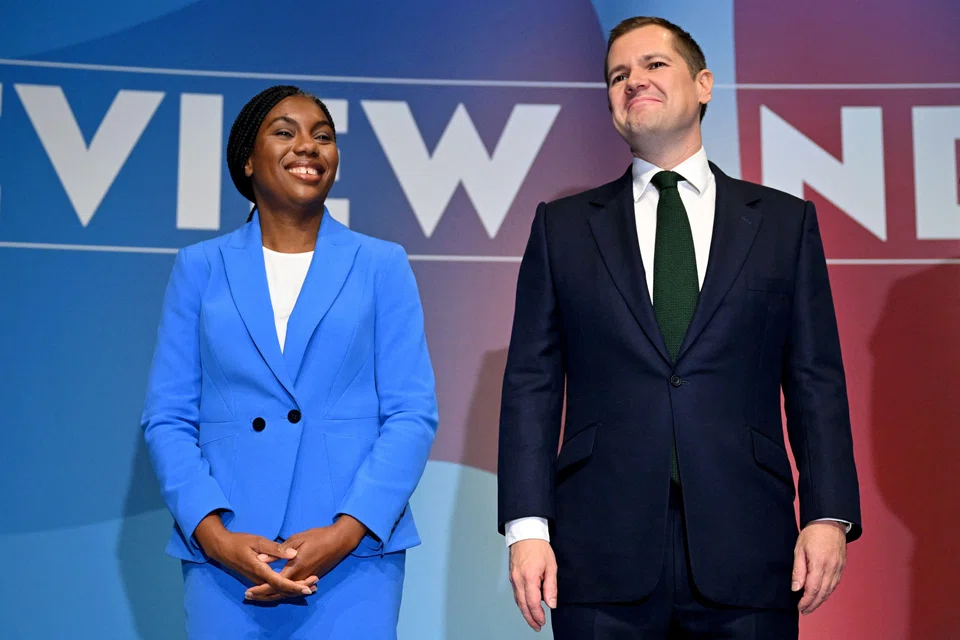
MUCH of the world’s attention is currently focused on the Nov 5 US presidential and congressional elections. Yet, Saturday (Nov 2) sees the lower-profile, but potentially consequential, internal UK Conservative ballot to elect a new leader and define the party’s future economic and political direction.
Polls indicate that the favourite is feisty, former secretary of state for business and trade Kemi Badenoch, seen by many Conservatives as a 21st-century Margaret Thatcher.
Yet, even if Badenoch scores a big victory on Saturday, she (or former secretary of state for housing, communities and local government Robert Jenrick, if he pulls off a surprise win) would defy recent history if either eventually becomes the next UK prime minister, surpassing Thatcher’s own achievement of winning power in 1979 after one term as opposition leader.
This is because the scale of the challenge facing the Conservatives today is significantly bigger than when Thatcher became the Tory leader in 1975 after the party lost power in 1974. Few seriously thought then that the Conservatives would not enter government again at some stage.
Yet in 2024, this prospect is far from assured, despite the Labour government’s uneven start in office. The Labour party secured a landslide advantage of 174 seats in the House of Commons in July, compared with its three-seat majority in October 1974. This makes it much harder for the Conservatives to defeat it in a single parliamentary term.
The political landscape also now has multiple key differences compared with the second half of the 1970s.
For one, the insurgent Reform UK, a new right-wing, populist party, is eating into the core vote of Conservatives.
This threat is made more challenging by Reform UK’s leader Nigel Farage, who has proven himself to be one of the most effective, albeit controversial, politicians of recent decades. This includes his co-leadership of the “Leave” campaign during the 2016 Brexit referendum.
Second, the Liberals have become a major political force again, winning more than 70 MPs in July. The centrist party is challenging the Conservatives for preponderance in much of southern England, whereas the Liberals of the 1970s had a much smaller total of seats.
To be sure, Badenoch is a formidable politician who should not be underestimated. Her personal journey, spending much of her childhood in Nigeria, is as remarkable as her political ascent in recent years.
Yet there are nagging doubts about her political judgment that even some Conservatives acknowledge. Some detractors even joke that her fiery temperament means that she could start a fight in an empty room.
Unquestionably, her campaign has been rocked by questions about whether she is too divisive. At the annual Conservative conference in Birmingham in September, Badenoch received negative media coverage when she asserted that maternity pay is “excessive”, and also said that some civil servants are so bad that 10 per cent of them should be in prison.
These are not isolated incidents. In 2005, she slammed Bob Geldof’s Live 8 fundraising charity concerts as patronising to Africans. In 2017, after her election as an MP, she even admitted hacking former Labour deputy leader Harriet Harman’s website.
Yet, polls indicate that Badenoch is most likely to win on Saturday. A ConservativeHome survey of party members released last week put her 24 percentage points ahead of Jenrick, with a 55-to-31 lead.
Badenoch also has the support of a growing slice of the party establishment. This includes two former leaders – Iain Duncan Smith and William Hague – who know how hard opposition is.
Part of the reason for this growing support is that many Conservatives think Badenoch would bring Thatcherite qualities to the post of leader of the opposition. This includes what they perceive as a moral clarity that makes her the natural political heir to Thatcher.
While the challenges facing Badenoch in 2024 are very different from what the so-called Iron Lady faced in the 1970s, it is clear that the former is trying to copy key elements of Thatcher’s playbook to power. An example is Badenoch’s reluctance to announce an array of new policies in recent weeks, in contrast to Jenrick.
This follows the template of Thatcher in February 1975, when she sought and won the party leadership after former prime minister Edward Heath vacated office. At the time, Thatcher was aware that the next election would probably be years away – eventually in 1979 – and therefore focused more on political principles than policies to begin with.
It was not until around two and a half years later, in October 1976, that Thatcher published The Right Approach document. This included key policies that would ultimately help define Thatcherism in the 1980s, including cutting taxation and public spending, and a strong focus on law and order.
It remains to be seen if, in the very different digital age of the 2020s, Badenoch will be able to remain in a policy-free zone for so long.
However, her instincts are towards trying to win Saturday’s leadership contest by being seen as the “best Conservative”, and only then setting out broad policy ideas, followed by specifics, with an election most likely in 2028 or 2029.
Even if this playbook proves effective, however, Badenoch would face a huge, uphill struggle to win the next election. Compared with some earlier political eras, the period since Thatcher entered 10 Downing Street in 1979 has seen each major party in government ruling for more than a decade.
The Conservatives were in power for 18 years, from 1979 to 1997, then Labour secured some 13 years in office from 1997 to 2010. This was followed by the Conservatives winning about 14 years in office from 2010 to 2024.
Given the size of Labour’s landslide in July 2024 – vastly larger than what it won in October 1974 – a second term in office in 2028 or 2029 may potentially beckon. This is far from inevitable, but it would require a remarkable turnaround in fortunes for the Conservatives to become the largest party again in the House of Commons after just one term in opposition.
This may mean that the Conservatives will require more than one leader to win office again. This would follow the pattern when the Conservatives were last in opposition from 1997 to 2010, when the party chose a succession of leaders who had mixed effectiveness.
Michael Howard (2003 to 2005) and David Cameron (2005 to 2010) moved the party back to power, while Duncan Smith (2001 to 2003) and Hague (1997 to 2001) proved less effective.
Taken together, this is why the political mountain facing Badenoch, or Jenrick, is so big as the next leader of the opposition. The UK landscape facing the Conservatives in the mid-2020s is significantly more challenging for the party than a half-century earlier when Thatcher plotted her path to power.
The writer is an associate at LSE IDEAS at the London School of Economics
TRENDING NOW

Britain’s mansion tax shows the difficulty of targeting wealth

Once staunchly pro-China, Malaysian Chinese businesses are now distancing themselves from Beijing

The only common thing in S-E Asia is that we all eat rice: Cisco’s Asean president

Singapore data centre operator DayOne opts for US IPO at likely US$20 billion valuation

