HOCK LOCK SIEW

No hope, no way out for No Signboard’s investors short of exit offer or winding up company

Uma Devi
Published Wed, Feb 7, 2024 · 05:00 AM
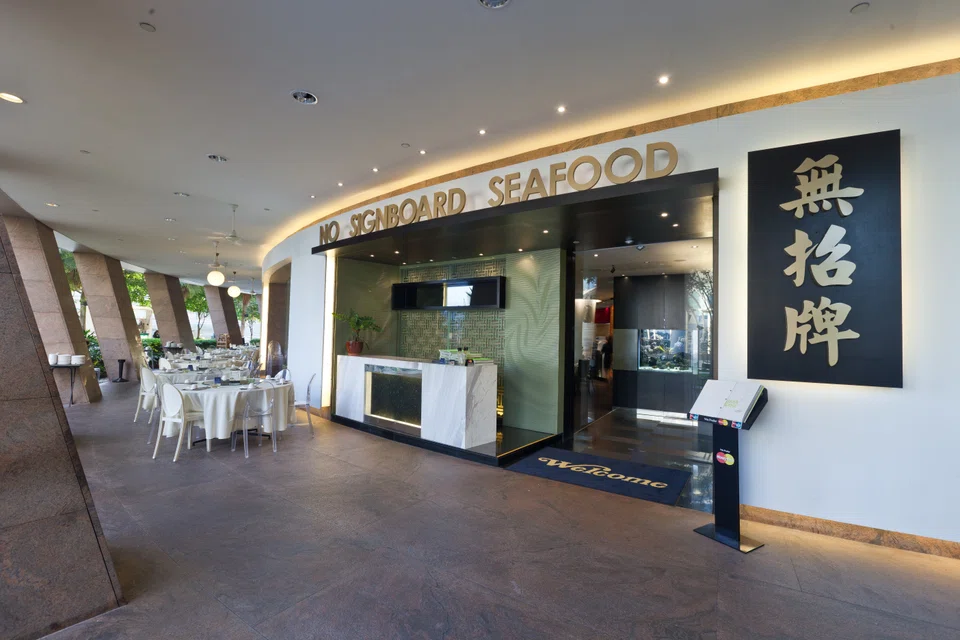
    • It appears that No Signboard is banking all its hopes on a memorandum of understanding inkned with Gazelle Ventures for up to S$5 million in investments.
    • It appears that No Signboard is banking all its hopes on a memorandum of understanding inkned with Gazelle Ventures for up to S$5 million in investments. PHOTO: NO SIGNBOARD

    LONG-SUFFERING shareholders of No Signboard Holdings have had no lack of reasons to feel aggrieved. 

    The final straw might have been when the restaurant operator’s auditor, PKF-CAP, in January flagged uncertainty about whether the group would be able to continue operating as a going concern.

    Among other things, No Signboard’s net loss for FY2022 came in at S$4.7 million, and its total liabilities exceeded total assets by S$7.1 million.


    This comes as its number of outlets has dwindled; it has shuttered its restaurants in locations such as Esplanade mall and Clarke Quay, and is now left with one outlet in Geylang.

    It also runs a casual dim sum speciality shop – branded as nosignboard Sheng Jian – in Northpoint City in Yishun. 

    Another brand under the No Signboard umbrella – hotpot chain Little Sheep – terminated its franchise agreement last year because of the group’s failure to set up the agreed-upon number of new restaurants.

    Under the decade-long agreement, No Signboard was supposed to have launched one restaurant a year for the first five years.

    No Signboard owed Little Sheep an outstanding payment of US$61,695.85 in late fees and penalties. Little Sheep also demanded that the restaurant operator cover the losses incurred as a result of the termination. 

    What could be particularly frustrating for its minority shareholders, however, is that they have no way out of the mess.

    The stock has been suspended from trading on the Singapore Exchange (SGX) since Jan 24, 2022.

    The company has said that one of its priorities at the moment is to resume trading, and that it has submitted a trading-resumption proposal to the bourse.

    It might perhaps be better off for it to begin winding down – or for its majority shareholders to make a fair and reasonable offer to acquire all the shares they do not already own.

    Meanwhile, the management needs to do more, including examining its business model, cost structure and the financing options available in the market. 

    Too many eggs in one basket

    It appears that No Signboard is banking all its hopes on a memorandum of understanding (MOU) that it inked with one Gazelle Ventures for up to S$5 million in investments.

    Of that sum, S$500,000 is to be secured through the subscription of new shares that will constitute 75 per cent of the company’s enlarged share capital, while the remaining S$4.5 million will be through a convertible instrument. 

    Such investments are typically used by listed companies for working capital, or as a way to pare debt. 

    Singapore-incorporated Gazelle – jointly owned by Gazelle Capital and Valiant Investments – invests in food, agri-tech and sustainable agriculture-related businesses. 

    A question hangs over what good Gazelle can do for No Signboard, especially since it will hold a 75 per cent stake at the end of its investment. 

    Gazelle has also shown some hesitation. On May 26, 2023, it had requested that No Signboard return the full investment amount until the preceding conditions under the agreement were fulfilled or waived. Gazelle said then that it was concerned that the delay in the completion of the agreement posed a risk to it. 

    However, it withdrew the request shortly after. No Signboard said this was “a show of their support for the company’s trading-resumption proposal”. 

    No Signboard’s list of troubles, however, appear to be more than something that a sum of S$5 million can cover. 

    As part of the company’s audit, PKF-CAP said there were indicators of impairment in plant and equipment at No Signboard’s restaurants, as well as its related right-of-use assets. These charges amounted to S$807,564 and S$1.4 million, respectively. 

    These impairments could be just the tip of the iceberg. Other liabilities could come to light if more rigorous and thorough checks are done.

    The uncertainty in the food and beverage industry, both locally and globally, could also push No Signboard to fork out money to cover additional liabilities as and when they arise. 

    Realistically, the company should recognise that S$5 million will not last very long, especially since its total liabilities are already higher than its assets. In that case, it should start looking at other ways it can secure funds from means apart from bank borrowings. 

    What’s next?

    No Signboard should consider putting investors out of their misery.

    One option would be for the company to begin winding down, and selling its assets. But for shareholder reprieve, controlling shareholder GuGong might have to make a move to acquire all the shares of the company. 

    According to Bloomberg data, it owns 54.9 per cent of No Signboard’s shares, and Su Haijin – one of several accused in the high-profile billion-dollar money-laundering bust – owns 20 per cent. 

    GuGong, which has had disputes with No Signboard, could make an offer to acquire all shares of the company at a fair and reasonable price. It could then restructure the company, or turn No Signboard into a shell company to use for its own business activities. 

    Regulators, however, will have to ensure that minority shareholders’ interests are protected.