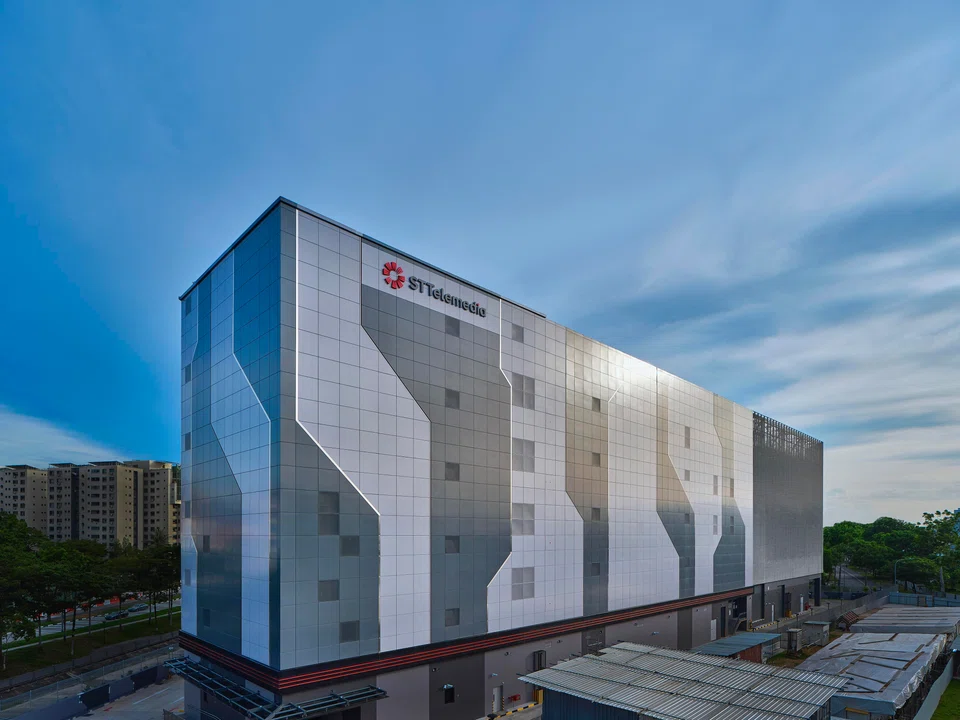
No longer a ‘boring’ telco: Singtel’s multibillion-dollar data centre bet with KKR to power its transformation
By teaming up with KKR to take a controlling stake in STT GDC, the telco is moving from the regional league to the global main stage

[SINGAPORE] When the market whispers about a S$13.8 billion deal, people usually listen. But when Singtel and private equity giant KKR are the ones doing the talking – and the target is ST Telemedia Global Data Centres (STT GDC) – the market doesn’t just listen; it rallies.
Singtel shares climbed 1.1 per cent on Monday (Feb 2) on reports over the weekend that a KKR-Singtel consortium was nearing a deal. Sovereign wealth funds GIC from Singapore and Mubadala from Abu Dhabi were also said to be in talks to join as minority co-investors.
As anticipation built, shares of the Singapore-listed telecom company soared another 4.7 per cent on Tuesday to close at S$4.86. It opened at S$4.95 on Wednesday, after the deal was announced earlier in the morning.
That’s all in the region of the all-time high of S$4.88 set in November last year, when rumours last surfaced that KKR and Singtel were in “advanced talks” to buy STT GDC.
Already, Singtel was one of the better performers among Singapore’s blue-chip counters in 2025. It generated a total return with dividends reinvested of 54.1 per cent for the full year, nearly double the 28.8 per cent total return of the benchmark Straits Times Index (STI).
The optimism over Singtel is palpable, and for good reason.
The consortium-led buyout of Temasek-owned STT GDC isn’t just one of the largest digital infrastructure deals in Asia; it marks the moment Singtel finally sheds its “boring telco” skin for good.
For years, Singtel has been preaching the gospel of capital recycling. It sold bits of Airtel, trimmed stakes in non-core assets and hoarded cash. Now, we see where that war chest is headed.
By teaming up with KKR to take a controlling stake in STT GDC, Singtel is moving from the regional arena to the global main stage.
While its own data centre arm, Nxera, is a formidable regional player, STT GDC is a different beast entirely.
We are talking about 2.3 gigawatts of total IT load capacity; a footprint spanning 100 facilities across the UK, Germany, Italy, South Korea, India and South-east Asia; and a valuation that reflects the artificial intelligence (AI) premium currently sweeping through the infrastructure world.
Data centres sit at the confluence of trends Singtel has been positioning itself around for years: cloud adoption, AI workloads and the rising need for secure, carrier-neutral infrastructure across Asia and Europe.
By folding STT GDC into its stable, Singtel gains immediate scale, geographic reach and a portfolio that would have taken years to replicate organically.
The deal also reinforces the management’s message that capital recycling is no longer a slogan, but an operating principle.
Proceeds from asset monetisation, including stakes in overseas associates, are increasingly being redeployed into businesses with longer growth runways and more predictable cash flows.
Data centres, while capital-intensive, offer contracted revenues and inflation-linked pricing that contrast favourably with the margin pressures facing traditional telco services.
For investors, the synergy is obvious. Nxera brings the specialised, liquid-cooled “AI-ready” tech that can handle the heat of Nvidia’s latest chips; STT GDC brings the massive, global real estate. It is a marriage of brain and brawn.
Some critics may call it a “left pocket to right pocket” transfer of assets. STT GDC is a unit of ST Telemedia, which is wholly owned by Singapore investment company Temasek. Singtel, too, is majority-held by Temasek.
But, for the savvy observer, this is strategic consolidation.
Bringing STT GDC under the umbrella of Singtel and KKR benefits the enlarged entity given the latter’s infrastructure expertise and financial muscle. Further down the road, the business could be in prime position for an eventual mega-initial public offering or spin-off.
At what cost?
KKR and Singtel on Wednesday announced the acquisition of the remaining 82 per cent stake in STT GDC from ST Telemedia for S$6.6 billion.
This represents an implied enterprise value of about S$13.8 billion, including leverage and capital expenditure for committed projects.
There was no mention of GIC or Mubadala in the announcement as widely anticipated, but it is believed that they are indirectly invested through KKR.
At S$6.6 billion, however, the deal implies a valuation far higher than late last year, when KKR and Singtel were said to be seeking a loan of S$5 billion to finance the deal. Much of this markup is likely driven by the AI frenzy.
In October last year, an investor group including BlackRock, Microsoft and Nvidia moved to buy US-based Aligned Data Centers – one of the world’s biggest data centre operators with nearly 80 facilities – in a deal worth US$40 billion.
That was part of a series of big-ticket deals involving Big Tech and Silicon Valley startups fuelled by the boom in AI.
Major tech companies including Alphabet, Amazon, Meta and Microsoft were forecast to splash out some US$400 billion on AI infrastructure in 2025, according to Morgan Stanley estimates.
Meanwhile, Goldman Sachs estimates that global AI-related infrastructure spending could reach US$3 trillion to US$4 trillion by 2030.
Apparently, data centres are the new oil – and everyone wants a well.
Analysts are optimistic that Singtel can fund its portion of the debt relatively comfortably on the back of its asset monetisation initiatives.
Singtel recently raised S$1.5 billion from selling a stake in India’s Bharti Airtel, bringing its asset recycling proceeds to a total of S$5.6 billion since the start of the Singtel28 plan.
By partnering KKR, Singtel avoids shouldering the entire liability on its own balance sheet. Much of the deal’s debt will likely be “ring-fenced” at the consortium level rather than sitting directly on Singtel’s books.
The market should not see this as reckless borrowing, but as a strategic swop: trading mature, low-growth telco stakes for high-growth, AI-ready infrastructure. For income investors, this is the “Goldilocks” scenario: growth without the threat of a credit-induced dividend cut.
However, data centres have a notoriously big appetite for capital expenditure requirements, and investors will be watching closely to see if this massive commitment of capital eats into the healthy dividend payouts they’ve grown accustomed to.
Dividend yield
Despite the heavy investment in data centres, Singtel’s dividend yield is projected to remain one of the most attractive among the blue-chip constituents of the STI.
Analysts from RHB, for example, estimate a forward dividend yield of 4.2 per cent for the 2026 financial year ending March, and 4.4 per cent for FY2027 and FY2028.
On the upside, the move into STT GDC provides a growth engine that traditional mobile services simply cannot match.
If the consortium can navigate the execution risks of merging two massive platforms, Singtel might just find itself rerated as a high-growth infrastructure play.
For now, the bulls are in charge. Singtel is no longer just a company that sells you a SIM card; it is becoming a landlord of the Internet.
TRENDING NOW
Grab CEO’s wife Chloe Tong on life with Anthony Tan and finding her purpose
Income Insurance appoints former Manulife Singapore top man as new CEO
Incidence of civil servants buying property near unannounced MRT stations ‘a concern’, but may not establish misconduct: PSD
Three ex-employees of Envy group join Ng Yu Zhi in bankruptcy