THE BROAD VIEW

The Nobel laureate who liked to collaborate with his adversaries

Psychologist Daniel Kahneman insisted on the value of working with those with whom we disagree
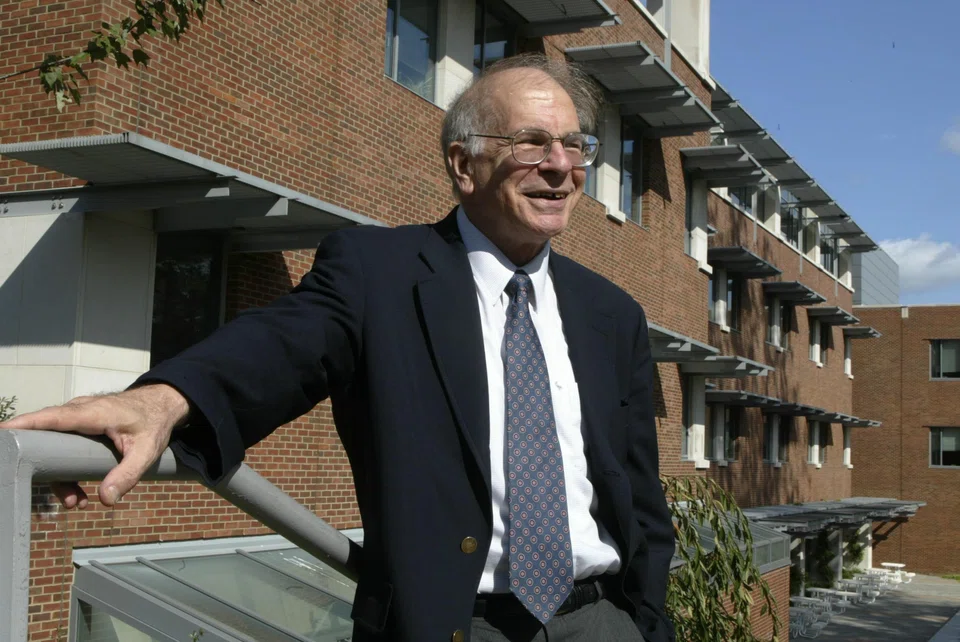
    • Kahneman is best known for his path-breaking explorations of human judgment and decision-making, and of how people deviate from perfect rationality.
    • Kahneman is best known for his path-breaking explorations of human judgment and decision-making, and of how people deviate from perfect rationality. PHOTO: NYTIMES
    Published Fri, Apr 5, 2024 · 08:00 AM

    OUR all-American belief that money really does buy happiness is roughly correct for about 85 per cent of us. We know this thanks to the latest and perhaps final work of Daniel Kahneman, the Nobel Prize winner who insisted on the value of working with those with whom we disagree.

    Prof Kahneman, who died on Mar 27 at the age of 90, is best known for his path-breaking explorations of human judgment and decision-making, and of how people deviate from perfect rationality. He should also be remembered for a living and working philosophy that has never been more relevant: his enthusiasm for collaborating with his intellectual adversaries.

    This enthusiasm was deeply personal. He experienced real joy working with others to discover the truth, even if he learnt that he was wrong (something that often delighted him).


    Back to that finding, published last year, that for a strong majority of us, more is better when it comes to money. In 2010, Prof Kahneman and the Princeton economist Angus Deaton (also a Nobel Prize winner) published a highly influential essay that found that on average, higher-income groups show higher levels of happiness – but only to a point.

    Beyond a threshold at or below US$90,000, Profs Kahneman and Deaton found, there is no further progress in average happiness as income increases.

    Eleven years later, Matthew Killingsworth, a senior fellow at the Wharton School of the University of Pennsylvania, found exactly the opposite: People with higher income reported higher levels of average happiness. Period. The more money people have, the happier they are likely to be.

    What gives? You could imagine some furious exchange in which Profs Kahneman and Deaton made sharp objections to Dr Killingsworth’s paper, to which Dr Killingsworth answered equally sharply, leaving readers confused and exhausted.

    Prof Kahneman saw such a dynamic as “angry science”, which he described as a “nasty world of critiques, replies and rejoinders”, and “as a contest, where the aim is to embarrass”.

    As Prof Kahneman put it, those who live in that nasty world offer “a summary caricature of the target position, refute the weakest argument in that caricature, and declare the total destruction of the adversary’s position”. In his account, angry science is “a demeaning experience”. That dynamic might sound familiar, particularly in our politics.

    Instead, Prof Kahneman favoured an alternative that he termed “adversarial collaboration”. When people who disagree work together to test a hypothesis, they are involved in a common endeavour. They are trying not to win, but to figure out what is true. They might even become friends.

    In that spirit, Prof Kahneman, well into his 80s, asked Dr Killingsworth to collaborate, with the help of a friendly arbiter, Prof Barbara Mellers, an influential and widely admired psychologist. Their task was to look closely at Dr Killingsworth’s data to see whether he had analysed it properly, and also to understand what, if anything, had been missed by Profs Kahneman and Deaton.

    Their central conclusion was simple. Dr Killingsworth missed a threshold effect in his data that affected only one group: the least happy 15 per cent. For these largely unhappy people, average happiness does grow with rising income, up to a level of around US$100,000; but it stops growing after that. For a majority of us, by contrast, average happiness keeps growing with increases in income.

    Both sides were partly right and partly wrong. Their adversarial collaboration showed that the real story is more interesting and more complicated than anyone saw individually.

    Prof Kahneman engaged in a number of adversarial collaborations, with varying degrees of success. His first (and funniest) try was with his wife, the distinguished psychologist Anne Treisman. Their disagreement never did get resolved (Dr Treisman passed away in 2018). Each of them was able to explain away the results of their experiments – a tribute to what Prof Kahneman called “the stubborn persistence of challenged beliefs”.

    Still, adversarial collaborations sometimes do produce both agreement and truth, and Prof Kahneman added that “a common feature of all my experiences has been that the adversaries ended up on friendlier terms than (when) they started”.

    Prof Kahneman meant both to encourage better science and to strengthen the better angels of our nature. In academic life, adversarial collaborations hold great value. We could easily imagine a situation in which adversaries routinely collaborated to see if they could resolve disputes about the health effects of air pollutants, the consequences of increases in the minimum wage, the harms of climate change or the deterrent effects of the death penalty.

    And the idea can be understood more broadly. In fact, the United States Constitution should be seen as an effort to create the conditions for adversarial collaboration. Before the founding, it was often thought that republics could work only if people were relatively homogeneous – if they were broadly in agreement with one another.

    Objecting to the proposed Constitution, the pseudonymous anti-federalist Brutus emphasised this point: “In a republic, the manners, sentiments and interests of the people should be similar. If this be not the case, there will be a constant clashing of opinions; and the representatives of one part will be continually striving against those of the other.”

    Those who favoured the Constitution thought that Brutus had it exactly backward. In their view, the constant clashing of opinions was something not to fear but to welcome, at least if people collaborate – if they act as if they are engaged in a common endeavour.

    Sounding a lot like Prof Kahneman, Alexander Hamilton put it this way: “The differences of opinion, and the jarrings of parties (in the legislative department of the government) often promote deliberation and circumspection, and serve to check excesses in the majority”.

    Angry science is paralleled by angry democracy, a “nasty world of critiques, replies and rejoinders”, whose “aim is to embarrass”. That is especially true, of course, in the middle of political campaigns, when the whole point is to win.

    Still, the idea of adversarial collaboration has never been more important. Within organisations of all kinds – including corporations, nonprofits, think tanks and government agencies – sustained efforts should be made to lower the volume by isolating the points of disagreement and specifying tests to establish what is right.

    Asking how a disagreement might actually be resolved tends to turn enemies, focused on winning and losing, into teammates, focused on truth.

    As usual, Prof Kahneman was right. We could use a lot more of that. NYTIMES

    The writer is a law professor at Harvard and an author of Noise with Daniel Kahneman and Olivier Sibony