

Obesity is ballooning – and office life can make it worse
Workplace routines can encourage unhealthy eating habits and sedentary behaviour

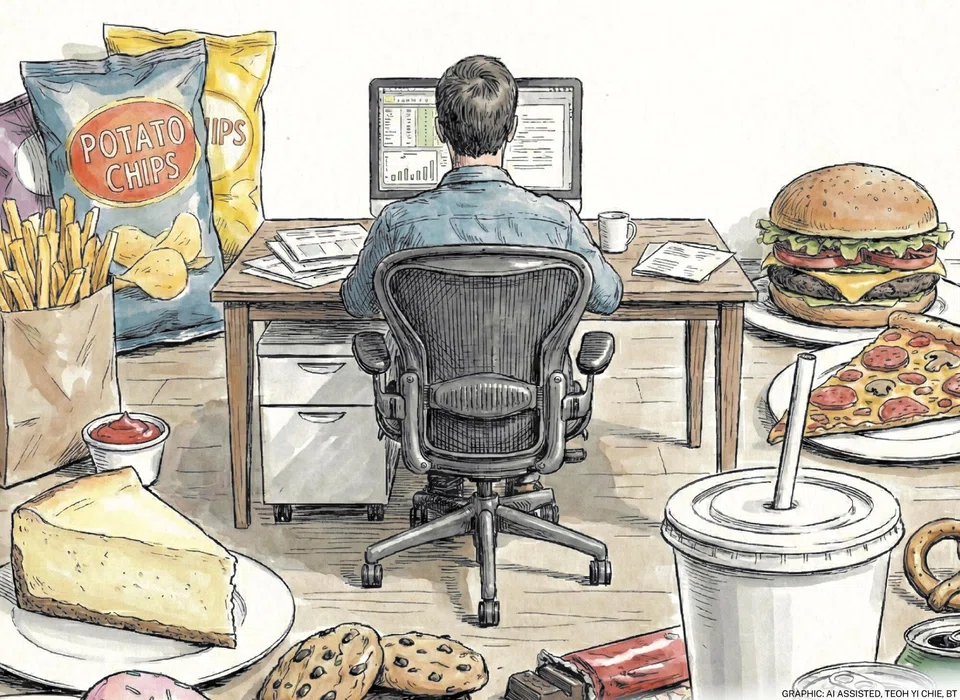
[SINGAPORE] Like many white-collar workers in Singapore today, Sathiya Sundar goes to the office three days a week. The communications professional has had this hybrid arrangement for two years – and sees a clear difference between the days spent in the office and those at home.
When he has to go into office, his day stretches to about 10.5 hours, including an hour spent commuting to and fro. Meals are heavier, eaten out with colleagues, rather than being home-cooked.
When he works from home, the routine is different. He starts earlier, snacks lightly through the day instead of having a heavy lunch, and often finds the mental space to exercise after work.
“If it’s an office day, I find it harder to motivate myself,” says Sathiya. “By the time I get home, I usually end up putting exercise off altogether.”
As an increasing number of workers spend more time in the office, they might make similar discoveries.
Several years after the Covid-19 pandemic normalised hybrid work, many employers are trying to make it less common again. While not all are mandating a full five-day return, attendance is firming up as organisations settle into more regular on-site routines.
That shift is also visible in the property market. As reported by The Business Times, office landlords have become more assertive about raising rents.
This is buoyed by firmer leasing sentiment and stronger demand for higher-quality space – reflecting expectations that offices will be occupied more consistently.
But rising office time has implications for everyday health – a serious concern, not least as population health indicators are already moving in the wrong direction.
A weaker baseline
Singapore’s obesity rate rose to 12.7 per cent in 2023 to 2024, up from 10.5 per cent four years earlier, said the National Population Health Survey released last October.
The highest obesity rate was for those aged 30 to 39 years. It climbed to 14.9 per cent, from 12.4 per cent previously.

For those aged 18 to 29, the rate almost doubled over the same period to 11.6 per cent, from 6.6 per cent before. This was despite this age group having the highest prevalence of sufficient total physical activity each week, at 89.7 per cent.
But the definition of physical activity is broad. Commuting accounted for the largest share overall, at 51.6 per cent, followed by leisure-time physical activity (24.7 per cent) and work-related activity (23.6 per cent).
In other words, the survey has given equal weight to commuting – which may just mean short walks to and from bus stops or train stations – and longer weekend walks or cycling, for instance.
Yet, commuting might actually decrease the time spent on dedicated exercise, says Susan Fanning, head of well-being solutions for Asia-Pacific at professional services firm Aon.
According to World Health Organization guidelines, adults should aim for at least 150 minutes of moderate-intensity physical activity a week, or 75 minutes of vigorous activity, or a combination of the two. But this often proves difficult, with many already strapped for time.
Dr Khoo Chin Meng, a senior consultant and head of the endocrinology division at National University Hospital, has noticed that including regular exercise in their schedules is often a challenge for many of his patients.
Some may underestimate the need for such exercise, too. Says Dr Khoo: “They think metabolic disease won’t affect them because they are still young, walk to the MRT (station) or a bus stop, don’t smoke or drink excessively, and their body weight has not changed much over the years.”

Another factor that is misunderstood is abdominal obesity. It is often seen as an “aesthetic issue” rather than a medical one, notes Dr Nitya Venkiteswaran, medical adviser for medical and regulatory affairs at Novo Nordisk Singapore, a manufacturer of weight-loss pills.
But the build-up of excess fat around one’s stomach is often associated with reduced insulin effectiveness and other related metabolic health issues, she points out.
“Reduced insulin effectiveness matters because it makes it harder for the body to regulate blood sugar levels, increasing the risk of conditions such as Type 2 diabetes, heart disease and other metabolic health problems over time,” adds Dr Nitya.
The impact of office routines
According to a 2025 report by insurance broker Howden Singapore, 60 per cent of employees gain an average of 3 kg a year in their first job.
The office environment normalises extended hours of sitting, with limited movement, says Sarah Wong, senior director for employee benefits at Howden.
These habits “become ingrained early” and set the stage for chronic conditions such as obesity and diabetes, she adds.
Easy access to calorie-dense food may also encourage snacking, especially when long hours and work pressure leave employees drained.
Annelise Lai, a senior psychologist and founder of Soma Psychology Clinic, says the stress of the modern workplace does not just cause fatigue, but may affect how we eat.
“It actively hijacks our body’s biological systems, confusing the fundamental signals that tell us when we are hungry or full.”
This comes from a significant hormonal change, not a simple failure of willpower, she explains. Chronic stress keeps cortisol – the stress hormone – constantly elevated, signalling a need for quick, energy-dense food as the body prepares for survival.

“This drives the intense craving for sugar and fat, as the body prepares for a perceived ‘crisis’. This isn’t a conscious choice; it’s a primal directive from the brain,” she says.
“After a long, mentally taxing day, the part of the brain responsible for impulse control is depleted. Our rational self knows we should choose a balanced meal, but the exhausted brain defaults to the easiest, fastest source of pleasure, usually the most calorically rewarding options.”
The office environment can reinforce these biological and psychological responses, she adds. Eating while working and frequent snacking at one’s desk are widely accepted, while pantries and shared treats keep highly rewarding food constantly within arm’s reach.
For some high-performing workers, the trip to the coffee machine or pantry may be the “only acceptable mini-break they grant themselves because resting is often viewed as weakness”, she says.
Sleep debt further exacerbates the problem.
In Singapore, more than half the population sleeps less than seven hours a night, according to a 2024 survey by market research firm YouGov.
Going about one’s daily duties on insufficient sleep leaves energy reserves low, says Lai. When fatigue sets in, the brain seeks the fastest possible lift: typically sugar, caffeine or processed carbohydrates.
Over time, the act of seeking brief mental relief becomes closely conditioned to food, entrenching a pattern that is quick but maladaptive for managing workplace pressure, she adds.
Fatigue can also cause some individuals to put off exercising, says Dr Vivien Lim, a specialist in endocrinology at Gleneagles Medical Centre.
And workplace routines often involve additional social eating, she adds.
“There might be social gatherings or client engagements that would entail more meals or suppers, which might include alcohol, all of which contribute to calories.”
Helping employees get healthier
Given that employees spend a significant portion of their waking hours at work, the workplace becomes a “powerful determinant of health behaviours”, says Howden’s Wong.
Yet, as Aon’s Fanning notes, many employers continue to treat employee well-being as something that can be tackled through “siloed programmes and perks rather than a cultural imperative”, which limits the impact of such efforts.

For example, offering benefits such as gym memberships without addressing broader issues – such as workload pressures or shift fatigue – risks having little effect, as employees may lack the time, energy or capacity to use them.
“Organisations that don’t embed well-being into policies and leadership training risk superficial engagement,” says Fanning.
She notes that progressive companies in industries such as tech and professional services are tying workers’ well-being to the key performance indicators of their leadership.
Employee health should be seen as a business imperative rather than a human resource issue, says Wong. If employees’ physical and mental health decline, this could mean higher absenteeism, lower productivity and, ultimately, revenue loss.
Employers that take a more holistic approach to well-being are also better placed to compete for talent, she adds.

Howden’s report, which examined workers’ expectations of workplace support, found that benefits linked to maintaining “optimal health at every age” ranked among their top five priorities.
The other four priorities were flexible work arrangements, mental health support, help across different life stages, and opportunities for meaningful work.
More than four in five employees in Singapore are more likely to stick with companies that offer such benefits, found the report.
But achieving better health outcomes does not require dramatic changes. Novo Nordisk’s Dr Nitya says that even modest changes in the work environment can lead to meaningful improvements in metabolic health over time.
“The most effective strategies encourage healthier choices, make them accessible, and integrate them into daily routines.”
What employers and workers can do
Movement
- Break up long periods of sitting with standing meetings, walking discussions or activity breaks.
- Design offices to encourage movement; for example, placing printers or shared facilities further away.
Food
- Avoid long fasting periods and large late dinners.
- Have a balanced breakfast or early meal with protein and fibre.
- Eat more whole grains, vegetables, fruits, legumes and unsaturated fats.
- Provide healthier options at work, not energy-dense snacks.
Stress and sleep
- Have clearer break structures and limit back-to-back meetings.
- Set after-hours boundaries and allow work-schedule flexibility.
- Get seven to nine hours of regular sleep; this helps appetite regulation and glucose metabolism.
Early detection
- Encourage regular health screenings and basic health education to help employees identify risks early.
She adds: “Ultimately, sustainable improvements occur when organisations view metabolic health not just as individual responsibility, but as a part of a broader ecosystem of workplace well-being.
“Leadership matters. When leaders model and normalise healthier habits, employees are more likely to adopt them consistently.”






