OCBC should put its properties into a Reit and distribute the trust’s units to shareholders
Redeveloped Chulia and Church Streets properties can anchor a Reit
WHAT does not kill one makes one stronger. This adage might aptly describe Singapore’s listed banking trio, which have emerged strongly from the Covid-19 pandemic.
Take Singapore’s longest established bank, OCBC . It was formed in 1932 from the merger of three local banks, the oldest of which was founded in 1912.
Shareholders who gather at the bank’s annual general meeting (AGM) on Apr 30 at Sands Expo & Convention Centre will have much to celebrate.
OCBC’s net profit attributable to equity holders for 2023 of S$7 billion was 44 per cent higher than pre-pandemic in 2019.
In 2023, return on equity (ROE) was 13.7 per cent, versus 11.2 per cent in 2019. Meanwhile, the bank’s common equity tier 1 capital adequacy ratio rose from 14.9 per cent in 2019 to 15.9 per cent in 2023. The bank enjoys high credit ratings by major rating agencies.
Shareholders are also being rewarded. Including the proposed final dividend, OCBC’s full year dividend per share for 2023 is S$0.82, up 21 per cent from a year ago and 55 per cent from 2019.
For 2024, OCBC’s ROE target is 13 to 14 per cent. If the bank continues achieving double-digit ROE, shareholders can look forward to continued growth in profit and dividend going forward.
Unlocking property value
Perhaps the bank should reward its shareholders with a special dividend linked to its property holdings in a few years’ time.
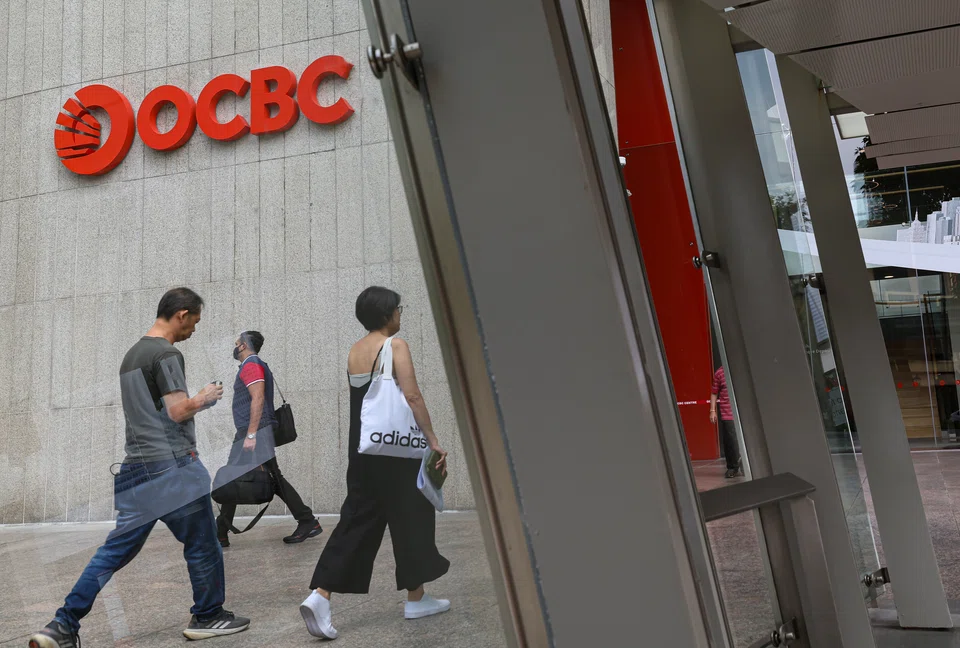
Early this month, OCBC said it is exploring the redevelopment of its 63, 65 Chulia Street and 18 Church Street properties to rejuvenate a strategic area in the Central Business District (CBD). The bank’s head office is located at OCBC Centre, 65 Chulia Street, and was designed by the late IM Pei.
The said possible redevelopment of properties, sitting on over 120,000 square feet (sq ft) of land, could create a new development with office, retail and hospitality components.
Assuming a plot ratio of 8.4, gross floor area (GFA) will exceed 1 million sq ft. If the price per square foot of GFA is S$2,500 or more, gross development value can top S$2.5 billion.
Possibly, the redevelopment’s scale might be even larger depending on what is being planned and approved.
OCBC’s shareholders should welcome the redevelopment of the Chulia Street and Church Street properties as it optimises their value. Also, the bank can have a new head office building, which will help in brand building and attracting as well as retaining talent.
Should the bank proceed with the said redevelopment, it may need to transfer relevant properties to a partner to undertake the project. Upon its completion, the partner can then transfer the properties back to OCBC.
The bank’s property holdings are sizeable. It has investment properties with a market value of S$2.7 billion as at end-2023.
Might owning properties be inefficient for the bank and possibly a drag on ROE?
Reit rationale
Bundling the redeveloped Chulia Street and Church Street properties plus other property assets of the group into a Singapore-listed real estate investment trust (Reit) in a few years’ time makes sense.
Units in the said trust, which might hold several billion Singapore dollars worth of properties, can be distributed to OCBC’s shareholders via a dividend in specie.
Such a Reit will have adequate size and free float. It will also be anchored by high-quality assets, namely the redeveloped Chulia Street and Church Street properties.
Potentially, such a Reit can differentiate itself from the trusts with external managers, which dominate the local bourse, by being internally managed, where unitholders own the manager. An internally managed trust may have lower management costs compared with externally managed trusts.
Importantly, having properties held through a Reit could result in greater focus on extracting value from active asset management. After all, a few billion dollars worth of properties will likely get much less management attention when they belong to a banking group with total assets of S$581.4 billion as at end-2023, where property may be a non-core business, versus being owned by a Reit.
OCBC need not own its head office space. To get security of tenure, it can sign a long-term lease. The organisation can also command much bargaining power in the leasing market due to its large space requirement.
Meanwhile, the bank’s shareholders might welcome receiving Reit units. Shareholders who want to cash in can sell their units. Others can hold onto their units to collect recurrent income and enjoy potential asset appreciation.
The bank’s shareholders who gather at its upcoming AGM may be concerned that the redevelopment of OCBC Centre, which was completed 48 years ago and nicknamed the calculator, needs to be done sensitively given the building’s rich heritage.
Still, redeveloping OCBC Centre and its neighbouring buildings can create a new CBD landmark which meets the needs of today’s space users.
Given the bank’s expertise in helping companies structure their business holdings and tap capital markets, the bank’s management should be able to package a redeveloped OCBC Centre and its neighbouring buildings plus other properties into a Reit vehicle that trades well.
Looking ahead, OCBC’s shareholders can perhaps ride on the bank working to be Asia’s leading financial services partner for a sustainable future while owning the bank’s properties via a separately listed trust.
The writer owns shares in OCBC