THE LEVEL GROUND

OCBC should sell Chulia Street properties so assets can be redeveloped to benefit Singapore

Divesting these buildings will also help create shareholder value

Summarise
Leslie Yee
Published Mon, Mar 31, 2025 · 05:18 PM
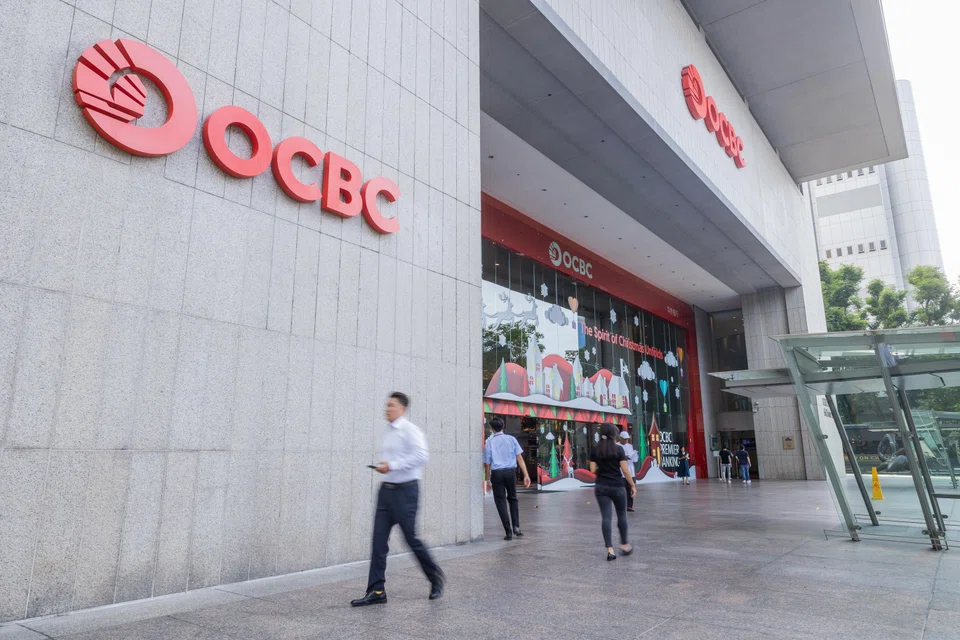
    • Let a property group create a new landmark by redeveloping the OCBC Centre cluster of buildings.
    • Let a property group create a new landmark by redeveloping the OCBC Centre cluster of buildings. PHOTO: BT FILE

    SHAREHOLDERS of OCBC who gather at the annual general meeting on Apr 17 should be generally upbeat. 

    The bank’s net profit rose 8 per cent from a year ago to S$7.6 billion in 2024. Including the recommended final dividend and special dividend, dividend per share for 2024 will total S$1.01, up 23 per cent from that in 2023.

    However, some shareholders may have reservations over how well OCBC, led by group chief executive officer Helen Wong, who took the helm in April 2021, is performing relative to market leader DBS . 

    OCBC posted return on equity (ROE) of 11.1 per cent, 13.7 per cent and 13.7 per cent, respectively, in 2022, 2023 and 2024 – well below DBS’ ROE of 15 per cent, 18 per cent and 18 per cent in 2022, 2023 and 2024, respectively.

    Perhaps, shareholders might also want to know how Wong and the OCBC board are optimising the value from the bank’s ownership of 63, 65 Chulia Street and 18 Church Street in Singapore’s Central Business District (CBD).

    Completed in 1976, OCBC Centre, at 65 Chulia Street, comprises a 50-storey tower, where OCBC’s head office is housed, and a car park block. 

    OCBC Centre South at 18 Church Street, completed in 1985, comprises a seven-storey building with a basement. The 15-storey OCBC Centre East at 63 Chulia Street, was completed in 1996.

    In early April 2024, OCBC said that it was exploring the redevelopment of the trio of properties to rejuvenate a strategic area in the CBD. 

    Huge capital outlay

    However, when OCBC announced its full-year results for 2024 in late February, Wong mentioned in her presentation deck that the bank will defer planning for redevelopment of the OCBC Centre cluster of buildings.

    Certainly, there are good reasons to put the redevelopment plans on the back burner.

    As it stands, the bank does not appear to be running out of space at the trio of buildings to house its operations. 

    Any redevelopment work may take several years and entail costly relocation to temporary premises for affected staff assuming the bank moves back to occupy the redeveloped buildings.   

    Critically, redeveloping the Chulia and Church Street properties would involve a huge capital outlay. 

    For one, if the approved redevelopment plans include additional gross floor area (GFA) from the existing figure of about 1.2 million square feet (sq ft) across the three buildings, such additional GFA comes at a price. 

    Land betterment charge (LBC) would be payable to the state. This is a tax creaming off 70 per cent of the appreciation in land value when some sites are put to higher use or built on more intensively.

    Other development costs include construction costs and professional fees. OCBC might also incur transaction costs when transferring the properties to be redeveloped to a partner to carry out the development work and subsequently transferring the completed properties back to it. 

    In addition, management may need to spend time overseeing the property redevelopment project, which has execution risks including possible delay in project completion.

    Ultimately, incurring expenditure on property redevelopment may not represent optimal use of capital to benefit shareholders. The bank might do better deploying capital to make bolt-on acquisitions and other investments that strengthen its platform or reward shareholders, for example. 

    And top management might want to be laser focused on navigating a choppy environment of rising trade tariffs and geopolitical tensions.

    Gain for state coffers

    Nonetheless, Singapore loses when the trio of Chulia and Church Street buildings are not being redeveloped. 

    Occupying a combined over 120,000 sq ft of land near the Singapore River, the redevelopment project’s total GFA could top 1.8 million sq ft if it has a plot ratio of 15 times. In turn, gross development value can exceed S$5 billion assuming price per square foot of GFA of S$2,800.

    State coffers will gain from collecting higher property taxes from the redeveloped buildings. Undertaking the redevelopment works will contribute to gross domestic product and support jobs. 

    Crucially, redeveloping the OCBC Centre cluster of buildings can potentially yield a new landmark Grade A office-led integrated development with top-class retail and hospitality components that enhances a historic part of Singapore’s CBD.

    A new development can offer great work spaces by incorporating the highest green building standards, efficient spaces with large floor plates of around 30,000 sq ft, flexible spaces and biophilic as well as recreational elements.   

    Currently, there is little upcoming supply of new Grade A office space in the core CBD. Redeveloping the OCBC Centre cluster of buildings will inject much-needed future supply of Grade A CBD office space to meet the demand of diverse users.

    Realising some benefits

    Perhaps, OCBC should sell 63, 65 Chulia Street and 18 Church Street for a handsome profit. Selling the properties can help the bank realise some benefits from uplift in land value due to intensification in use of said properties as not all the uplift in land value is eaten up by paying LBC. 

    Meanwhile, the lender can set a date to move out of the above properties that gives it sufficient time to find replacement spaces.

    A sale could allow property groups experienced in building office/integrated developments here – such as CapitaLand Development, City Developments Ltd , GuocoLand , Hongkong Land or Keppel , working on their own or with partners – to buy the Chulia and Church Street properties, and redevelop them into a new icon that rejuvenates a core part of the CBD.

    As for OCBC, it can recycle proceeds from selling its properties to buy or lease much newer central area office space to house its operations. Indeed, OCBC is likely to find more conducive work spaces for its head office staff at a newer building than the nearly-50 year old IM Pei-designed OCBC Centre.

    Finding a new owner for the OCBC Centre cluster of buildings is key to these properties realising their potential in a win-win for OCBC and Singapore. Property consultants should make a beeline to help OCBC sell their Chulia and Church Street properties and find replacement space for its head office and other operations.  

    The writer owns shares in OCBC