

As one Chinese billionaire family builds its S-Reit empire, what does it mean for minority investors?
The consolidation of power under the Tang family comes with some potential for growth, but also a fair share of uncertainty

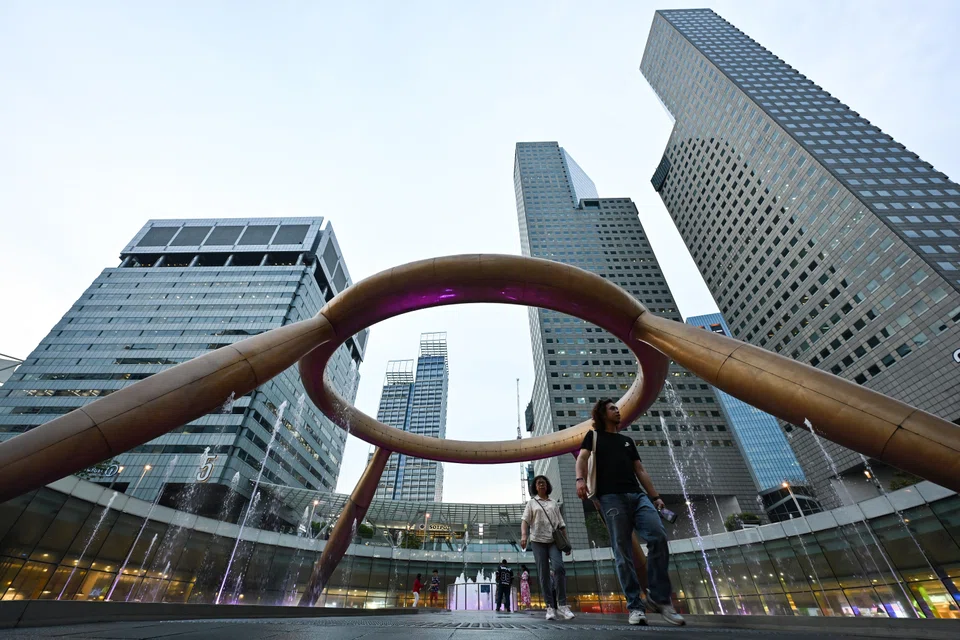
[SINGAPORE] When Suntec Real Estate Investment Trust (Suntec Reit) last week announced its financial results for the full year ended Dec 31, there appeared to be somewhat more interest than usual.
It was neither the fact that Suntec Reit was the first Singapore-listed real estate investment trust (S-Reit) to release its results in this earnings season, nor that it posted a 13.6 per cent increase in full-year distribution per unit on the back of lower financing costs and stronger operating performance across its Singapore portfolio.
For some market watchers, the results announcement was an opportunity to gain some colour on Suntec Reit’s new management, after property tycoon Gordon Tang in December swooped in to acquire the Reit manager from ESR Group.
The acquisition of the Reit manager came after Tang and his wife Celine Tang in February last year failed to take over Suntec Reit, when the offer lapsed with their shareholding falling short of the 50 per cent threshold.
The acquisition of manager ESR Trust Management (Suntec) is still subject to Monetary Authority of Singapore approval, but Gordon Tang and his affiliates already currently own a 35.7 per cent stake in Suntec Reit.
Analysts see the acquisition as a “slight positive”, and believe the new management will embark on a strategic review as soon as the first half of 2026.
The new sponsor intends to accelerate growth at Suntec Reit, including providing a pipeline for future growth by acquisition, said UOB Kay Hian analyst Jonathan Koh in a report following Suntec Reit’s results announcement.
The way Koh sees it, the Reit manager could evaluate the potential acquisition of the 9 Penang Road property – a commercial building that currently houses the entire operations of UBS Singapore – from Gordon Tang’s SingHaiyi Group.
Real estate company SingHaiyi was formerly listed on the mainboard of the Singapore Exchange (SGX), before it was taken private by the Tangs in 2022.
In a separate post-results report, Maybank Research analyst Liu Miaomiao noted that the Suntec Reit management has also “indicated firm interest in monetising (its) mature Australia assets and Singapore strata units”.
Proceeds from these divestments will mainly be used for debt repayment and a progressive return to unitholders, she added.
RHB Group analyst Vijay Natarajan, meanwhile, sees the divestment of Suntec Reit’s overseas assets at par or a premium to book values as well as a continued interest rate decline as potential catalysts for the counter, which is still trading at a 27 per cent discount to its book value.
More clarity needed
Units of Suntec Reit have climbed 26.1 per cent in the past year, with a total return of 33 per cent with distributions reinvested.
It has outperformed its S-Reit peers, which have gained 11.6 per cent over the same period, generating a total return of 17 per cent.
This was mainly due to its low base, as the Reit recovered from negative sentiment mainly due to its higher-than-average aggregate leverage ratio and all-in cost of debt.
As at Dec 31, 2025, Suntec Reit’s gearing ratio has fallen 90 basis points to 41.5 per cent, from 42.4 per cent as at end-2024. Meanwhile, its all-in financing cost has dropped 3.71 per cent per annum, from 4.06 per cent previously.
But Suntec Reit unitholders hoping for further upside following its potential strategic review must be warned that it will not be a quick affair.
A strategic review at another S-Reit, Acrophyte Hospitality Trust – formerly known as ARA US Hospitality Trust before the Tangs bought out its managers in the middle of 2024 – has been ongoing since May last year.
The managers of Acrophyte Hospitality Trust last year said that it was evaluating a range of strategic options, and was also in discussions with the sponsor regarding a potential transaction involving the stapled securities.
Acrophyte Ltd, an entity wholly owned by Gordon and Celine Tang’s daughter Tang Jialei and son Tang Jialin, in May 2024 acquired a 19 per cent stake in the hospitality stapled group. Together with Gordon Tang’s existing 9.27 per cent stake, this brought the Tang family’s total stake to 28.27 per cent.
Acrophyte was formerly known as Chip Eng Seng and was listed on the SGX mainboard, before it was privatised by the Tangs in 2023.
Besides Suntec Reit and Acrophyte Hospitality Trust, the Tangs also own stakes in Singapore-listed companies such as GRC (formerly known as OKH Global) and OUE Reit .
They also had sizeable holdings in another S-Reit – Eagle Hospitality Trust – which has been suspended since 2020 and is still undergoing liquidation.
The high-profile collapse, largely due to financial difficulties and governance lapses, put a dent in investor confidence in the Singapore stock market.
For minority shareholders of Suntec Reit and Acrophyte Hospitality Trust, the consolidation of power under the Tang family comes with some potential for growth, but also a fair share of uncertainty.
For example, could the Tangs decide to merge the two Reits?
UOB Kay Hian’s Koh, for one, believes that Suntec Reit is “unlikely” to deviate from its existing investing mandate into the US hospitality sector – which is the space where Acrophyte Hospitality Trust currently operates.
But plenty of other questions on the future strategy of these two S-Reits remain. And the managers – as well as the controlling shareholders, the Tang family – must make an extra effort to communicate these plans to investors.
TRENDING NOW

Philippine power giant First Gen rebuffs foreign offers, plans up to US$2.6 billion in expansion

Once staunchly pro-China, Malaysian Chinese businesses are now distancing themselves from Beijing

Nearly half of Singapore workers put in at least six unpaid hours a week: survey
Vietnam’s data-centre investment rush faces reality check on power and site constraints

