

Osaka Expo seeks to showcase Japan’s success to the world
Hosting the event must connect to a wider story that reflects the country’s strengths
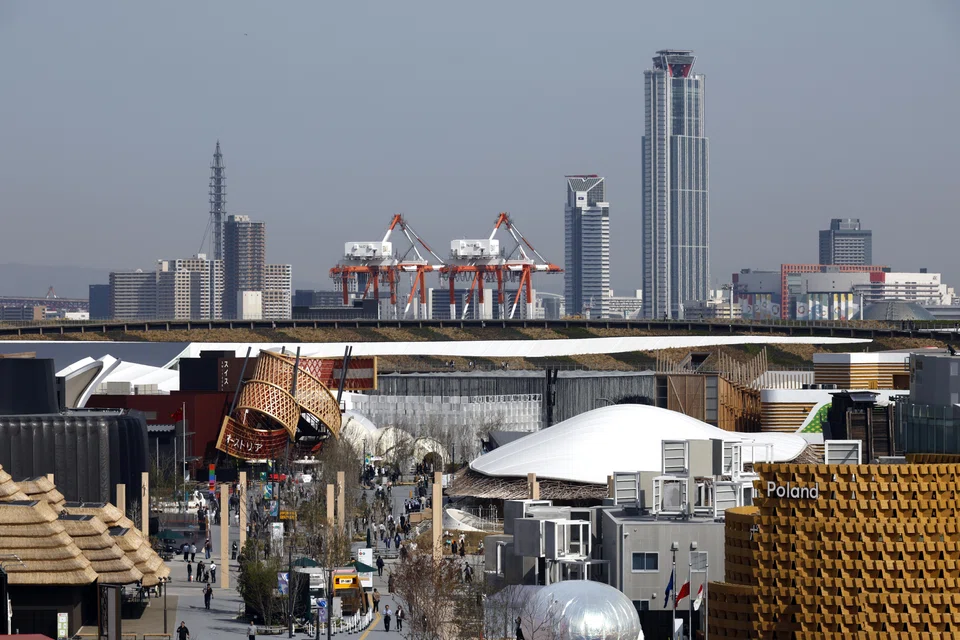
JAPAN’S hosting of the Summer Olympics during the Covid pandemic was a huge challenge. However, the upcoming Osaka Expo is a potentially standout positive global event in 2025 that could showcase the nation’s success to the world with potentially significant economic dividends.
The origins of modern-day Expos date back to at least the 19th century. Historically, one of the big ones was the 1851 UK Great Exhibition planned by then-Queen Victoria’s husband, Prince Albert. This set the stage for later key events, including 1853 in New York, 1876 in Philadelphia, 1878 in Paris, 1888 in Barcelona, 1889 in Paris, 1891 in Prague, 1893 in Chicago, 1897 in Brussels, 1904 in St. Louis, and 1915 in San Francisco.
In more recent decades, countries have sought to leverage Expos to try to enhance their image on the global stage. This includes the Expos in Brisbane in 1988, and Seville in 1992 which aligned with Spain’s hosting of the Barcelona Summer Olympics that year.
This is the historical context for Osaka’s big event in 2025, which starts on Sunday (Apr 13), around a half-century after the city last held the Expo amid much business and consumer interest. There are already many predictions of how the event will drive a tourism- and wider foreign investment-led rejuvenation of Japan’s so-called second city.
According to the Asia Pacific Institute of Research, the economic impact is forecast to be about 2.75 trillion yen (over S$25 billion) nationwide. By contrast, the Resona Research Institute forecasts spending to be a more modest, but still substantial, one trillion yen.
Significant transformation
While the exact economic impact of the event may not be clear for months to come, what is undeniable is that Japan’s second city is already undergoing a significant transformation. An almost 400-hectare, artificial island in Osaka Bay has been created for the expected 28 million visitors. The event will bring together around 160 countries and regions and run until October.
As impressive as the Osaka Bay development is, the biggest change to the physical character of the city is in the centre with the redevelopment of the Osaka Station area into the so-called Grand Green Osaka. There has also been an influx of upmarket hotels, including the Canopy by Hilton Osaka Umeda; the Hotel Hankyu Gran Respire Osaka; and the Waldorf Astoria Osaka.
For over a century, one of the key features of Expos has been showcasing a country’s cutting-edge innovation. In earlier eras, inventions such as the telephone were showcased.
Fast forward to 2025, and the theme of Osaka’s event is “Designing Future Society for Our Lives”. One big feature will be the showcasing of flying car services. The Osakako Vertiport will be ground zero for display of state-of-the-art vehicles which will be flown to nearby sites.
At least two major questions arise from the ambitions of the hosts of Expos and other such big events like the Olympics and Commonwealth Games. Firstly, can a country’s reputation be enhanced in the same way as a corporate (or other organisations) might do by hosting them? And, secondly, can this have a significant, sustainable national economic impact?
Rising competition
On the first issue, competition for the attention of stakeholders like investors and tourists is intensifying, and national reputation is therefore a prized asset or a big liability, with a direct effect on future political, economic, and social fortunes. Boosting country branding is therefore an ever-common ambition in what is an overcrowded global information marketplace, and a number of countries have successfully delivered big events to positively differentiate themselves to the world.
One key example of a success story is the Seville Expo, which aligned with the Barcelona Olympics. For good reason, 1992 has therefore been described as the year that “Spanish soft power conquered the world” and the “year of Spain”.
Yet, many nations fail to fully capitalise, reputationally or economically, upon hosting Expos and major sporting events like the Olympics. Moreover, on the economic front, numerous studies have indicated that “legacy-driven” big event growth is sometimes over-hyped.
This is shown most recently by Japan’s hosting of the 2020 Summer Olympics. This was blighted by the Covid-19 pandemic and forced the Games to be delayed until 2021.
In 2018, when Osaka was announced as the host of the Expo in 2025, delight was expressed in Japan. Then-prime minister Shinzo Abe said the country would “achieve a magnificent expo in Osaka that would give dreams and surprises to everyone in the world” and that it would be “a golden opportunity to promote the fascinating charms of Japan to the rest of the world”.
Coherent vision
Beyond these warm words, however, to maximise prospects of Japan benefiting, reputationally, the country must pursue a concerted reputation and economic strategy that aligns all key national stakeholders -- across the public, private and third sectors – around a single, coherent vision for its country brand to emphasise traits such as a respected international leader, technological innovation, and cultural powerhouse. This exercise should not just be the preserve of tourism agencies, let alone government, but must involve the private and third sectors too.
Spain in 1992 showed how this can be done effectively by connecting the Expo and Olympic events into a narrative about a wider transformation in the country at the time. This included the nation’s political and economic transformation following its transition to democracy after the death of previous ruler Francisco Franco, including the accession to the now-EU in 1986.
Another good example is New Zealand which transformed global perceptions of itself in the 1980s and 1990s. This included building a destination brand for outdoor sports and tourism, in part, by leveraging the hosting of events like the 1987 Rugby World Cup and the 1990 Commonwealth Games. Here, the untapped potential of the country’s natural environment was recognised, and subsequently showcased in films like The Lord of the Rings.
The Spanish and New Zealand examples underline how even relatively simple, unified country brand visions can be powerful. This is a lesson that Japan would do well to learn fast as it seeks to capitalise upon the Osaka Expo in 2025.
In the midst of the hurly burly of the next few months, the long-term economic opportunities of the event should not be sidelined. Moreover, as with Spain and New Zealand, a key part of this must be connecting Osaka’s hosting of the big event to a wider story that showcases Japan’s strengths so as to increase favourability of international perceptions of the country, politically, economically and socially.
The writer is an associate at LSE IDEAS at the London School of Economics
TRENDING NOW

Once staunchly pro-China, Malaysian Chinese businesses are now distancing themselves from Beijing

Cliff Tan has 7 million followers and a 4-month waitlist. Why won’t he expand his business?

Could stablecoins be the future of money?

Grab CEO’s wife Chloe Tong on life with Anthony Tan and finding her purpose

