Paragon deal: Why investors should get ready for more Reit mergers and take-private offers
In a less-conducive operating backdrop, smaller Reits may be weeded out, as larger ones play the role of consolidators

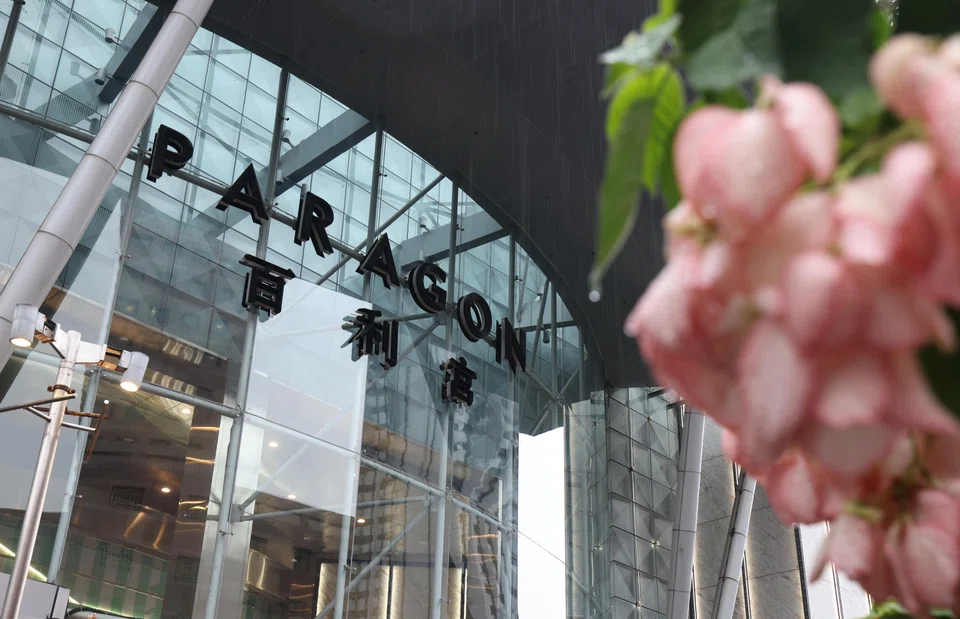
THE most prosaic observation about the purchase of Paragon by CapitaLand Integrated Commercial Trust (CICT) from Cuscaden Peak may also be the most profound: Among real estate investment trusts (Reits), the biggest players have an unbeatable advantage when it comes to acquiring assets and enhancing them.
So, perhaps investors should get ready for more take-private deals, and another spate of mergers.
With elevated inflation and interest rates weighing on yield-oriented investments and the ongoing rejuvenation of the broader Singapore market, investors will probably become less enamoured with all but the largest Reits that are exposed to the most resilient asset classes.
Against this less conducive backdrop, some of the smaller Reits may be weeded out, while the largest players play the role of consolidators, scooping up assets that become available amid the shake-out.
Indeed, the most striking aspect of the Paragon deal is that the manager of CICT seems much less fazed by the ageing property’s need for a costly asset enhancement initiative (AEI) than Cuscaden Peak.
A key rationale for Cuscaden Peak’s take-private offer for Paragon Reit last year was that its flagship asset needed an AEI costing between S$300 million and S$600 million in order to maintain its competitiveness – an exercise which would have caused enormous volatility in its distributions per unit (DPU).
The manager of CICT has said it will conduct its own evaluation of AEI opportunities for Paragon, and that the final scope and costs may differ from Cuscaden Peak’s preliminary analysis.
One reason for this seeming nonchalance is that Paragon is not an overwhelmingly large proportion of CICT’s portfolio; a phased AEI combined with upward rent adjustments could mitigate much of the adverse impact on its DPU.
CICT also has ample financial capacity to take on an asset like Paragon, thanks in part to its S$2.5 billion sale of Asia Square Tower 2.
CICT’s manager noted that it is unlocking value from the leasehold office asset by selling it at a net property income yield of 3 per cent, and redeploying the capital into a freehold integrated development at a higher yield of 3.9 per cent.
CICT has also raised S$750 million through a placement of new units at S$2.30 each.
Exits and repositionings
Cuscaden Peak was not the only Reit sponsor that felt the need to withdraw from the public market.
Frasers Hospitality Trust was also taken private by its sponsor group last year, after a strategic review determined that it would have difficulty growing its distributions and net asset value (NAV) in the face of adverse macroeconomic trends and structural factors in the hotel space.
Meanwhile, some sponsor groups have been trying to reposition the weaker Reits under their umbrellas, or simply selling them off.
In an interesting case, CapitaLand Investment launched Shanghai-listed CapitaLand Commercial C-Reit last year. CapitaLand China Trust (CLCT) – which has not been trading well in Singapore – played a direct role in the exercise by taking a stake in the Reit, and seeding it with one of its properties.
CLCT’s sponsor group has said it will list a second China Reit later this year, and eventually combine both the China Reits. This could create a bigger platform for CLCT to tap China’s domestic capital market, and unlock the value of its mature assets.
In another case, ESR Group sold Suntec Reit’s manager to Tang Organization earlier this year. The acquiring group, which already controlled about 36 per cent of Suntec Reit’s units, said it would conduct a strategic review to strengthen the Reit’s performance and enhance its capital efficiency.
In the wake of that transaction, Hongkong Land acquired 10.8 per cent of Suntec Reit’s units from ESR Group – sparking speculation that it may be interested in buying some of its assets.
Hongkong Land launched an S$8.2 billion property fund in Singapore earlier in the year. Among the fund’s assets are Hongkong Land’s one-third stakes in Marina Bay Financial Centre (MBFC) Towers 1 and 2, Marina Bay Link Mall and One Raffles Quay.
Qatar Investment Authority’s Asia Square Tower 1 is also part of the fund’s initial portfolio.
More mergers?
These recent developments highlight the consolidating role that large property groups – such as CapitaLand, Frasers Property and Hongkong Land – are playing in the shifting dynamics of the Reit sector.
Meanwhile, CICT’s acquisition of Paragon underscores the importance of the largest Singapore-focused Reits in sustaining the vibrancy of the whole sector.
With their heft and the resilience of their Singapore-based assets, CICT and others like it – including CapitaLand Ascendas Reit (Clar), Frasers Centrepoint Trust and Keppel Reit – have helped draw investors as well as new listing aspirants to the Singapore market.
With increasingly unfavourable macroeconomic conditions, the time might now be right for the largest Singapore-focused Reits to strengthen themselves by becoming even bigger through mergers.
This is not a new idea. Many of the leading Reits in the market have merged in the past to gain scale. CICT was known as CapitaLand Mall Trust until it acquired CapitaLand Commercial Trust in 2020. Mapletree Commercial Trust was renamed Mapletree Pan Asia Commercial Trust (MPACT) four years ago, after acquiring Mapletree North Asia Commercial Trust.
Mergers among sponsor groups have also resulted in Reits with overlapping mandates combining themselves. This happened after CapitaLand acquired Ascendas-Singbridge, and after ARA Asset Management was acquired by ESR Group.
Looking ahead, the much-talked-about merger of CapitaLand Investment and Mapletree Investments could be a catalyst for Clar to subsume Mapletree Industrial Trust, and for CICT to acquire MPACT.
Some groundwork will probably be necessary to stave off minority investor resistance, though. One obvious sticking point is that CICT is 95 per cent exposed to Singapore, and trades at 1.1 times NAV; while MPACT is only 61 per cent exposed to Singapore, and trades at 0.7 times NAV.
Still, the creation of bigger Reits, with larger exposure to resilient asset classes, could be the key to maintaining the vibrancy of the sector.