

Singapore’s electric dream: 1 to EVs, 0 to plug-in hybrids so far. Here’s why
Branded by critics as a skippable step to fully electric vehicles, a China-driven renaissance could make them relevant again

CHIA, who declined to give her full name and works in the financial industry, is the owner of a 2021 Volvo XC40 plug-in hybrid electric vehicle (PHEV).
A car that can run on petrol and yet be charged by external sources, it gives her the low running costs of an electric vehicle (EV) with the flexibility of choosing not to charge it if doing so is a hassle.
Chia says that when charged, the car offers enough electric range – 40 km, according to Volvo – to cover her daily commute, and it is cheaper than running on petrol.
In this way, PHEVs are a bridge between internal combustion engine (ICE) vehicles and full battery EVs, offering the best of both worlds.
Critics say they are a pointless middle ground that can safely be skipped for full EVs. Indeed, they have since been eclipsed by EVs in sales – nowhere more so than in Singapore, where they do not receive the same subsidies as EVs, unlike in other countries. In Singapore, Chinese EV giant BYD sells only full electric models, largely because they enjoy a rebate not extended to PHEVs.
But if PHEVs are a pointless stopgap, then why has BYD sold nearly 10 times as many of them as EVs in the first three quarters of 2024?
As China’s EV boom continues to change the dynamics of the global EV market, PHEVs are now the fastest-growing segment of vehicles worldwide.
As PHEV technology improves, it could offer consumers and business owners an alternative to full EVs long into the future, even in Singapore.
Electric spectrum
Before 2018, PHEVs and EVs showed similar adoption rates globally. But by 2021, as a fraction of total car sales around the world, EVs were, at 6 per cent, double that of PHEVs, which made up 3 per cent.
Conventional ICE cars use only fuel, usually petrol, to power their engine, while hybrid electric vehicles (HEVs) use petrol and electricity reclaimed from braking or slowing down.
A PHEV simply adds a larger battery pack and the ability to charge it by plugging into an external charger, like an EV. But unlike an EV, a PHEV is able to run on petrol and can travel farther – typically over 1,000 km with a full tank and charge.
In Singapore’s early stages of vehicle electrification, PHEVs even outsold EVs.
In 2014, the first year EVs and PHEVs were recorded in Land Transport Authority (LTA) data, 47 PHEVs were registered, compared with one EV. By 2016, there were 125 PHEVs registered, and 12 EVs.
Oliver Redrup, associate partner with EY Corporate Advisors, says that PHEVs initially outsold EVs due to limited EV brand and product options. In addition, PHEVs were more broadly available.
But that changed as EV-related technology advanced and incentives offset the higher cost of EVs compared with that of ICE cars.
In 2021, the LTA introduced the EV Early Adoption Incentive (EEAI), which gave EVs a rebate of up to S$25,000, but this did not extend to PHEVs.
That year, the EV population in Singapore more than doubled to 2,942 from 1,217 in 2020. Without rebates, PHEVs were uncompetitive in price against EV models and still more expensive than ICE cars.
As at September 2024, the population of PHEVs was 1,508 (less than 1 per cent of the total motor vehicle population), compared with 21,796 EVs (3.3 per cent), and 93,530 HEVs (14.3 per cent).
Splitting the charge
In many other markets, PHEVs are treated similarly to EVs in terms of tax and rebate terms.
For example, most European Union countries provide incentives for chargeable EVs, meaning PHEVs and full EVs. South Korea and China provide incentives for PHEVs and EVs, as do the United States, Mexico, Canada, Australia and New Zealand.
In response to queries, an LTA spokesperson says that hybrids – both PHEVs and HEVs – do not qualify for the EEAI, as this incentive is intended to encourage the adoption of full battery EVs and jump-start the ecosystem for such vehicles.
The LTA’s long-term vision of 100 per cent cleaner-energy vehicles by 2040 includes electric and hybrid cars, he adds. However, as EVs are among the cleanest and lowest-emission vehicular technologies available today, they qualify for higher incentives than hybrid vehicles.
PHEVs and HEVs, depending on performance, qualify for Vehicular Emissions Scheme rebates of up to S$2,500. However, only vehicles with zero tailpipe emissions – full EVs – qualify for the highest rebate of S$15,000.
Walter Theseira, associate professor of economics at the Singapore University of Social Sciences, notes that compared with the mid-2010s, there are now many competitive EV choices and so PHEV ownership makes “less sense” today.
According to EY’s Redrup, the extensive deployment of charging points and low average daily mileage of drivers in Singapore have lessened anxiety over EV ranges, and the government can focus on the direct transition to battery EVs.
PHEVs may also not be as efficient or clean as their manufacturers claim, nor have the electric range that is advertised.
A 2021 EU report that sampled 600,000 cars in on-road tests found that, on average, PHEVs emit and consume more than three times their manufacturer-tested figures.
Yet, the EU report showed that PHEVs are still significantly more efficient and cleaner than ICE cars in real life. On average, the PHEVs studied emitted 32.3 per cent less carbon dioxide and consumed 24.3 per cent less fuel than ICE cars.
Plugging into the mainstream
In fact, PHEVs continue to find a small audience in Singapore. In the first nine months of this year, 155 new PHEVs were registered, outstripping the registrations of some EV brands.
“With a PHEV, we also have the option to avoid EV pain points, such as a lack of chargers and too many charging ‘brands’, and the need to install multiple apps,” Volvo owner Chia adds.
“There’s also higher road tax for EVs, despite purchase incentives.”
EVs registered after Jan 1, 2023, incur an additional S$700 road tax yearly.
From the mid-2010s until now, most PHEVs in Singapore have been luxury models from brands such as BMW, Mercedes-Benz and Volvo, as few mainstream brands offer PHEVs.
Mercedes-Benz sells the largest number of PHEVs here – 55 in the first nine months of 2024 – and offers four models. A spokesperson for the brand says that customers appreciate the ability to switch between electric and petrol power, which allows for longer journeys without range anxiety.
Yet, instead of fading as EV adoption continues across the world, PHEVs have been undergoing a renaissance – one that could even spread to Singapore.
The same factors that have driven China’s EV blitz – namely improved technology, lower battery prices and massive economies of scale – have also charged up PHEV sales by making mainstream cost-competitive models a reality.
According to a June BloombergNEF report, for the past five years, PHEVs have been the fastest-growing vehicle type worldwide, ahead of EVs, HEVs and ICE cars.
It noted that the average prices of PHEVs in China have fallen steadily in the last five years, taking them from the most expensive option to now being fully cost-competitive with petrol and battery-electric models.
In fact, from January to September, BYD sold almost 10 times as many PHEVs than EVs in China: 1,566,822 versus 164,956. Some 60 per cent of its global sales came from PHEVs.
Total EV sales in China for the same period were 4,988,000, compared with 3,328,000 in the year-ago period. EV sales were up 11.6 per cent, but PHEV sales rose 84.2 per cent.
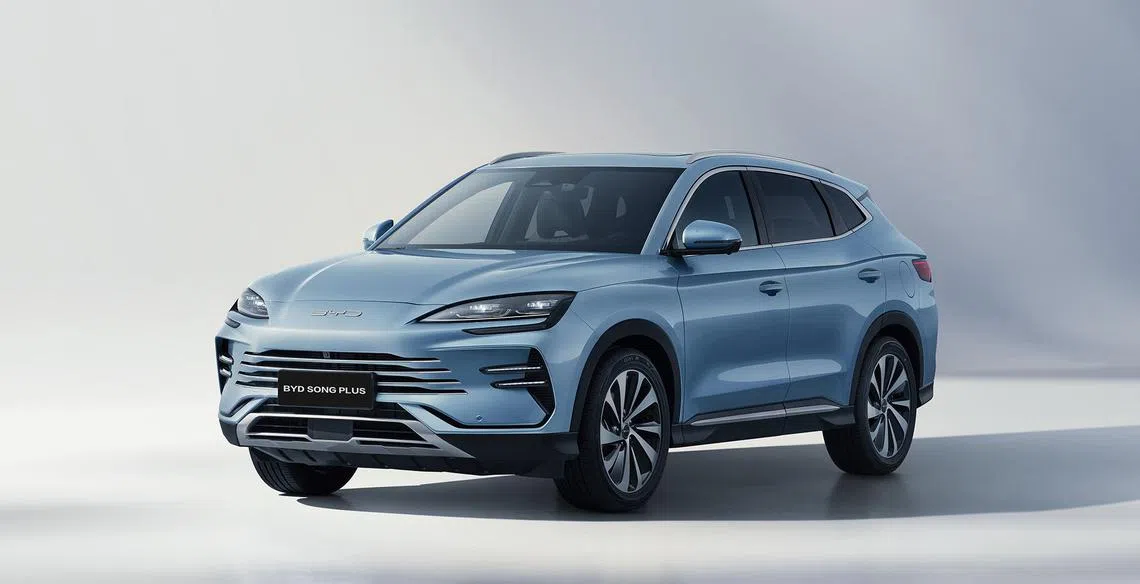
Unlike older PHEVs, the current models have larger batteries, longer electric ranges, and are capable of fast charging. An example is BYD’s best-selling model in China, the Song Plus mid-sized sport utility vehicle (SUV).
The PHEV model has a starting price of 135,800 yuan (S$25,180) – cheaper than its EV version at 149,800 yuan – and is competitive with its Japanese hybrid competitor, the Toyota Corolla Cross, which costs 129,800 yuan.
The Song Plus PHEV has an electric range of 138 km, and can be charged to 80 per cent in 20 minutes. Older PHEVs, such as Chia’s Volvo, typically have an electric range of less than 50 km and take three to four hours to charge.
Fast charging could help address PHEVs’ relatively slow charge times compared with newer EVs, which have resulted in users being less likely to recharge their vehicles. Slow charging “held back” earlier PHEV models, notes the BloombergNEF report.
Joshua Cobb, senior automotive industry analyst for BMI, says that the arrival of Chinese PHEVs is building on the brand awareness of Chinese manufacturers and low prices.
“Chinese PHEVs will perform well, regardless of subsidies,” he adds, in part due to China’s dominance of the battery supply chain and its ability to provide low-cost power cells for cars.
Do the evolution

As the wheel of electrification turns, advancing both PHEV and EV technology, some manufacturers are seeing the promise of PHEVs even in Singapore.
The Republic will see its first mainstream PHEV passenger car later this year.
Vertex Automobile, the distributor for China manufacturer Chery’s brands Omoda and Jaecoo, will launch the Jaecoo J7 PHEV SUV in the fourth quarter of 2024. The car has an electric range of 105 km and a total range of more than 1,000 km.
A Vertex representative tells The Business Times that the PHEV market has been held back by a lack of more affordable mainstream models as well as consumers’ unfamiliarity with the benefits of PHEV technology.
While costs have not yet been confirmed, the J7 is expected to be priced as a mainstream SUV and is targeted at consumers who want a greener alternative to petrol cars but are not ready for full EV adoption just yet.
Two other China manufacturers tell BT that they are monitoring market conditions and would introduce PHEVs if they become cost-competitive against HEVs and ICE cars.
A BYD spokesperson says that in light of the domestic success of its PHEV models, the company is studying the feasibility of introducing them to Asean markets including Singapore.
Other brands are banking on the fact that PHEV technology could have appeal among more than private car owners, as they can help reduce emissions and costs for businesses while avoiding extended downtimes required for EV charging.
Earlier this year, Hong Seh Evolution launched the LEVC VN5 van.
Costing around S$85,000 without a Certificate of Entitlement, it is a PHEV that uses a slightly different technology which promises even more efficiency. As an extended-range electric vehicle (Erev), its engine does not drive the vehicle directly, and instead only charges the battery, which feeds power to an electric motor.
This allows the ICE to operate in its most efficient range at all times. With a 31-kilowatt-hour battery pack that charges in half an hour, it has 102 km of electric range and a total range of more than 500 km, which is longer than that of most EV vans.
The technology has already been adopted by bus operators.
In the third quarter of 2024, a total of 11 diesel PHEV buses – all using Erev technology – were registered, mostly to private bus operators, marking the first time the technology has featured in buses in Singapore. Three were from Yutong and eight were from Zhongtong – both China manufacturers.
A representative for Zhongtong distributor Cycle & Carriage says that the brand’s PHEV buses can save up to 55 per cent more fuel compared with diesel buses.
Neo Tiam Ting, chairperson of Think One Group, the distributor of Yutong buses, tells BT that while a hybrid bus costs more, its improved efficiency means that an operator can earn the difference back over the vehicle’s lifetime.
This is one example cited by industry observers who argue that there is plenty of life left in PHEVs, given their flexibility.
Yet, unlike cars, neither EV nor hybrid buses benefit from incentives.
BMI’s Cobb says that the new generation of PHEVs will not only have larger batteries for longer electric ranges, but could also use flexible fuels – biofuels, synthetic carbon-neutral fuels and even natural gas – to extend the viability of PHEVs and provide them with long-term relevance.
Carsten Intra, chief executive officer of Volkswagen Commercial Vehicles, tells BT that hybrid technology will be a long-term bridge to zero-emissions transport as battery technology matures, and that it is important for manufacturers to offer a range of electrified solutions to clients.
The German manufacturer is planning to launch a new Transporter van with ICE, EV and PHEV options in some markets, including Australia, in the coming future.
“It is important to offer customers a choice, because there will be different needs for each business or user, and (EV adoption) will be at different rates in different regions of the world,” he adds.
But ultimately, technology will follow the needs of the market, which will be shaped by business needs, legislation and other factors.
“In the end, our business customers simply want to have the most cost-efficient solution for their business,” says Intra.
TRENDING NOW

Fed hike throws Singapore banks a margin lifeline; UOB most likely to feel impact

He built the Vingroup empire. Now South-east Asia’s richest man is handing some key roles to his sons

Real-estate veteran Desmond Sim quits from CEO roles at Realion, ETC

Chagee, Mixue and Luckin won the market. Sustaining their edge is the harder part

