

Political and economic storm clouds loom over upcoming EU address
As no-confidence votes fuel the bloc’s market anxiety, Ursula von der Leyen’s agenda is at risk
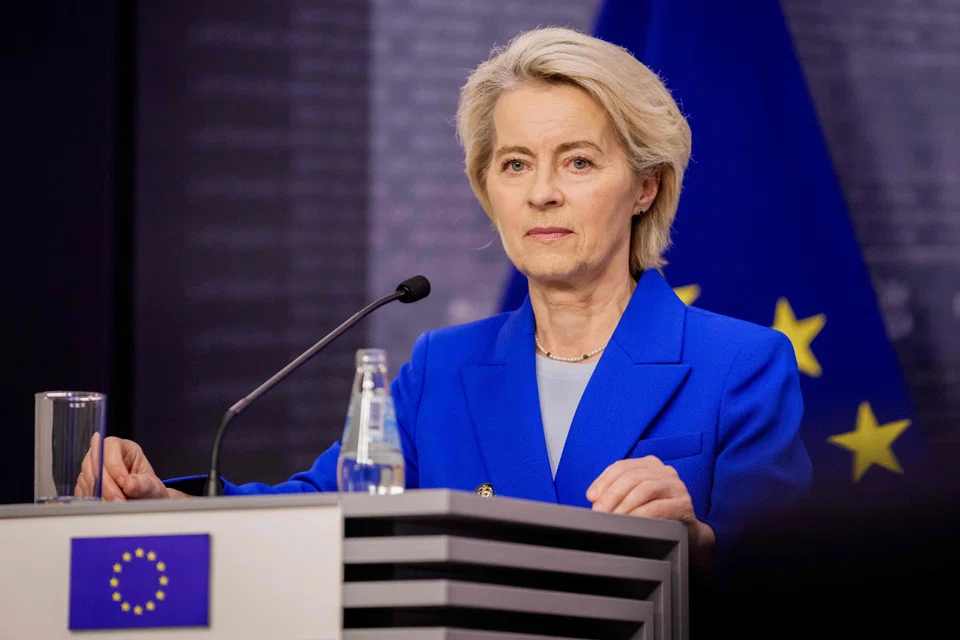
EUROPEAN Commission President Ursula von der Leyen is less than a year into her second term in Brussels. Yet she has already run into significant trouble as she prepares to make the State of the Union speech on Wednesday (Sep 10), which will set the agenda for the European Union’s 450 million people, as economic storm clouds gather.
This is not just important for the future of Europe, but also the rest of the world, as the EU remains an economic superpower. The bloc is the world’s largest exporter of manufactured goods and services, and also the biggest export market for around 80 countries, including those in Asean.
Opposition grows
As Dr von der Leyen finalises the details of her big address, political instability in much of Europe’s core is growing.
This is highlighted by two recent no-confidence votes: one in Brussels against her in July, and the other against the French prime minister on Monday. Long-term borrowing costs for the eurozone’s second-largest economy surged to levels unseen since the global financial crisis, reflecting investor concerns about France’s fiscal outlook amid these developments.
The first of these no-confidence votes happened in the European Parliament. While the motion against Dr von der Leyen was defeated – with 360 legislators backing her, 175 voting against and 18 abstaining – the number of opponents, combined with more than 160 legislators who did not vote, highlights the shifting political sands.
Such confidence votes are unusual in the European Parliament and have adverse consequences: forcing not only the incumbent commission president’s departure from office, but also that of the entire college of 27 commissioners. The last such vote was tabled against then commission president Jean-Claude Juncker more than a decade ago.
Yet what Dr von der Leyen’s supporters now fear is that further no-confidence votes are to come. This is especially likely after a difficult period that has seen US President Donald Trump perceived to have gotten the upper hand over her in the new US-EU trade deal, and a growing view that the European Green Deal is being diluted to prioritise global competitiveness.
Only 10 per cent of legislators are required to force another confidence vote against Dr von der Leyen. Already, at least two blocs at either end of the political spectrum, The Left and the far-right Patriots for Europe, are reportedly working on different motions, to be tabled in the coming weeks, if the minimum threshold of signatures is secured.
French instability is a warning signal
The potential for instability in Brussels is mirrored at a national level, most starkly in France. A successful no-confidence vote on Monday collapsed the government, triggering a level of political turmoil unseen in decades.
It marks the second time a French government has lost a no-confidence vote in more than 60 years. The country faces its fifth prime minister in some 20 months, a symptom of the deep political fragmentation that followed President Emmanuel Macron’s failed snap-election gamble in 2024.
However, today’s instability stems from the longer-term collapse of France’s traditional political order, which Macron himself accelerated with his insurgent victory in 2017. The 2017 and 2022 presidential elections were the first in modern French history where neither a Republican nor Socialist candidate reached the final round.
Having lacked a stable legislative majority since 2022, Macron now presides over a deadlocked parliament while public debt exceeds 110 per cent of the country’s gross domestic product. This has shattered the high hopes of his presidency and dramatically increased the prospect of a far-right victory in the 2027 presidential election – an outcome that would send shockwaves across the EU.
Macron’s predicament offers a sobering preview of what could happen at the EU level. The likely outcome is that of a lame-duck president limping along, unable to enact a meaningful agenda – a scenario that Dr von der Leyen’s supporters fear may also be seen in Brussels.
The timing could hardly be worse for Macron, Dr von der Leyen or Europe at large. The challenges are growing seemingly as fast as their power bases are shrinking.
The writer is an associate at LSE IDEAS at the London School of Economics






