The political cult of the entrepreneur
Is what’s good for America’s richest men also good for America?
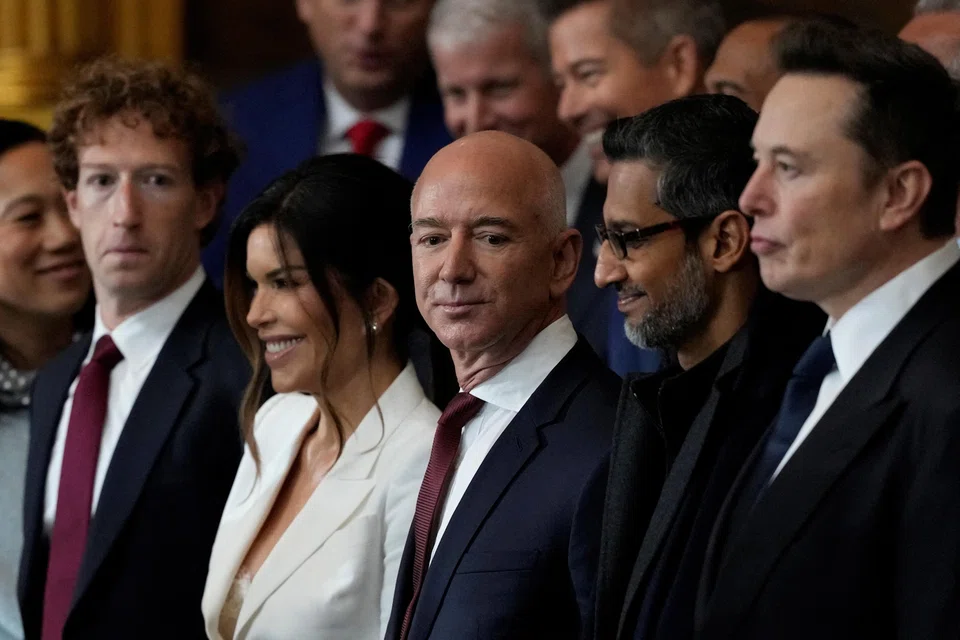
IN OUR era, the meaning of any image depends which side you’re on. Take the photograph of Mark Zuckerberg, Jeff Bezos, Elon Musk and Sundar Pichai sitting in front of Cabinet members at Donald Trump’s second inauguration.
Caricature liberal elitists, like me, saw it as a portrait of American oligarchy. Trump, his supporters and the tech moguls themselves interpret the picture differently.
Trump, a master of spectacle, put the billionaires there for a reason. His message: “I’ve brought them to heel and harnessed them to the American project.”
He knows most of his voters will approve. Maga is built more on the cult of the entrepreneur than on the cult of the strongman, though they overlap. Many businesspeople regard great entrepreneurs as the winners of life’s game.
Trump built his reputation playing a great entrepreneur on TV. He then went into politics selling the notion that government was a “malfunctioning corporation called the USA”, to quote Gordon Gekko’s “Greed is good” speech from the 1987 movie Wall Street.
Trump promised to run government like a business. The Donald Trump vs Kamala Harris election was, among countless contrasts, entrepreneur against government official.
Trumpism may represent the peak of the political cult of entrepreneurs. I can’t think of another entrepreneur becoming head of government in a major economy, except Silvio Berlusconi. Past US political cults were attached to soldiers (Washington, Eisenhower) or to corporate bosses, such as Mitt Romney.
George W Bush, who had a Harvard MBA, was hailed as a “CEO president”. But the corporate CEO is a rule-bound figure in a suit with degrees. The entrepreneur is a wilder beast, autonomous, rule-breaking, often a college dropout. He’s his own man. (This is a male cult – recall Zuckerberg’s recent praise of “masculine energy”.)
The biggest entrepreneurial fortunes in history were coined in Silicon Valley between about 1998 and 2008. Today, the beneficiaries are middle-aged. Their 80-hour work weeks are mostly over, leaving them with enough energy to pour into politics.
They are known to ordinary Americans by their first names or nicknames, in Musk’s case by his tweets, and by their anti-corporate dress. The billionaires relentlessly self-brand as iconoclasts, which can go wrong, as perhaps with Musk’s apparent Nazi salute.
Underpinning the cult is the belief that what’s good for entrepreneurs is good for America. Venture capitalist Marc Andreessen told podcaster Joe Rogan that Trump’s message, “America has to win”, meant that US companies “should win global markets... How can anybody be against that?” After all, Andreessen argued, only economic growth could pay for “welfare programmes and food assistance programmes, all these things”.
The argument is dubious. First, Europeans retire earlier and live longer than Americans, despite lower economic growth and mostly lower governmental debt-to-GDP ratios. Second, growth doesn’t necessarily boost public spending, given that Big Tech has perfected tax avoidance. Nor do these companies create many jobs. Meta has 72,000 mostly high-skilled employees, including immigrants on H1-B visas.
Last, how do the moguls – who spent decades ignoring Washington – read that photograph? In Andreessen’s telling, Joe Biden forced them into Trump’s arms. Whereas most ordinary Americans seem to have experienced Bidenism as a time of inflation and drift, the moguls saw something more sinister: a business-hating administration stamping out their freedoms. Andreessen accuses the Biden-era Securities and Exchange Commission of “trying to kill the crypto industry”.
Crypto and artificial intelligence (AI) are the entrepreneurs’ new battlefields. One difference between Trump I and Trump II is that the price of bitcoin was US$900 in 2016 and is more than US$100,000 today, while we saw on Monday that shifts in AI can now turn global stock markets.
On crypto and AI, as on everything else, America is divided. Democrats are wary of crypto as a money-laundering opportunity. Trumpists see it as a libertarian business that subverts government (albeit that crypto entrepreneurs want bank accounts and Trump’s support).
Biden tried to regulate AI; Trump won’t. Tech moguls hope he’ll help them win what Peter Thiel calls the “global war” to conquer enemy territories such as the EU, the UK and Brazil.
Billionaires care about policies, but they want love too. Several, like Andreessen, used to lean liberal. But if liberals reject you, you’ll choose the guy who loves you (for now) and shows it with his seating plan.
TRENDING NOW
He built the Vingroup empire. Now South-east Asia’s richest man is handing some key roles to his sons
Grab CEO’s wife Chloe Tong on life with Anthony Tan and finding her purpose
What role can Japan play in Asean’s future?
From folding clothes to factory work: Why China is sending humanoid robots to school