

Poor economies of scale raise questions about viability of grocery delivery startups

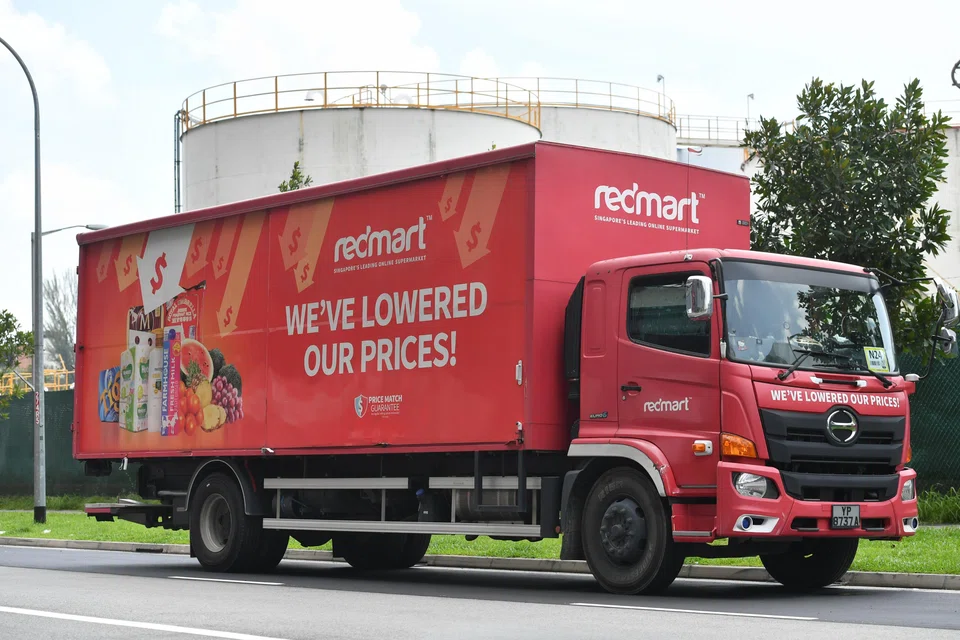
OVER a decade after homegrown online grocer RedMart launched its delivery services, many Singapore residents have got used to the idea of having milk, rice and toilet paper delivered to their doorsteps. It’s a great convenience for customers. But it shows no signs, still, of being a great business for investors.
Just last week, grocery startup UglyFood announced its closure on Instagram. Indonesia-based HappyFresh said in September 2022 it would lay off staff and restructure as it faced a cash crunch. And rival Sayurbox is reportedly cutting staff too. On-demand ride and delivery platform Grab, meanwhile, appears to have called it quits on a grocery business launched in December 2020. It still provides delivery for supermarket partners on its platform.
As interest rates rise and the era of easy money comes to an end, the startup space is rationalising. Grocery delivery is one segment that is turning out to be particularly unappealing.
Grocery delivery startups compete on the basis of driving up the size of a customer’s basket by offering the convenience of having goods delivered to one’s doorstep. In theory, this model should bring economies of scale and recurring income from weekly household orders.
There are several problems with this model, though. The first is that achieving scale requires significant investment. Toilet paper may keep fairly well in any warehouse, but frozen chicken requires sub-zero temperatures and lettuce needs a lightly chilled environment. Such specialised facilities do not come cheap.
On top of this, startups would have to experiment to find the right mix of inventory. Any overstocking would lead to wastage, or force companies to offer discounts in order to clear warehouse space. Understocking, on the other hand, might turn off customers.
The second problem is that grocery store operators already do very well, with decent margins. Established supermarket chains typically have strong loyalty programmes, strong supply chains, a strong physical presence, and strong tech infrastructure.
This means that the economies of scale that grocery delivery startups hope to achieve have often already been achieved by their brick-and-mortar rivals.
In order to compete successfully, some startups may be forced to lower their prices in order to attract customers away from physical supermarkets. And although online-only grocery stores can save on the cost of retail space, they end up spending all those savings on the cost of deliveries.
Struggle against incumbents
This struggle against incumbents is reflected in the ratio of costs to revenue for a grocery delivery company versus a traditional supermarket operator.
At RedMart, for instance, distribution and marketing costs were equivalent to 33.2 per cent of revenue for FY2022 ended Mar 31, according to regulatory filings with the Accounting and Corporate Regulatory Authority of Singapore.
The company does seem to have gained some economies of scale over the years. In FY2019, the ratio of distribution and marketing costs to revenue was 38.2 per cent. But that downtrend appears to have hit a floor, at 32 per cent in FY2021.
In the United Kingdom, online grocer Ocado reported similar numbers. Distribution and administrative costs were equal to 35.2 per cent of 2020’s revenue and 40.5 per cent of 2021’s revenue.
By comparison, locally listed DFI Retail Group Holdings , which operates the Cold Storage and Giant supermarkets in Singapore, saw distribution and selling costs of just 25.6 per cent of 2021’s revenue and 25.1 per cent of FY2020 revenue.
DFI is not a pure-play grocer. The company also operates restaurants, convenience stores and health and beauty products retailers. But homegrown Sheng Siong Group is a pure play, and its numbers are even better.
Sheng Siong’s selling and distribution costs are very low, at 0.6 per cent of 2021’s revenue and 0.5 per cent of 2020’s revenue. Its biggest expense is administrative expenses, but these came to just 17.6 per cent of 2020’s revenue and 16.8 per cent of 2021’s revenue.
One possible reason for the high cost of grocery deliveries is the cold chain. Customers need to be on hand to receive their items, or risk having them spoil at their doorsteps. This requires delivery time slots, and makes optimal route planning near impossible.
RedMart seems to be trying to adjust for its high costs with the introduction of slot fees in June 2022, charging S$5.99 for a scheduled two-hour slot or S$3.99 for a scheduled six-hour slot for delivery. These fees are waived for orders of above S$150 and S$100, respectively, for two-hour and six-hour slots. Deliveries were previously free for orders of more than S$60.
When asked how RedMart would turn profitable, Loh Wee Lee, chief executive officer of parent Lazada Singapore, pointed out that the online grocer has been the beneficiary of the behavioural shift accelerated by the pandemic. More people are getting their groceries delivered, and this behaviour is expected to be permanent.
“In the last 12 months, RedMart has continued to grow its operations in order to support the more than 20 per cent increase in customer spending,” he said.
RedMart is also trying to grow the customer base for its private label products. Such products offer margins of between 25 and 30 per cent, whereas brand name products offer slim single-digit margins.
“Our private label range of products has also grown by more than 70 items, to over 500 now, with one in two customers buying our RedMart private label products; and we are looking to further grow this by 10 per cent in 2023,” said Loh.
Increasing capacity
Investments undertaken by RedMart also appear to be about increasing capacity to meet demand.
“Underpinning these expansions in operations is RedMart’s warehouse facility that employs state-of-the-art automation solutions. The over-S$100 million investment in 2020 drastically improves efficiencies and increases worker productivity by more than 400 per cent,” said Loh.
Even with those investments, however, RedMart is in the red. The company’s next set of numbers will be helpful in demonstrating the price sensitivity of customers. But it is difficult to imagine that they will lift the company into profitability.
It may be that consumers will eventually have to decide between paying a higher price for deliveries, or doing without them altogether. Because the current model is unlikely to be attractive for startup investors.






