Private equity giant Carlyle can grow bigger but needs to stay on its toes: co-founder David Rubenstein
Billionaire is a workaholic who encourages other wealthy people to give back

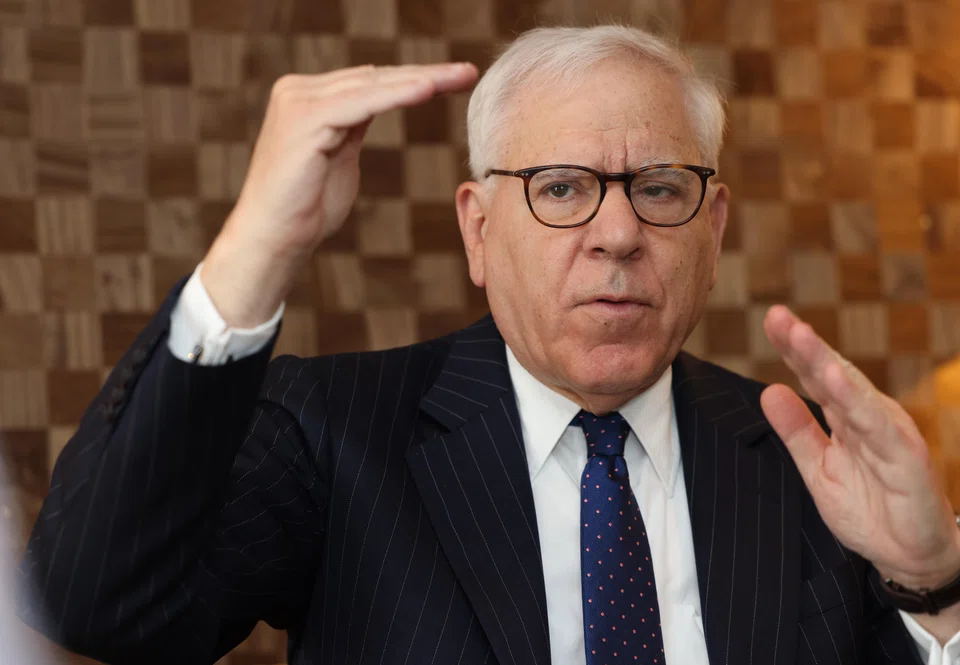
[SINGAPORE] Despite mounting risks, the private equity business is in “pretty good shape”, claimed David Rubenstein, co-founder and co-chairman of global investment firm, The Carlyle Group – a leader in private equity.
Rubenstein thinks Carlyle, which has about US$500 billion of assets under management, can grow even bigger with its challenge being “continuing to get really good young people that want to be in this business and working with us”.
This can then ensure that “our investors, who have a lot of options, continue to see us as being a very good place in which to invest money”, he added.
While worried over the direction of the global economy and ongoing wars, Rubenstein expressed confidence in prospects for private equity, which used to be a US-centric business, but today is a global business that is flourishing in Asia,
However, the 76-year-old American billionaire warned against “just trying to do deals for the purpose of doing deals, as opposed to getting high rates of return”, in his exclusive interview with The Business Times in Singapore.
“The entire private equity industry is premised on the notion that you’re going to get a higher rate of return on your money investing in private equity than you will in public equities. If that turns out not to be the case in the future, then the industry will shrivel up, but right now, for the last 40 years or so, private equity has outperformed public equities almost every year, and probably I hope will continue,” observed Rubenstein.
Carlyle will “always have to be on our toes”, he said, as there will invariably be “new competitors coming along who have new ideas”.
A good business
Admitting to a weakness of not knowing how to relax, Rubenstein described private equity as “a good business if you know what you’re doing” and one that requires its people to be smart and work hard.
The father of three is proud that his children, who were all educated at Ivy League universities, are in the private equity space, albeit not with Carlyle.
“My three children are in private equity, so it must be a good business,” he quipped, adding “they could have gone to something else, but they like private equity, and they’re the future generation”.
Rubenstein sees private equity serving a useful purpose for investors who are not just wealthy people, but also the likes of pension funds and endowments. Trying to make money for pensioners can make the private equity business a fun one to be in “because you’re actually helping people to get a higher standard of living”, he argues.
“Private markets offer an opportunity to do things without enormous public exposure that might be detrimental to the growth of a company. A lot of the great companies in the world have done very well as private companies, and then they go public later,” he noted.
Big issues
Rubenstein is generally optimistic on big issues of the day such as the Chinese economy, India’s growth prospects and the use of artificial intelligence.
On the vital US-China relationship, while noting history shows that often when an emerging power rises to challenge a dominant one military conflict ensues, Rubenstein believes military conflict between the two powers can be avoided because the consequences are too great.
“We’ve never had a military conflict between two nuclear powers, and two nuclear powers that would get into a military conflict would be catastrophic,” he said.
Rubenstein sees the economy of China, which is the great economic marvel of the last 50 years, still performing reasonably well.
“If you go to China, you see enormous amounts of entrepreneurial activity, you see really cutting-edge technologies being developed, particularly in AI,” he observed.
As for India, which is backed by its large population, he expects the country to become the largest economy especially as “capitalism is increasingly being welcomed in India, and increasingly you’re seeing Indian companies exporting things outside of India”.
“I think India and China both are gigantic economies, and I think they’re terrific places in which to invest,” he added.
Addressing fears over AI destroying jobs, Rubenstein draws comfort from history.
“If you go back through the history of modern technology, ever since the 1700s, every time a new technology comes along and people get nervous about the steam engine, or whatever it might be, the Internet, in the end, people figure out how to take advantage of these new technologies and to create new jobs,” he said.
“AI may displace some people from their current jobs, but I suspect these people will reinvent themselves and ultimately wind up in jobs that are even better,” argues Rubenstein. Still, he admits it may be too early to see AI’s impact on jobs as “we’re at the very, very, very beginning of AI”.
Singapore
Rubenstein admires Singapore and the late Lee Kuan Yew, who was the country’s first prime minister.
He noted “Singapore, from its start, has had to balance its location, which is in Asia, with its economic opportunities, which are often outside of Asia, say the United States and the rest of the world”.
According to him, the Republic “has done a wonderful job of taking a relatively small country population-wise and making it into a well-respected country that people want to invest in, invest with and have an affiliation with”.
He described Singapore as a pleasant place to live and work, encouraging to entrepreneurs and one with an honest government as well as good public servants.
“It’s a very unique place, and one of my favourite places in the world is Singapore,” he added.
During his recent visit, Rubenstein met senior leaders of GIC and Temasek, both of whom are active in private investments.
Addressing the perceived lack of effective leadership in the world today, he noted it is hard to find a leader like the late Lee, whom he described as one of the most impressive leaders of the 20th century.
Still, Rubenstein was philosophical, noting “at any given time in history, people always say this is not a good time for leadership”.
“Every person who’s 50 years old or older thinks that people younger aren’t as good, but in the end, younger people figure out how to get things done,” he added.
Giving back
Rubenstein, who is active in philanthropy, said “the amount of money given in philanthropy every year is still a drop in the bucket compared to what governments can spend”. “Governments are much larger and they have much more resources, but I think philanthropy can be a good way to tilt things in certain areas where governments aren’t doing things.”
He added “we’re seeing more and more people giving money to philanthropic causes, but still, the dominant thing that people do with their money throughout the world is to give it to their children or their spouse, and that will probably continue”.
Commenting on the view of rich folk in the developed world, he said “in some circles, the word billionaire is a curse word, but it’s unfortunate that people have that view”. “I try to encourage other wealthy people to give away their money and their time and try to give back to society.”
Besides supporting various philanthropic causes, the Baltimore-native also decided to give back by investing in Major League Baseball team the Baltimore Orioles – an investment which he claims has generated good returns.
Looking ahead, he believes while capitalism is not perfect and has lots of challenges, “I haven’t seen a better economic system that creates wealth better”.
However, he noted “the biggest problem with capitalism is the income inequality that often comes about when people make a lot of money, so that’s a big challenge”.