

Quiet malls, full containers: The two-speed reality of the Chinese economy
The China that disappointed investors may not be the same one that is growing
THE malls in Shenzhen were quieter than I expected. Designer stores had more staff than customers. The only crowds were in the food courts.
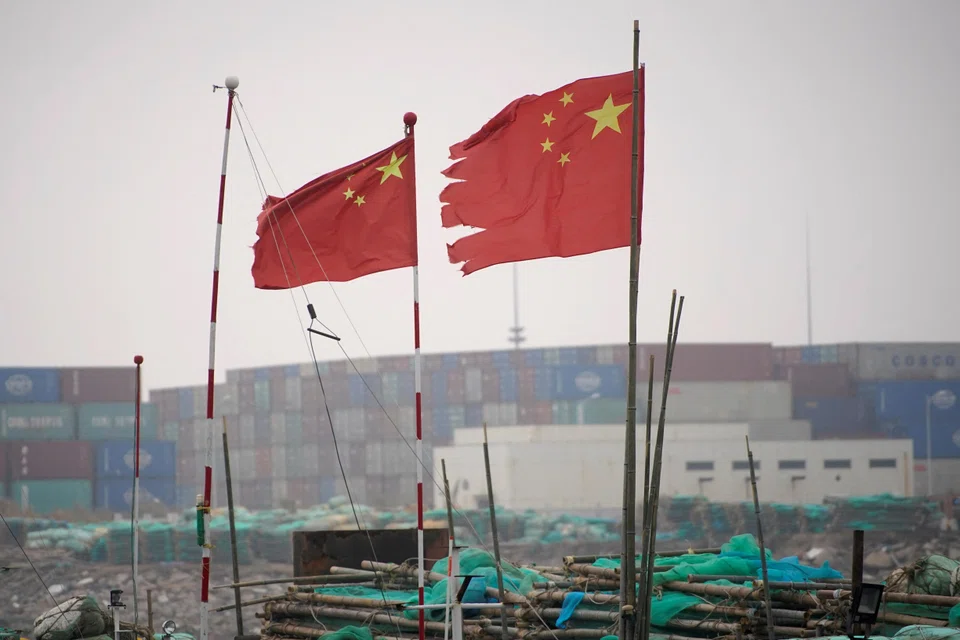
The headlines told a different story. Customs data showed that China posted a record trade surplus of nearly US$1.2 trillion in 2025. Exports rose 6.6 per cent year on year in December.
These two scenes can coexist; they describe an economy running at two speeds. The picture on the ground is more mixed than the headlines suggest.
Official data put industrial output up about 6 per cent in 2025. Retail sales growth remained in the low single digits. The factory belt is humming. Household caution lingers after the property slump. The benefits of export growth have not visibly reached the shopping malls yet.
Meanwhile, the export machine has found new destinations. Last year, exports to Africa rose by about a quarter. Shipments to South-east Asia and the European Union also outpaced overall export growth. The gains are broad-based across emerging markets and Europe.
In Germany, China’s BYD registered more than 23,000 vehicles, up more than 700 per cent from 2024 to 2025. In Singapore, the company overtook Toyota to become the best-selling car brand in 2025, with a 21.2 per cent share of registrations. Globally, BYD has overtaken Tesla to become the world’s largest maker of electric vehicles (EVs).
In Shenzhen, Shanghai and other major Chinese cities, EVs are already the norm. The streets are quieter than they used to be – no engine noise, just the occasional horn.
The export surge is buying time, but it cannot replace domestic consumption. Without household spending, the growth model will eventually hit a ceiling.
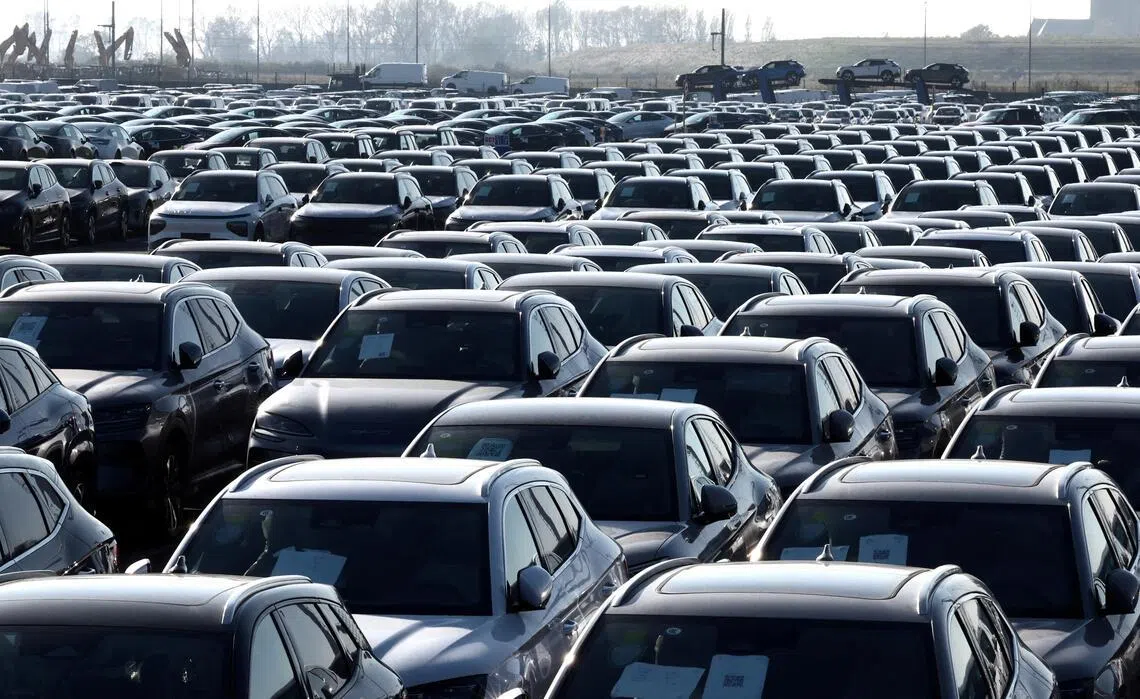
China is now exporting finished systems: EVs, batteries and industrial components now sit deeper in supply chains. These products are harder to substitute than simple manufactured goods.
Michael Pettis, professor of finance at Peking University, has argued that China’s export dependence reflects structural choices. The growth model prioritises production over consumption; that keeps the factory belt running even as shopping malls wait for households to spend.
But export-led growth has limits: It works when catching up, but faces resistance when supply chains concentrate and production capacity sits in one location. The more sustainable path requires stronger consumption and productivity, not just more factories.
On the consumption side, the weakness feels deeper than a normal cycle, even though spending is still growing.
The property slump has damaged household balance sheets and wage growth has slowed. Youth unemployment data is no longer published in the same way, but the signals that filter through remain weak.
Spending has shifted towards experiences. Economist Keyu Jin, author of The New China Playbook, has argued this is a generational shift.
With younger Chinese spending differently, prioritising experiences over assets, the old formula of work hard, buy property and watch it appreciate has stalled. A different set of priorities is emerging.
A new restlessness
The Chinese Ministry of Culture and Tourism reported nearly five billion trips in the first three quarters of 2025, up 18 per cent from the year before.
Average spending per trip during major holidays has, however, remained below 2019 levels. People are travelling more, but spending less per trip. They are trading up on frequency and down on ticket size.
What began as economic caution is becoming cultural preference: Domestic travel has become the default, supported by a world-class high-speed rail network. Infrastructure has improved faster than international alternatives. Once habits reset, they rarely snap back fully.
In Guangzhou and Shenzhen in December 2025, I sensed something else beneath the surface.
The conversations were not about despair. They were about opportunity. Young professionals are rethinking the career paths their parents took for granted. The old escalator feels stuck. Building something new feels less optional.
University students I spoke with are not waiting for jobs at established firms. They are forming teams and chasing opportunities while at school. Some are building artificial intelligence (AI) applications for local businesses; others are launching lifestyle brands in fashion and beauty. The big tech firms are no longer the default destination.
The mood was not defeated, but restless.
This restlessness shows up in the sudden rise of brands such as Pop Mart, whose collectible toy Labubu has become a global cultural phenomenon. Most of what these Chinese youth build will not show up in public markets, at least in the near term.

Singapore investors have had a difficult few years with China exposure. Their China funds have lagged those in the US and developed markets. Yet, Chinese brands are showing up everywhere, from restaurants and skincare to streaming platforms and everyday household items. The returns do not match what they see on the ground.
The China that disappointed investors may not be the same China that is growing.
For years, property, banks and a handful of Internet platforms dominated market indices. That no longer captures the full picture. The growth sits in fragmented places. Component suppliers feeding battery champions. Brands like Pop Mart winning on emotional resonance. Industrial exporters selling finished systems.
Singapore investors asking about China exposure are posing the wrong question. The question is not how much China. The question is which China.
The funds that disappointed held property developers, state banks and Internet platforms. The growth sits in battery supply chains, industrial exports and brands capturing younger consumers.
Some are accessible through public markets. Much is not. Finding what is accessible requires looking at suppliers, brands and exporters building the new economy, not just the names that dominated the old indices.
The malls may be quiet for now. But the containers are still moving.
The writer is director of private wealth management at UOB Kay Hian. He writes about behavioural finance at appliedmindletter.com. The views expressed are his own.






