

Rather than Lawrence Wong’s choice of deputies, the post-GE Cabinet is the one to watch
While some were surprised that a 4G leader was not promoted to DPM, there is precedent for choosing a more experienced minister

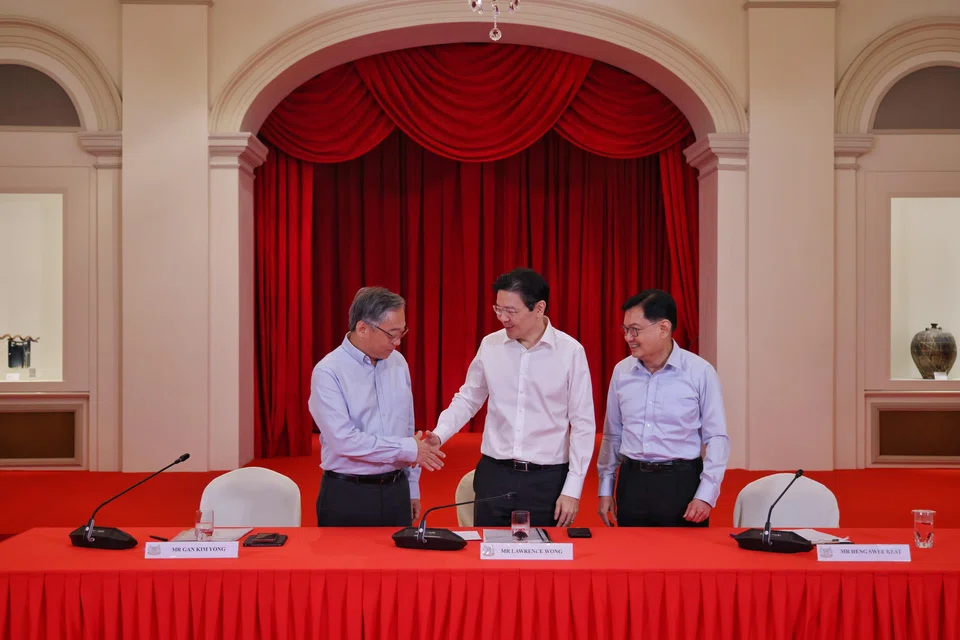
SINGAPORE’S next prime minister’s choice of deputies was surprising in some respects, yet also entirely understandable, with some dubbing it a “safe” or even “conservative” choice.
The surprise is felt by those who expected a fourth-generation (4G) minister to be elevated to deputy prime minister (DPM), once Lawrence Wong relinquishes this role to become prime minister on May 15.
Instead, DPM Wong has chosen a successor not from his peers, but his predecessors: current Minister for Trade and Industry Gan Kim Yong. Current DPM Heng Swee Keat will continue in his role.
Yet the choice of Gan can also be considered “safe” for at least two reasons: his depth of experience, and the existence of a precedent.
Explaining his choice at Monday’s (May 13) press conference on his new Cabinet, DPM Wong did not invoke the past. Instead, he focused on the future, noting that these two experienced deputies “will provide a steady hand in this initial period of transition”.
Yet it is not hard to notice that his decision – retaining a current DPM, while promoting an earlier-generation minister rather than a peer – echoes that of his predecessor Lee Hsien Loong.
When PM Lee took office in August 2004, it was a similar story. Tony Tan, who became DPM during Goh Chok Tong’s term as prime minister, remained in the role.
Replacing PM Lee as DPM was then-Minister for Foreign Affairs and Minister for Law S Jayakumar. Both Jayakumar and Tan had about a decade more experience than PM Lee.
Granted, the parallel is therefore imperfect. On Monday, Gan quipped that he was “not quite 4G”, with DPM Wong echoing this. But DPM Heng is more of a contemporary to DPM Wong, with both having entered politics in 2011.
Still, this precedent provides a convenient rejoinder – though it has not been explicitly made – to questions about DPM Wong’s decision not to elevate another 4G leader.
As some observers have noted, the choice of Gan over a 4G minister might spark speculation that Wong couldn’t find a suitable peer as a second-in-command. The possible response, in this case, is that PM Lee did not choose a peer either.
What bears watching, instead, is the Cabinet that will be formed if and when the People’s Action Party (PAP) is returned to power at the next General Election, due by November 2025.
On Monday, DPM Wong said he intends to rotate the 4G ministers to different portfolios then, and noted that some senior ministers may retire at or shortly after the next election.
The unasked question is whether his deputies will change then, too.
Barely a year after PM Lee formed his first Cabinet, then-DPM Tan retired as DPM in September 2005, making way for a younger minister: then-Minister for Home Affairs Wong Kan Seng.
These DPMs saw PM Lee through his first election as prime minister, in 2006. It was only in 2009, during a mid-term reshuffle, that Jayakumar was replaced as DPM by then-Minister for Defence Teo Chee Hean – marking a full generational transition of leadership at the top.
DPM Wong, of course, is not fettered by his predecessor’s decisions. He will undoubtedly have reasons for each change he makes in his next Cabinet.
Still, if either Gan or Heng is replaced as DPM, at least there will be some form of precedent. Tan provides a double parallel: the retirement of an older-generation leader, in Gan’s case; or the retirement of a DPM from the former PM’s Cabinet, in Heng’s case.
TRENDING NOW

NEA identifies 7 firms responsible for haze fires, notices issued urging action: Grace Fu
DBS remains analysts’ pick ahead of Q3 earnings after Singapore banks’ share slump
High Court rules against Julius Baer’s Singapore trust arm in US$50 million family trust dispute

Could stablecoins be the future of money?

