
Recent market rout and the impact on equities
While volatility is likely to remain in the second half of 2024, fundamentals for the Singapore bourse are largely intact
AS SINGAPORE marks its 59th birthday this month with nationwide National Day celebration activities, will the excitement bubble into the equity market? Is the market’s frothiness finally turning the tide on an overheated artificial intelligence (AI) rally? Have markets pushed ahead of fundamentals?
Global markets have been volatile since the July US jobs report. This showed the US economy added 114,000 jobs in July, and an unemployment rate of 4.3 per cent – the highest since the pandemic. This sparked the “Sahm rule” which pointed to an impending recession. What followed was a massive bout of risk aversion that hit global markets with sharp declines for several major asset classes.
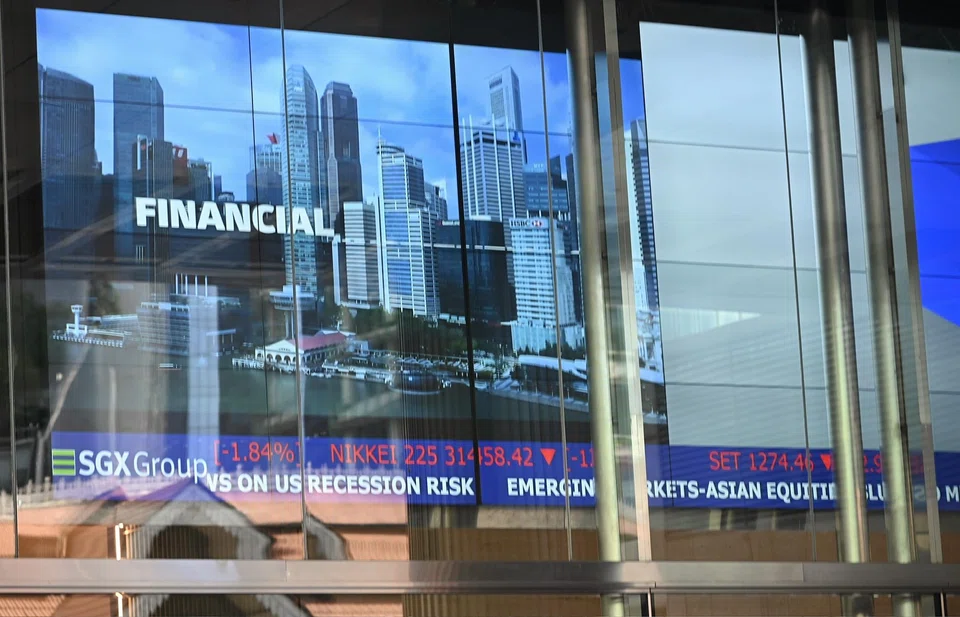
The Nikkei 225 index fell 12 per cent on Aug 5, the largest single-day decline since October 2008 (when it fell 11.4 per cent), reflecting market concerns about the economic outlook, red-hot tech valuations, and rising geopolitical tensions in the Middle East. This was further aggravated by poor earnings and outlook concerns for the big-tech companies, further adding fuel to the hard-landing scenario for the US economy. The CBOE Volatility Index (VIX) – commonly referred to as the market’s fear index – also spiked to the highest level since the pandemic in 2020.
Sharper US rate cuts ahead?
US Federal Reserve chairman Jerome Powell had indicated that rate cuts are imminent, and most economists expect the first cut of 2024 to come in September. However, if the job data continues to be weak, this could point to sharper rate cuts ahead. In addition, the US presidential election in November will create more uncertainty for the global market.
Based on the latest poll, the gap between US Vice-President Kamala Harris and former president Donald Trump has narrowed. However, the outcome remains too close to call, and there will be more market volatility in the weeks ahead as a Trump presidency could mean higher tariffs on imports, which could put a strain on its trading partners and hurt international trades.
For now, fundamentals remain intact as corporate earnings are projected to grow 10.2 per cent in 2024 and 13.6 per cent in 2025 based on consensus estimates on the S&P 500. For the Strait Times Index (STI), the projected earnings growth is 4.8 per cent for 2024 and 3.3 per cent for 2025 – which is reasonable for the Singapore market as it has several well-established companies. With any price correction of more than 10 per cent, it is often prudent to re-evaluate if the selling is warranted versus fundamentals and corporate earnings growth.
On the Singapore bourse, a committee was recently set up to look at measures to revitalise the stock market. Some key focus areas will include low trading liquidity and the lack of new listings. This committee comprises several key members from the Monetary Authority of Singapore (MAS), Temasek Holdings, Singapore Exchange and the private sector. While these measures may take time to take shape, we view this as a positive move in the right direction to re-energise the local exchange for the longer term.
On a broader perspective, AI is a long-term mega trend and is likely to continue to attract investments. Elevated valuations for the sector have come off with the recent price corrections. As a major key trend that covers most of the global big technology companies, any near- to medium-term price volatility will continue to have spillover effects on Asia and Singapore. This was clearly the case with the recent market rout. When the tech-heavy Nasdaq Composite Index fell about 8 per cent in early August (from Jul 31 to Aug 5) together with the sharp one-day decline for the Nikkei 225, the STI fell 6.1 per cent.
While recent share price corrections were sharp for the strongest price gainers in the AI space, there was also a switch to laggards and value stocks, especially in sectors that will benefit from lower interest rates.
For the rest of this year, a key market focus will be on the pace and number of rate cuts by the Fed. This could potentially benefit companies and sectors that are more highly geared as well as high dividend yielding stocks. In a progressively lower interest rate environment, Singapore’s real estate investment trusts (Reits), which currently provide an average yield of almost 6 per cent, may start to see renewed interest. Our preference is for large Reits with strong sponsors.
As an indication, the FTSE ST All-Share Real Estate Investment Trusts Index (FSTREI) touched its lowest point in 2024 in April at 624.6 – or a year-to-date decline of 14.1 per cent. Since then, and with the prospect of lower rates in the coming months, this has narrowed and the FSTREI is now down 10.1 per cent. As interest rates are widely expected to be further cut in 2025, this could give Singapore Reits a much-needed lift. At the current level, the average yield is around 6.2 per cent, and in a lower interest rate setting in 2025, this could see renewed interest in the beleaguered Singapore Reit sector.
Singapore’s key banking sector
The key sector in the Singapore market is the banking industry which accounts for almost half the weightage on the Straits Times Index (STI) and is its dominant price mover. After a record-smashing year in 2023, lower net interest margin is a key focus in 2024. With the recently released second-quarter results, banks’ margins seem to be intact. However, going forward, margins are likely to come off in line with the cuts in US rates. This will be partly mitigated by a pick-up in loans volumes as well as the continuous push to grow fee income, especially in the wealth space. As an indication, DBS has grown its assets under management (AUM) from S$365 billion at the end of 2023 to S$396 billion by June 2024 – an increase of S$31 billion or 8 per cent. Similarly, UOB has grown its AUM from S$176 billion to S$182 billion, up S$6 billion or 3 per cent.
With a well-established regional footprint, there are opportunities for the banks to undertake more cross-selling opportunities, and this should help to lift wealth and fee income. Recent price corrections have also partly priced in the weaker global economic outlook. With higher dividend payouts estimated for 2024, bank stocks are offering dividend yields of more than 5 per cent – which is also attractive in a lower rates environment.
While volatility is likely to remain in the second half of 2024, with the US presidential election and interest rates driving market directions, the fundamentals for the Singapore market are largely intact. The local economy is likely to grow 2 to 3 per cent in 2024 and with corporate earnings growth estimated at 3 to 5 per cent for 2024-2025. In terms of valuations, the current price-earnings ratio of 10.3 times is also undemanding versus historical trends and regional peers. We continue to be overweight on the Singapore market as heightened risk aversion will favour defensive blue chips here.
The writer is head of OCBC Investment Research



