Record-breaking El Nino could hurt South-east Asia’s growth
AMID human-induced climate change, July 2023 broke records as the hottest month ever documented. The World Meteorological Organization declared on Jul 4 that the world has entered an El Nino cycle, with the Meteorological Service Singapore confirming this on Aug 11.
El Nino is a natural climate pattern that features abnormal warming of the ocean’s surface in the central and eastern equatorial Pacific Ocean. It has significant effects on global weather; in South-east Asia, it often causes increased temperatures, prolonged droughts, and other problems.
Over the past 30 years, the collective economic impact of natural and human-induced climate change on South-east Asian nations is as high as S$295 billion, according to research by a team at Nanyang Technological University (NTU).
South-east Asia’s climate risk exposure
In South-east Asia, El Nino often brings reduced rainfall, leading to severe drought conditions. This poses significant challenges for agriculture and related sectors. As at 2021, about 29 per cent of the region’s workforce was employed in the agricultural sector, with even higher shares in Laos (58 per cent) and Myanmar (46 per cent).
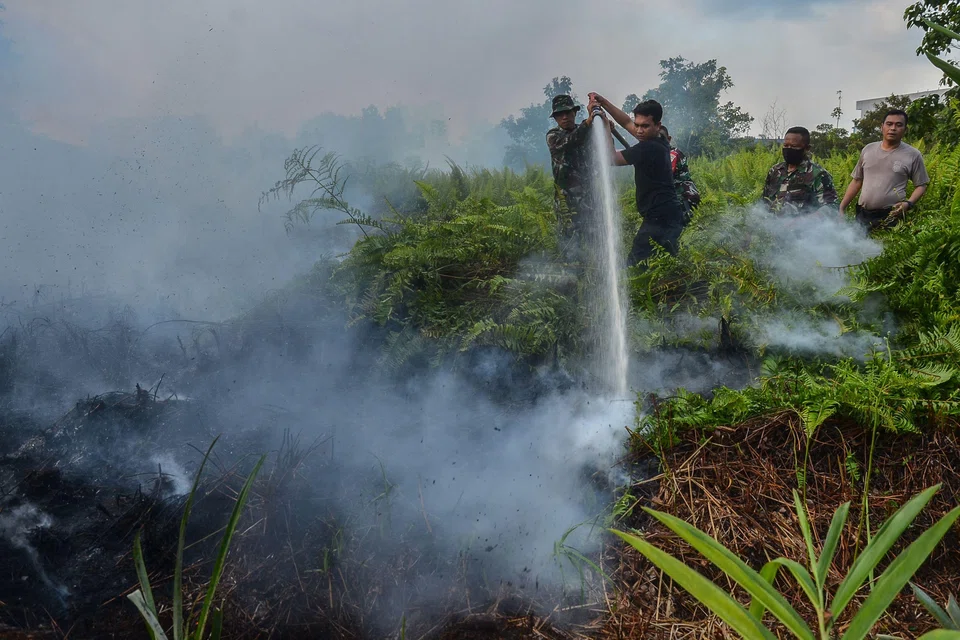
Moreover, reduced rainfall amplifies the risk of wildfires in neighbouring countries. Prevailing winds, particularly from Indonesia and parts of Malaysia, frequently transport the hazardous haze to Singapore, with significant economic repercussions due to healthcare costs and work disruptions.
More developed nations, such as Singapore, have shown a comparatively stronger resilience to El Nino. However, it’s crucial to recognise that Singapore is not exempt from its effects.
For example, when farming suffers because of El Nino, this creates problems in the global supply chain. Moreover, El Nino’s higher temperatures mean that people use more electricity to stay cool, leading to higher energy prices.
Analysis by the NTU research team reveals the profound impact of El Nino events on South-east Asia’s economies. Indonesia bears the heaviest burden, with an estimated loss of approximately 13 per cent in its gross domestic product (GDP) per capita in 2022, compared to a scenario with no El Nino events since 1990.
For Singapore, the impact translates into a shortfall of S$2,700 in GDP per capita, compared to scenarios without El Nino.
One immediate impact in Singapore is on electricity consumption. Examining the Republic’s electricity consumption patterns during El Nino events, the team observed a 1.4 per cent increase in monthly household electricity consumption in these periods.
This was statistically significant for all types of dwellings, except one-room and two-room public flats. The most striking surge was during the major El Nino period from October 2015 to March 2016, with a 3.2 per cent spike.
Between 2005 and 2022, Singapore residents collectively spent an additional S$100 million (inflation-adjusted to 2023) to cover the extra 401 GW of electricity consumption resulting from El Nino-induced weather anomalies.
The extra electricity consumed due to El Nino is equivalent to emitting 172,000 tonnes of carbon dioxide into the atmosphere, or consuming 35,000 tonnes of oil.
Further pressures ahead
The recent forecast by the Climate Prediction Center of the US National Oceanic and Atmospheric Administration paints a concerning picture. Between December 2023 and February 2024, the average sea surface temperature anomaly in the eastern equatorial Pacific will reach 1.04 deg C.
The extra heat is causing more extreme temperatures in different regions and seasons – melting snow and sea ice, making heavy rain even stronger, and forcing some animals and plants to seek new habitats while others lose their homes.
Furthermore, there is a 60 per cent probability that this El Nino event will persist until May 2024.
In light of these estimates, we anticipate that El Nino’s impact will result in a 0.7 per cent to 2.9 per cent slowdown in Singapore’s GDP per capita growth for 2024.
Crucially, the economic implications of El Nino extend far beyond the year of the event itself.
The two most paramount El Nino events in history – from 1982 to 1983, and 1997 to 1998 – generated global economic losses exceeding US$4.1 trillion and US$5.7 trillion respectively, extending more than five years after their occurrences and casting long shadows over the global economy.
El Nino’s economic impact on South-east Asia is undeniable. The silver lining would be if this climate phenomenon prompts nations to proactively adapt and invest in climate-resilient infrastructure, while advancing scientific research in related fields.
Such adaptations would not only strengthen resilience, but also open doors to innovation and international cooperation, potentially mitigating the impact on both regional and global economies.
Yanbin Xu is a PhD candidate and Professor Wenjun Zhu is an assistant professor in the division of banking and finance at Nanyang Business School, NTU. Professor Benjamin P Horton is director of NTU’s Earth Observatory of Singapore.
TRENDING NOW
He built the Vingroup empire. Now South-east Asia’s richest man is handing some key roles to his sons
Grab CEO’s wife Chloe Tong on life with Anthony Tan and finding her purpose
What role can Japan play in Asean’s future?
From folding clothes to factory work: Why China is sending humanoid robots to school