

Rethinking the purpose of share buybacks
IN 2022, companies listed on the Singapore Exchange (SGX) spent a three-year high of about S$1.7 billion on share buybacks. Those listed on the Hong Kong Exchanges and Clearing Limited (HKEx) also broke repurchase records in recent years. A large increase in share buybacks was also observed among firms listed on Bursa Malaysia from 2017 to 2018, although this has moderated since 2020.
Over in the United States, a 1 per cent tax on companies purchasing their own shares from the market was signed into law by US President Joe Biden in February.
Democratic lawmaker Chuck Schumer reportedly said: “I hate stock buybacks… Instead of investing in workers and in training and research and in equipment, they don’t do a thing to make the company better and they artificially raise the stock price by just reducing the number of shares. They are despicable. I’d like to abolish them”.
Excessive share buybacks, sometimes funded by debt, have been blamed for recent scandals or bankruptcies in companies such as Boeing and Bed Bath & Beyond.
Rationale
Companies may engage in share buybacks for various reasons, for instance to signal that the company’s shares are undervalued or to fund employee share plans. They may also be used as an alternative to dividends to redistribute excess cash to shareholders, when there is a lack of good investment opportunities.
In certain countries, companies may return cash to their shareholders through share buybacks instead of dividends for tax reasons. In the US, while share buybacks were not directly taxed (before the recent introduction of the 1 per cent tax on companies), dividends are taxed twice, once as corporate income and again as dividends. Contrastingly, dividend distributions to shareholders are generally not taxed in Singapore, Malaysia and Hong Kong.
Companies doing share buybacks often cite increasing shareholder value as one of the main rationales. For example, one SGX-listed company claims that share buybacks are “one of the ways through which shareholders’ value may be enhanced”.
Share buybacks, however, may also be used to increase executive remuneration which is linked to accounting metrics such as earnings per share (EPS) or return on equity (ROE); artificially support a company’s share price; help managers or major shareholders avoid margin calls which may be triggered by declining share prices; or reduce the total shares outstanding to enable major shareholders to more easily privatise a company.
Spending financial resources on buybacks may also cause companies to underinvest in innovation, skilled workforces, essential capital expenditures necessary to sustain long-term growth, and ESG improvement projects.
Rules governing share buybacks
Companies listed on the SGX, Bursa and HKEx face largely similar regulatory requirements relating to share buybacks. One difference is that the price limit for Bursa-listed companies is no more than 15 per cent, rather than 5 per cent, of the weighted average market price over the past five market days.
Also, while SGX Regulation has published a regulatory column stating inter alia that share buybacks should be no more than 30 per cent of daily trading volume, Bursa and HKEx do not specify a limit based on daily trading volume.
All three Asian markets require actual share buybacks to be promptly announced. In contrast, publicly traded companies in the US are only required to disclose daily actual buybacks on a quarterly or semi-annual basis.
There is no maximum volume or share price imposed on US companies conducting share buybacks. Companies can, however, adopt Rule 10B-18 issued by the Securities and Exchange Commission (SEC), a safe harbour rule intended to reduce their potential liability for manipulation of their share prices when conducting open market share buybacks.
The rule states that companies should only repurchase shares through one broker on a single day; buybacks should not constitute the opening transaction or be made 30 minutes before the close of trading; buybacks should not exceed 25 per cent of the average daily trading volume of their shares within one trading day; and shares should not be bought back at a price exceeding the highest independent bid or the last independent transaction price, whichever is higher.
Actual share buybacks
We conducted a comprehensive study of share buybacks undertaken by all issuers listed on SGX, Bursa and HKEx between Jan 1, 2010 and Dec 31, 2022, except real estate investment trusts, secondary listings, business trusts, stapled trusts and other forms of investment trusts, closed-end funds and exchange-traded funds.
Over this period, the SGX-listed issuers in our study spent an average of S$1.53 million per calendar year per company on buybacks, with a maximum amount spent of S$500 million.
Bursa-listed companies, the average was RM1.361 million (S$400,000) per calendar year per company with a maximum of RM1.45 billion. HKEx-listed companies spent an average of HK$12.26 million (S$2.11 million) per year per company, with a maximum of HK$33.44 billion.
On average, 13.65 per cent of SGX-listed companies conducted share buybacks at least once per calendar year; the average number of buybacks per company was 2.38 per year; and the maximum number of buybacks conducted by a single company in a single year was 197.
This compares with 16.42 per cent of Bursa-listed companies, an average of 3.35 per year, and a maximum per year of 221; and 8.41 per cent of HKEx-listed companies, an average of 1.62 per year, and a maximum per year of 198.
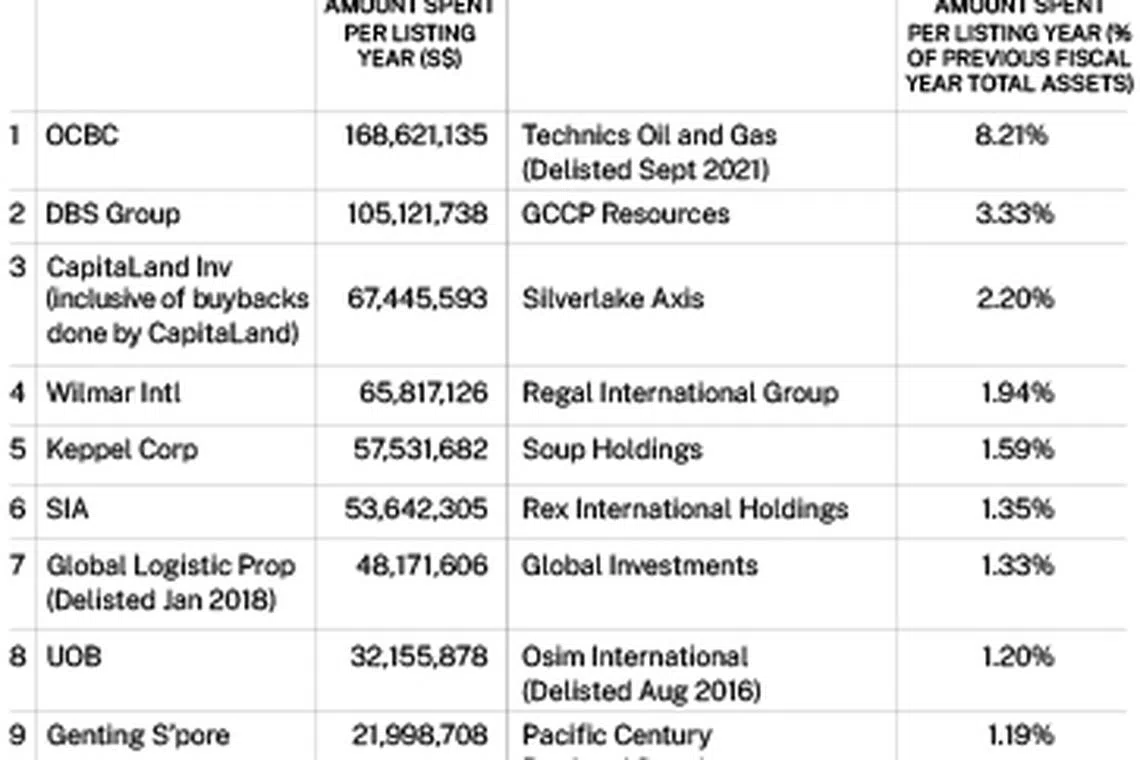
The table below shows the 10 SGX-listed companies listed for at least three years between 2010 and 2022 that had the highest average total amount and highest average relative amounts spent on buybacks per listing year.
In Hong Kong, China Evergrande, the second-largest Chinese property developer by sales, spent an average of HK$2.66 billion per listing year on buybacks. It was ranked third based among those with at least three listing years, and also third among all companies in the sample. It has gone into restructuring, and its shares have been suspended from trading since March 2022.
Country Garden, Hong Kong’s largest listed Chinese property developer by sales, ranked eighth based on those with at least three listing years and also among all companies in the sample. It spent an average of HK$537.76 million per listing year. Like China Evergrande, its investment rating was downgraded. However, it has not defaulted, and its shares remain traded.
Post-buyback abnormal returns and financial performance
We then examined whether companies in our sample that spent relatively more on share buybacks increased shareholder value, based on abnormal returns one year, two years and three years after the year of the buybacks. The impact on ROE and return on assets (ROA) was also analysed.
For the different models we ran which controlled for various factors, companies spending more on buybacks had lower abnormal returns across the three markets one year, two years and three years after the buyback year, except in two cases.
The relationship is, however, generally statistically insignificant for all companies in the three markets and across the three fiscal years post-buyback, except for a statistically significant negative relationship for SGX-listed companies one year post-buyback in one of our models.
For ROE and ROA, there was a mixture of positive and negative relationships across the three markets for different time periods, but none are statistically significant.
Share buybacks may not benefit shareholders
Overall, our results show that, on average, there is no relationship between the amount spent on buybacks and shareholder returns over one-year to three-year periods following the buybacks for issuers listed on SGX, Bursa and HKEx. If anything, shareholder returns tend to decline on average.
However, our findings do not rule out the possibility that share buybacks may be beneficial or serve a useful purpose for some companies. For example, OCBC was the SGX-listed company which spent the most on share buybacks from 2010 to 2022 – S$2.192 billion in total.
Going as far back as 2008, all shares issued under the lender’s share option scheme, deferred share plan and employee share purchase plan were from treasury shares from share buybacks, except for less than 7.5 million new shares issued for its share option scheme and deferred share plan in 2021.
Under its employee share purchase plan, which has been in operation since 2004, any employee who is at least 21 years old and has joined for at least six months is eligible to use part of their pay to participate in this plan.
OCBC’s share buyback programme goes hand-in-hand with its aim of broad-based employee share ownership, which can improve employee engagement – part of the “social” aspect of ESG. According to the lender’s latest annual report, 6,872 employees had enrolled to participate under the 17th offering of this plan. In addition, OCBC did not experience any negative abnormal returns one to three years post-buyback across 2010 to 2022.
A recent Financial Times article said that share buybacks deserve less hate but more scrutiny. While there is not much hate in the Asia-Pacific region, we agree that there should be more scrutiny of the motivations for share buybacks.
Mak Yuen Teen is Professor (Practice) of Accounting at the National University of Singapore, where Tan Yi Jie is a double first class BBA (Accountancy) Honours and BSocSci (Economics) Honours graduate. This article is based on the honours thesis written by Tan under the supervision of Professor Mak.
TRENDING NOW

He built the Vingroup empire. Now South-east Asia’s richest man is handing some key roles to his sons
Quarter of Singtel special discounted shares sold ahead of CPF Board transfer
Why Tan Aik Keong of digital solutions specialist Agmo wants to make himself less indispensable

Asia needs new energy security architecture

