

In the robot-driven Fifth Industrial Revolution, human-centric skills remain key
A SHOPPER clicks on a fund transfer link provided by an online merchant, eager to pay for two luxury watches at jaw-droppingly low prices. Suddenly, alerts pop up via his banking app as cybersecurity systems powered by artificial intelligence (AI) detect the risks of a phishing scam – just in time to avert a devastating act of fraud.
Did AI just save the day? It did complete Herculean feats such as sifting through millions of data points in seconds to detect abnormal activity, but the real heroes here are still humans.
Only people, not machines, can understand and pre-empt the fear tactics and other behavioural strategies deployed by today’s increasingly sophisticated scammers.
And only people who have honed uniquely human skills such as empathy and social cognition can create the right AI-powered solutions to subvert fast-evolving cybercrime at scale – and, on the other end of the spectrum, meet customers’ deepest needs.
This is the kind of human prowess that organisations need to rely on when harnessing advanced technologies in the name of societal well-being – not just in cyberspace, but across every sector, industry and ecosystem.
From technical to human-centric skills
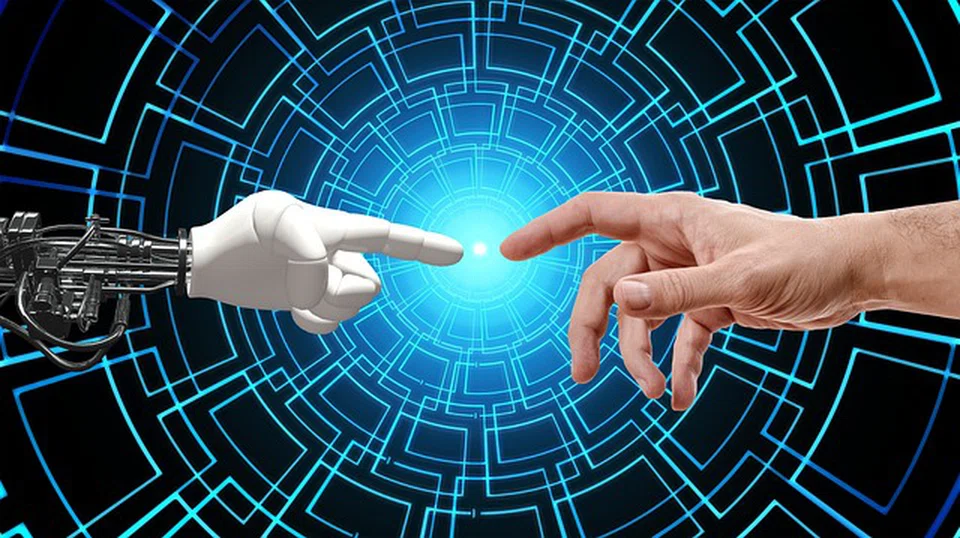
Human-centric skills will be the key to success for organisations gearing up for the Fifth Industrial Revolution, in which people and robots work together, with social well-being at the heart of industrial and enterprise transformation.
This means that organisations will need to shift their focus from training workers in traditional skills to helping them hone human capabilities that cannot be replicated or replaced by AI or machines.
Adult learners must be equipped with the right mindsets, skill sets and tool sets so that they can think critically while mastering skills and technical tools for practical application.
Only then can they align themselves to the Fifth Industrial Revolution, which the European Commission envisions will be defined by human-centricity, resilience, and sustainability.
Workforce practices need to ensure that production supports human workers’ pyscho-social needs. Human resources must be used sustainably, and worker resilience must be built through continual training and upskilling for lifelong employability.
The Industry 5.0 landscape is bound to be complex, because human nature is complicated. Honing human-centric skills will require corporate leaders and workers alike to embrace three deeper changes.
The Industry 5.0 paradigm shift
First, the Fifth Industrial Revolution requires a change of organisational systems and individual mindsets.
Many companies view labour as a factor of production which can be deployed alongside Industry 4.0 technologies such as AI, automation and the Internet of Things to maximise profits.
But what they need to do is shift to an Industry 5.0 paradigm where workers are viewed as the organisation’s lifeblood.
Workers should be seen as the source of creative and empathetic ideas on how to harness technology to work better, smarter and faster for the good of customers, societies and the planet.
Professionals must hone their skills not just to boost productivity and profitability, but to deploy critical thinking and social awareness to solve broader problems facing humanity, such as improving sustainability and social well-being.
Deconstructing learning
This brings us to the second change required for honing human-centric skills: the art of “unlearning to learn”.
Unlearning is about being able to think and behave differently when our existing mental models become obstacles.
As industries and jobs are disrupted by AI, virtually every worker will need to unlearn mental models that hinder him or her from acquiring human-centric skills.
Obsolete ways of thinking may trap workers into honing skills or knowledge that are no longer relevant in the digital age. They may find it hard to step out of old mental models to choose a new lens of value creation.
In the healthcare industry, for instance, workers need to shift their mindsets about how to create value in their jobs, as automation and robotics take over many of the important but mundane tasks that used to be an integral part of their work.
Healthcare professionals need to unlearn old performance metrics based on how efficiently they perform tasks such as data input and claims processing. Instead, they must shift to a new mindset of providing higher-quality patient care using skills such as empathy and problem-solving.
In the same vein, non-legal professionals no longer need to focus on the nitty-gritty of contract drafting in order to become adept at business negotiations. They can take courses on using generative AI to assist them with contract-related tasks.
This new mindset of using AI in tandem with higher-level cognitive skills will boost their ability to tackle real-world challenges, such as teasing out the nuances of business negotiations.
The third change is in how leaders and teams can scale human-centric competencies.
Human-centric skills can be exercised in diverse ways by people of different backgrounds, cultures and personalities.
But to help them do that, they need the right leaders. These are systems leaders who exemplify empathy and emotion, and combine that with critical thinking to bring diverse people together to problem-solve in volatile, complex environments.
Human-centric skills have existed as long as mankind has. But what makes these “soft skills” so cutting-edge today are the endless possibilities of combining them with AI’s “hard skills” to push the boundaries of Industry 5.0.
The writer is chief learning officer at SIM Academy






