

Robot judges – not a question of legitimacy but of choice
It’s a misconception that decisions made by AI are necessarily random and irrational, as an illustrative example shows

COMMUNICATION is the cornerstone of the legal profession – whether it involves preparing advice, drafting documents, or presenting arguments.
It is therefore unsurprising that the emergence of generative artificial intelligence (AI) large language models (LLMs), such as ChatGPT, which are capable of producing human-like conversational responses has sparked discourse on whether they can fully replace the legal profession.
The prevailing sentiment is that they cannot do so.
AI LLMs are generally perceived to be no more than powerful tools that complement a lawyer’s role.
However, a specific area worth re-evaluating is the suitability of AI LLMs as judges.
Much scepticism probably stems from concerns over the legitimacy of decisions, the ability to actually apply the law, errors in judgment, bias, prejudice, as well as confidentiality issues. Mahesh Rai’s commentary, published in The Business Times on 26 Apr, echoes some of these concerns.
Are our reservations towards embracing the concept of an AI judge really justifiable? Or do they arise from an unwarranted mistrust of the machines?
Let’s dig deeper.
An illustration
We start by dispelling a misconception – that AI LLM decisions are random and lack rationality, just like a coin toss.
They aren’t.
AI LLMs provide responses based on data-sets that they are trained on. If asked to do so, they can also give reasons for their decisions.
What better way to illustrate this than by actually presenting a dispute to be determined by the publicly available ChatGPT version 3.5.
The prompt involved setting out (i) undisputed facts leading to a dispute (over the purchase of mee goreng); (ii) the position taken by each party; and (iii) a request for a decision to be made.
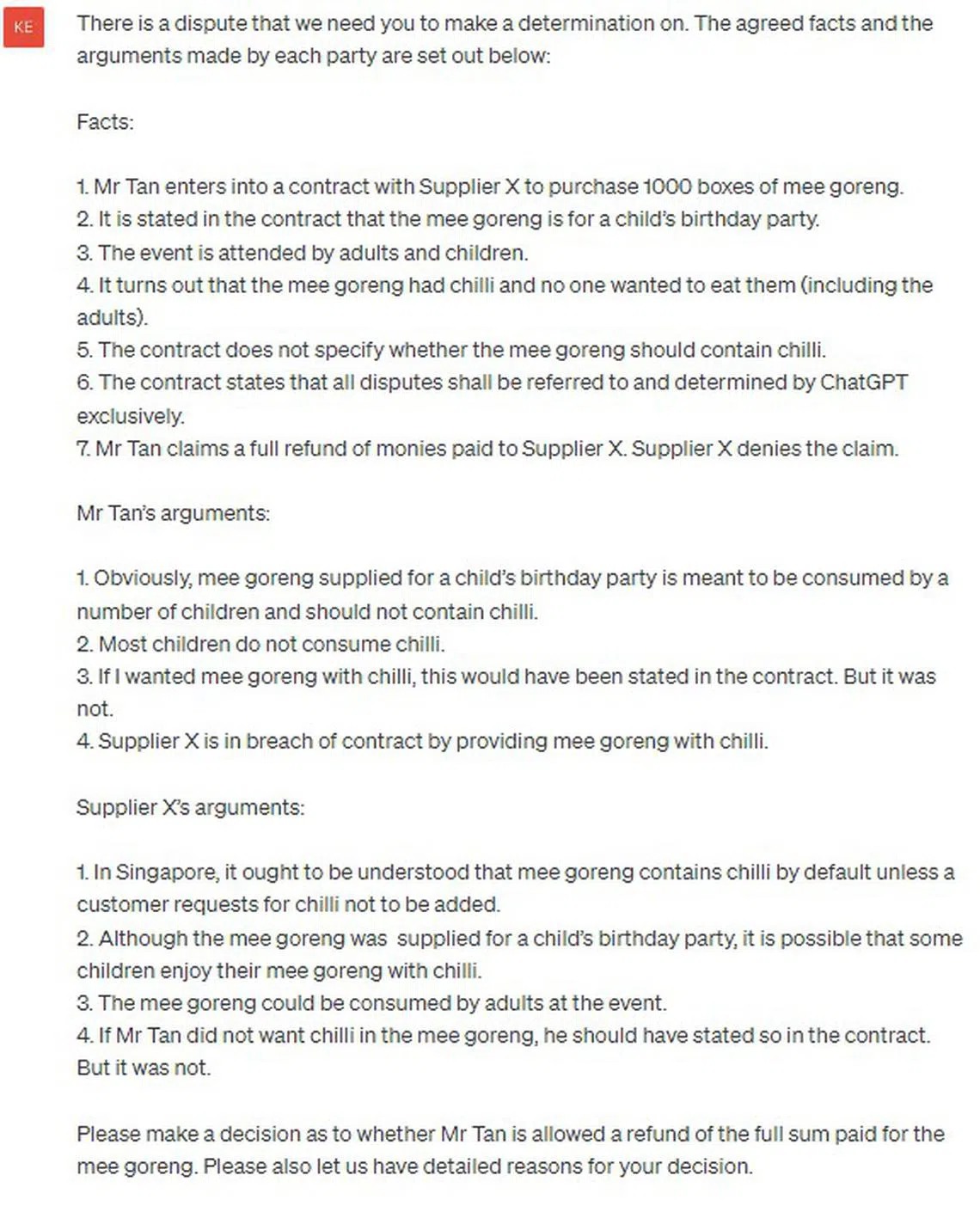
The response generated by ChatGPT is as follows:
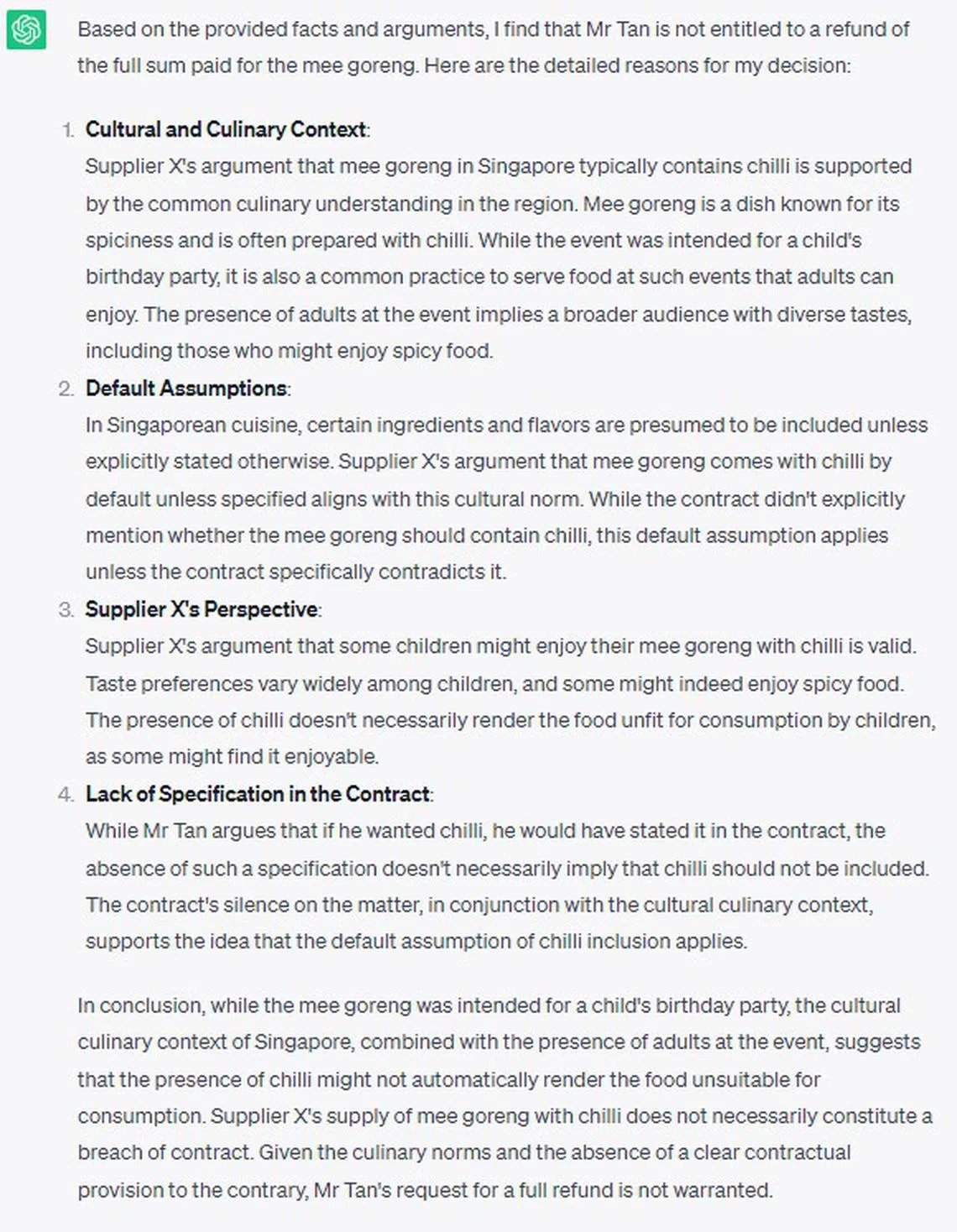
From the above, it can be observed that with a correct prompt structure, a reasoned decision from ChatGPT may be obtained (whether we agree with those reasons is a separate issue).
Now comes the larger question at hand: Are we prepared to embrace legally binding and enforceable AI-generated reasoned determinations?
The writer believes that there are good reasons to do so.
1. Speed and efficiency
Initiating proceedings by way of conventional court processes requires financial resources. In some cases, expenses associated with court proceedings may even exceed the amount claimed, making it uneconomical for individuals or small businesses to pursue their claims. Court processes also typically take months or even years to complete.
As a result, costs and delays associated with litigation often act as barriers to the advancement of claims.
In contrast, AI LLMs offer a paradigm shift with the revolutionary speeds at which decisions are made. It isn’t months, weeks or days – we are talking about decisions in a matter of seconds at minimal costs.
2. Error, bias, prejudice also prevalent in human decision-making
AI LLMs have been reported to communicate misinformation in a confident and assertive manner, a phenomenon known as a “hallucination”. As they generate responses based on data-sets that they have been trained with, decisions made by AI LLM judges may be influenced by bias and prejudice.
However, this is not a problem unique to AI LLMs.
Humans, too, are susceptible to errors and make decisions based on their finite knowledge, training, and expertise.
Individual beliefs, experiences, and idiosyncrasies inevitably shape the way that humans perceive a dispute. The presence of dissenting views expressed in judgments highlights the diversity of perspectives even among human judges.
If human judges aren’t disqualified due to their personal world-views and imperfections, why should we hold a robot judge to a different standard?
3. Confidentiality?
Caution has been advised on revealing confidential information to AI LLMs due to the accessibility of such data by AI developers. There is also a risk that AI LLMs become trained by such confidential information, and subsequently regenerate such information when communicating with other users.
While confidentiality concerns may limit the way that lawyers use AI LLMs for research or preparation of documents, do these concerns also extend to the use of AI LLMs as judges?
Aren’t we overlooking the fact that cases pursued by way of conventional court processes are generally also a matter of public record?
4. Parties’ choice
Last but not least, let’s not forget that the conventional court system is not the only avenue for disputes to be decided.
Other forms of alternative dispute resolution (ADR) mechanisms are well recognised. One notable example is that parties may agree to refer their disputes to arbitration (excluding certain matters like divorce, custody of children, criminal prosecutions, and the like).
Arbitral tribunals are chosen by the parties themselves or through agreed mechanisms (unlike assigned judges in the conventional court system). If parties concur, the appointed arbitrators need not be subject-matter experts, qualified lawyers, or, for that matter, educated at all.
Yet, in international arbitration, an arbitral tribunal’s decision on the substantive dispute is, by default, final, binding and non-appealable even if the losing party believes the decision to be flawed.
Importantly, it is not mandatory for an arbitral tribunal to apply Singapore law, or any other law. Parties may opt to have their disputes decided solely on what the arbitrators believe to be right and good, based on his or her own notions of justice, without reference to any system of law, criteria or rules (that is, ex aequo et bono).
If decisions made by arbitral tribunals are enforceable, why shouldn’t similar recognition be given to decisions made by robot judges?
Concluding thoughts
Does our discomfort with the concept of AI judges sprout from how we are so accustomed to having a competent judiciary that decides our disputes in Singapore? If so, then it begs the question whether this would also be the perspective shared by those in countries where there is less trust in their judiciary.
If disputing parties are content to entrust their disputes to robots for determination after having accepted the limitations, is there any real moral hazard in giving legal recognition to this potentially new ADR option (with appropriate safeguards in place)?
The writer is a senior associate for Kennedys Legal Solutions. His essay Charting A Course for AI’s Brand of Justice in Maritime Disputes won the Comite Maritime International Essay Competition 2023 for original writing in the field of maritime law.
TRENDING NOW

First Resources blames El Nino, outside fires for Kalimantan hotspots amid haze scrutiny

High Court rules against Julius Baer’s Singapore trust arm in US$50 million family trust dispute

Singapore key exports jump by higher-than-expected 68.4% in September, led by non-electronics

MSCI proposes downgrading Indonesia to standalone market status

